



Introduction
Tracking fixed assets can be surprisingly challenging for many organizations. Common fixed asset tracking challenges such as missing equipment, inaccurate records, or “ghost assets” (items that are recorded on the books but no longer exist) often lead to audit headaches and financial losses. These issues not only inflate your balance sheet but also risk non-compliance with audit and accounting standards. The good news? By following proven asset tracking tips and fixed asset tracking best practices, you can maintain accurate asset records, ensure audit readiness, and save your company time and money.
In this guide, you’ll learn:
- What fixed asset tracking is and why it’s critical for accurate records and audit compliance.
- Common asset tracking pitfalls like ghost assets, data errors, and poor visibility—and how to fix them.
- Proven best practices such as regular audits, asset tagging, real-time updates, and clear ownership.
- How to use the right tools and policies to maintain an audit-ready, reliable asset register year-round.
Common Fixed Asset Tracking Challenges and Solutions
Below we explore several frequent asset tracking problems and how to address each one. For every challenge, there is a corresponding best practice solution that can drastically improve your tracking process.
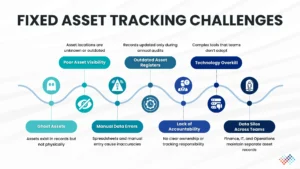
Fixed asset tracking challenges include ghost assets, poor visibility, and data errors. These issues are solved through systematic tracking supported by asset tags, clear ownership, and centralized records.
1. How can we eliminate “ghost assets” and keep asset records accurate?
Challenge:
“Ghost assets” are assets that appear in your ledger but are physically missing or unusable. They might have been lost, stolen, or disposed of without documentation, causing your books to be overstated. Ghost assets create false value on the balance sheet and can lead to overpaid insurance and taxes on non-existent items.
Best Practice Solution:
Conduct regular asset audits and promptly update records to remove ghost assets. Therefore, perform comprehensive annual inventory counts to verify every recorded asset exists. Meanwhile, investigate missing items, complete write-offs properly, and use cyclical counts mid-year. Finally, use modern asset tracking systems to reconcile and record disposals immediately.
By routinely catching and removing ghost assets, you’ll maintain accurate records and ensure compliance with financial reporting standards (e.g., GAAP/IFRS), keeping auditors satisfied. (For example, one AssetCues client discovered 15% of their listed assets were missing; after implementing annual audits and updates, they eliminated those ghost assets, avoiding unnecessary insurance costs and improving their audit outcomes.)
2. How do we keep track of asset locations and improve visibility?
Challenge:
A frustration is lack of asset visibility, leaving teams unaware of locations. Consequently, assets move across departments or facilities without proper logging. As a result, teams waste time searching and sometimes purchase unnecessary duplicates. Moreover, poor visibility weakens accountability, especially within complex multi-site organizations.
Best Practice Solution:
Implement location tracking discipline so every asset stays visible and accountable. Therefore, unique identifiers and real-time updates record each asset movement. Moreover, assign asset custodians to log transfers using scanning technology. Ultimately, consistent updates and barcode or RFID scans boost visibility.
The result is a continuously updated asset register where you can quickly query an item and see exactly where it is and who is responsible for it. This practice saves time (no more scavenger hunts for missing devices) and prevents asset loss or duplicate purchasing.
3. How can we reduce human error in asset data entry?
Challenge:
Human error in manual data entry causes inaccurate and unreliable asset records. Consequently, spreadsheets and hand-keying create typos, duplicates, and lost data. Over time, these small mistakes compound, resulting in an unreliable asset register. Moreover, studies show spreadsheets reach 90% error rates, making manual tracking risky.
Best Practice Solution:
Automate and standardize asset data capture using barcodes or RFID to reduce human error. Instead of manual entry, scanning records asset details instantly, reduces typos, and speeds inventory counts. Moreover, integrate asset tracking software with purchasing or accounting systems to eliminate duplicate data entry. Consequently, validation rules, system safeguards, and team training ensure consistent records, higher accuracy, and audit readiness.
By removing as much manual work as possible and catching errors at the point of entry, you’ll significantly improve data quality in your asset records.
4. How do we keep the asset register up-to-date (and not just once a year)?
Challenge:
Many companies update fixed asset registers only during annual audits. Meanwhile, unrecorded changes cause new assets, disposals, and moves issues. As a result, the asset register stays out-of-sync most months. Consequently, stale data drives poor decisions and frantic audit reconciliations.
Best Practice Solution:
Treat the asset register as a living document, maintained continuously rather than periodically. Record every acquisition, deployment, transfer, or retirement immediately to keep asset data accurate. Moreover, assign a dedicated asset owner and workflows to enforce real-time updates. Consequently, quarterly spot checks quickly surface outdated records and simplify audits companywide.
By keeping the asset list current, you’ll always have an accurate view of your assets for planning and compliance – and the year-end audit will become a formality rather than a fire drill.
5. How can we enforce accountability with a clear asset tracking policy?
Challenge:
A lack of formal policy and ownership often weakens effective asset tracking. Consequently, unclear responsibility causes updates to slip through organizational cracks. Moreover, without defined roles, assets move or disappear without accountability. Ultimately, inconsistent policies create gaps and errors, proving discipline drives system success.
Best Practice Solution:
Develop a comprehensive fixed asset tracking policy and enforce it consistently across the organization. Clearly define roles, assigning departmental asset custodians and an overall owner overseeing governance. Standardize procedures for inventories, tagging, transfers, disposals, and training to ensure consistent execution. Consequently, set value thresholds to focus effort while improving accountability, compliance, and reporting accuracy.
Once the policy is in place, get leadership buy-in so that department heads enforce compliance. Periodically review the policy and update it as needed (especially if audits uncover any lapses). With a clear policy and ownership structure, accountability becomes part of the culture: people know what’s expected, and asset tracking no longer happens on an “ad hoc” voluntary basis but as a standard operating procedure.
6. How do we choose the right asset tracking technology (and avoid overkill)?
Challenge:
Rushing into advanced technology without groundwork often causes costly technology overreach. For example, teams adopt RFID systems prematurely, while staff remain untrained. Meanwhile, expensive software goes underused as employees continue relying on spreadsheets. Therefore, misaligned technology without supporting processes creates frustration, waste, and false security.
Best Practice Solution:
Align asset tracking technology with operational needs, scale, and organizational readiness. Smaller environments benefit from barcode systems, while complex enterprises may require RFID or IoT. Therefore, assess asset volume, movement, budgets, and tracking frequency before selecting technology. Consequently, pair tools with training, workflows, and backups to ensure adoption and continuity.
“Appropriate technology, appropriately used” is the mantra. Start with simple, practical tools like barcoding and a cloud-based asset register, then scale as your asset management maturity grows. By aligning technology with your processes—not the other way around—you ensure adoption, usability, and maximum value from your asset tagging system.

7. How can we integrate asset data and break down silos between departments?
Challenge:
In many organizations, asset data is siloed across departments and systems. Consequently, finance, IT, maintenance, and operations maintain conflicting asset records. As a result, inconsistencies cause duplicate records, omissions, and manual reconciliation. Moreover, lack of integration prevents 360° asset visibility and limits valuable cross-functional insights.
Best Practice Solution:
Integrate asset tracking data to establish a single source of truth across departments. Start by identifying where asset data resides, including finance systems, IT databases, and spreadsheets. Moreover, select a centralized asset management system or ERP as the master record. Consequently, regular synchronization between teams like IT and Finance prevents discrepancies and blind spots.
Additionally, enable system integrations or structured data-sharing processes to keep records aligned. For example, connect CMDBs, maintenance logs, or quarterly exports with the asset register. Therefore, every asset addition, movement, or disposal becomes visible to all stakeholders. Ultimately, cross-functional reviews reinforce consistency, accuracy, and enterprise-wide asset visibility.
By breaking down silos, you ensure everyone works from the same accurate information. This not only improves accuracy and audit compliance (no more surprises where IT and Finance numbers don’t match), but also helps in strategic decision-making – for example, knowing an asset’s full history (usage, maintenance, and financial) in one place is invaluable for planning and audits alike.
Summary – Quick List of Best Practices
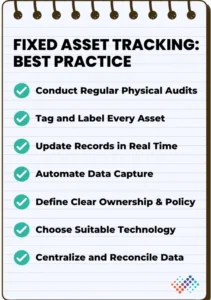
For a quick recap, here’s a checklist of fixed asset tracking best practices based on the challenges above. Use these tips to tighten your asset tracking process and avoid common mistakes:
-
Conduct Regular Physical Audits:
Verify asset existence at least annually (plus periodic spot checks) to eliminate ghost assets and ensure records match reality.
-
Tag and Label Every Asset:
Assign durable barcode or RFID tags and record each asset’s ID, location, and custodian. This makes assets easily scannable and trackable throughout their life.
-
Update Records in Real Time:
Treat your asset register as a live system – add new assets immediately, and record transfers or disposals as soon as they happen. Don’t wait for year-end; continuous updates keep data accurate.
-
Automate Data Capture:
Use asset management software and scanners to minimize manual entry. Integration between systems (finance, IT, maintenance) reduces duplicate work and human error, improving data accuracy.
-
Define Clear Ownership & Policy:
Establish an asset tracking policy that defines roles, responsibilities, and procedures (for inventory counts, tagging, transfers, etc.). Make department managers or asset custodians accountable for assets under their control.
-
Choose Suitable Technology:
Pick an asset tracking solution that fits your needs (e.g., barcode system for basic tracking, RFID/IoT for advanced needs). Ensure your team is trained to use it, and align your processes with the tool’s capabilities.
-
Centralize and Reconcile Data:
Avoid information silos by maintaining a single source of truth for assets or frequently syncing data between departments. Regularly reconcile asset data across Finance, IT, and other teams so everyone is on the same page.
By following these best practices, you’ll create a robust asset tracking system that minimizes losses, speeds up audits, and gives you full control over your fixed asset lifecycle.
Key Takeaways
- Overall, fixed asset tracking best practices becomes reliable when organizations combine regular physical audits with proper asset tagging, helping eliminate ghost assets, improve record accuracy, and stay audit-ready.
- By automating data capture, updating asset records in real time, and integrating systems across finance, IT, and operations, businesses significantly reduce human error and avoid costly compliance issues.
- Finally, clear ownership policies and the right-fit tracking technology ensure long-term control of the asset lifecycle, improving visibility, accountability, and financial decision-making.
Conclusion
Mastering fixed asset tracking becomes achievable by addressing common pitfalls with practices. By now, audits, thorough tagging, real-time updates, policies, tools, and collaboration align. Therefore, you prevent asset loss, ensure compliant records, and breeze through audits. Importantly, these best practices build accountability, accuracy, and treat assets as resources.
Start by prioritizing small improvements and build momentum with consistent action. Consistency matters; therefore, tagging new assets immediately delivers long-term impact. If uncertain, however, seek expert support through checklists or consultations. Ultimately, these fixed asset tracking best practices transform asset tracking from stress into business strength.

FAQs
Q1: How often should we do a fixed asset inventory?
Ans: You should perform a comprehensive physical inventory of fixed assets at least once a year. An annual inventory ensures that ghost assets or missing items are identified and corrected in your records. For larger organizations or those with high asset turnover, consider bi-annual or quarterly cycle counts of select asset categories to catch discrepancies early. Regular inventories keep your asset register accurate and audit-ready by continuously validating the existence and condition of your assets.
Q2: Should every tool or low-value item be tracked as a fixed asset?
Ans: Not necessarily, because organizations should define a clear asset tracking threshold. Typically, companies track assets above a capitalization limit or operational importance. However, even low-value items may require tracking if loss disrupts operations. Ultimately, balancing effort with risk ensures efficient and effective asset control.
Q3: Who should be responsible for fixed asset tracking in a company?
Ans: Fixed asset tracking is a team effort but needs clear ownership. Typically, Finance or Accounting owns registers, audits, and financial reporting. Meanwhile, departments assign asset custodians to manage daily tracking responsibilities. Therefore, collaboration between central oversight and departments ensures every asset stays accountable.
Q4: What’s the difference between asset tracking and inventory management?
Ans: Asset tracking monitors fixed assets like machinery, vehicles, and equipment over time. By contrast, inventory management handles short-term stock intended for sale or consumption. Therefore, asset tracking emphasizes lifecycle, location, depreciation, and maintenance for compliance. Meanwhile, inventory management focuses on quantities, turnover, and replenishment to meet demand.