



Introduction
Fixed asset tracking is how an organization knows, at any moment, which physical assets it owns, where each one is, who holds it, and what state it is in – and how it proves all of that when an auditor asks. This guide explains the full discipline: identifiers, tracking methods, the end-to-end process, monitoring, metrics and the challenges in between.
It is written from the perspective of teams that physically verify assets for a living, not from a tag catalogue. That lens matters: most tracking programs do not fail at the technology step. They fail in the gaps between a movement happening on the floor and a record changing in the system.
Closing those gaps is where fixed asset management software connects physical asset events to financial records, approvals, and ERP updates so the system stays current when the floor moves.
In this guide, you will learn:
- What fixed asset tracking involves, how identifiers support accurate records, and why tracking differs from inventory management across the asset lifecycle.
- How to implement fixed asset tracking through receipt, tagging, movement control, physical verification, reconciliation, and ongoing monitoring.
- Why informal transfers, temporary movements, unreliable identifiers, and system gaps cause register drift, and which controls address these recurring challenges.
- How to evaluate tracking effectiveness using verification, found-rate, tag integrity, transfer lag, gatepass, and exception closure metrics.
What Is Fixed Asset Tracking?
Fixed asset tracking is the process of recording and maintaining the identity, location, custodian and status of an organization’s long-term physical assets – equipment, machinery, IT hardware, vehicles, and furniture across their life, from receipt through physical asset tracking, transfers and verification to retirement, so records stay accurate and provable.
In practice, each asset carries a unique identifier an asset number backed by a tag such as a barcode, QR code, or RFID label and teams capture every meaningful event against that identifier, including receipt, issue, transfer, temporary movement out of premises, verification, repair, and disposal.
Tracking is the operational backbone of the wider fixed asset management discipline. The asset register and the ERP hold the financial view; tracking keeps that view true to the floor. Standards such as ISO 55000 frame this as maintaining reliable asset information across the lifecycle.
It differs from inventory tracking. Inventory management tracks stock that a company plans to consume or sell, whereas fixed asset tracking follows durable items that remain in the business. Therefore, fixed asset tracking focuses more on identity, custody, and condition than on quantity and turnover.
Why Tracking Fails and What It Costs
Tracking rarely breaks in the software. It breaks in the physical-to-record handoffs. Three failure modes account for most of the drift between the floor and the register, and each has a direct financial and audit consequence.
1. Informal transfers
Assets move between departments, floors, plants, and people through emails, phone calls, or handshakes, while teams update the system later, if they update it at all. As a result, locations, cost centers, and custodians become incorrect, depreciation reaches the wrong unit, and no one remains clearly accountable when someone needs or cannot find the asset.
2. Uncontrolled temporary movement
Assets leave premises for repair, calibration, demos, vendor work or employee use without a gatepass trail. When there is no record of what went out, who approved it and when it is due back, theft and loss risk rises, insurance positions weaken, and the organization cannot prove whether an asset is inside or outside its premises.
3. Unreliable identifiers
Physical verification depends on matching what teams find to what they record. However, when asset numbers, tags, or serials are missing, duplicated, or inconsistent, matching becomes manual detective work. Consequently, duplicate records, unmatched assets, and ghost assets accumulate, while every audit cycle costs more than the last.
Over time, this creates register drift. Small, unrecorded events accumulate quietly until a verification exercise or statutory audit exposes them all at once, resulting in write-offs, qualifications, and uncomfortable questions.
Identifiers First: Asset Numbers, Serials and Tags
Every reliable tracking program starts with identifier discipline, because everything else scanning, movement control, verification, reconciliation – matches against identifiers. Three layers do different jobs and should all be captured.

- Asset number: The record identifier the register and ERP use. It is the anchor every event ties back to.
- Serial number: The manufacturer’s identity for the unit. Essential for warranty, IT security and proving one specific machine is the one on the books.
- Tag: The scannable label barcode, QR or RFID physically attached to the asset. The tag makes field capture fast and unambiguous.
Two rules prevent most downstream pain. First, uniqueness: no tag or serial should ever map to two records, which argues for a controlled tag registry linked to ERP asset numbers rather than ad-hoc label printing. Second, granularity: one purchase-order line is often several physical assets – tag each unit, not the invoice line.
Fixed Asset Tracking Methods and Technologies
Tracking methods differ mainly in how events are captured: manually keyed, scanned by a person, or read automatically. Most enterprises mix methods by asset class and site rather than standardizing on one.
Method |
How capture works |
Best fit |
Watch out for |
|---|---|---|---|
| Spreadsheet / manual log | Someone types each event | Very small, static asset pools | Goes stale fast; no proof of events |
| Barcode / QR labels | A person scans a label with a handheld or phone | Offices, IT assets, most plant equipment | Needs line of sight and human action for every event |
| RFID tags | A reader detects tags without line of sight, in bulk | High-volume stores, data centers, fast audits | Higher setup cost; metal and liquid interference; still needs process discipline |
| GPS / cellular trackers | Device reports its own location continuously | Vehicles, high-value mobile plant | Power and subscription per asset; overkill for static assets |
| BLE beacons / IoT sensors | Receivers detect presence; sensors report condition | Movement-heavy zones; condition-sensitive assets | Infrastructure cost; data volume needs a plan |
Two supporting choices matter as much as the tag: mobile versus fixed scanning (mobile follows people and is cheap to roll out; fixed readers at doorways enforce capture automatically) and cloud versus on-premise deployment.
The technology decision belongs with the software decision, because the fixed asset management software features must support label generation, drive the scanning workflow and reconcile the results.
The Fixed Asset Tracking Process, End to End
A tracking program is a repeating operational cycle, not a one-time tagging project. Five stages cover the life of every event, and each stage has one control question to answer.
1. Receive and record
Capture the asset at physical receipt description, serial, location, custodian, photos even before finance creates the final ERP record. Control question: can we see assets that have arrived but are not yet on the books?
2. Tag and register
Assign the asset number, attach the tag, and link tag, serial and record in a controlled registry. Split multi-unit purchase lines into individual assets here. Control question: does every physical unit have exactly one identity?
3. Control movement
Route permanent transfers through mobile requests and approvals that update location, cost center and custodian at the moment of the move and route temporary movement through gatepasses with approvers, expected return dates and check-out / check-in status. Control question: could this asset move without leaving a record?
4. Verify physically
Run scheduled verification: scan assets in the field, capture evidence such as photos and location, and flag exceptions such as not found, found but unrecorded, or wrong custodian. Then, route each exception for investigation and approval rather than making silent edits. As a result, the control question becomes: when did a person last confirm that this asset exists?
5. Reconcile and update
Close the loop by reconciling verification results to the register and ERP: resolve ghost assets with documented approvals, create records for unrecorded finds, and correct locations and custodians. Continuous, approved synchronization here is what prevents the year-end reconciliation backlog. Control question: does the register now match the floor, and can we prove it?
Standing the program up follows the same shape: baseline the asset base with a full verification, fix identifiers, then run the cycle as business-as-usual with defined owners and a policy behind it.
Fixed Asset Tracking vs Fixed Asset Monitoring
Fixed asset tracking records discrete events: An asset was received, moved, scanned, verified.
Fixed asset monitoring watches state between events: Whether an asset is where it should be, still assigned to the right person, still in acceptable condition, and whether its pattern of activity signals risk.
Tracking answers ‘what happened and when’. Monitoring answers ‘what is true right now, and what is likely to go wrong next’. A gatepass record is tracking; an alert that the return date has passed is monitoring. A verification scan is tracking; a flag that an asset has missed two cycles is monitoring.
Monitoring makes risk predictable rather than leaving teams to discover it later. For example, platforms such as AssetCues analyze historical audit data and current lifecycle signals to flag assets at elevated risk of loss, theft, misuse, or non-verification. As a result, teams can apply risk-based controls instead of reacting to issues.
Therefore, you do not choose between the two. Instead, reliable fixed asset monitoring depends on reliable tracking data because, without disciplined event capture, teams have nothing trustworthy to monitor.
Metrics That Prove Tracking Works
A tracking program should measure its performance like any other control. Together, eight metrics show whether the register reflects the physical floor and whether teams consistently follow the process. Moreover, these metrics do not require benchmarks to provide value; the trend itself serves as the signal.
Metric |
What it tells you |
How it is calculated |
|---|---|---|
| Verification coverage | How much of the asset base was physically confirmed this cycle | Assets verified / assets planned for verification |
| Found rate | How much of the register matches the floor | Assets found / assets verified |
| Ghost (not-found) rate | How much of the register may not exist | Assets not found / assets verified |
| Unrecorded-asset finds | Completeness gaps in the register | Unrecorded assets found in the field, as a share of assets verified |
| Tag integrity | Whether identifiers are surviving in the field | Assets with readable, correct tags / assets inspected |
| Transfer update lag | Whether moves are recorded when they happen | Average days between physical move and record update |
| Gatepass overdue rate | Whether temporary movement is controlled | Gatepasses past expected return / open gatepasses |
| Exception closure rate | Whether findings get resolved, not parked | Exceptions closed with approval / exceptions raised in the period |
Review these on a fixed cadence with named owners, and investigate movement in the trend rather than chasing a single number.
Common Tracking Challenges (and Where They Come From)
Four challenges account for most struggling programs, and all four are process problems before they are technology problems.
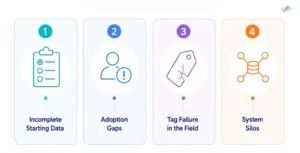
- Incomplete starting data: Assets missed in the baseline exercise stay invisible for years. A thorough initial verification, cross-checked against purchase and accounting records, is the fix, and a follow-up sweep catches what the first pass missed.
- Adoption gaps: Busy teams skip scans, and every skipped scan is silent register drift. Make capture effortless (mobile-first), make it expected (policy plus ownership), and make lapses visible (exception and lag metrics).
- Tag failure in the field: Labels wear, fall off, or become unreadable, and matching breaks. Therefore, inspect and re-tag during every verification cycle, and choose tag materials based on the environment rather than the catalogue price.
- System silos: When tracking, procurement, ERP, and IT records do not sync, disposals and additions can slip through the cracks, creating ghost assets. Therefore, integrate where possible; where that is not possible, define the manual handoff explicitly.
Where Software Fits
Software is what makes the cycle scalable. A tracking platform maintains the central asset record, generates and governs tags, drives mobile scanning and check-in / check-out, routes transfer and gatepass approvals, runs verification projects with evidence capture, and keeps ERP, ITSM and HR systems synchronized to one version of asset truth.
If you are scoping a platform, start with the fixed asset tracking software for capabilities, and the broader fixed asset management software page for how tracking connects to capitalization control and register accuracy. If you are comparing shortlists, our review of the best fixed asset tracking software ranks options by buyer type.
Key Takeaways
- Fixed asset tracking keeps identity, location, custodian and status true for long-term physical assets – and provable at audit time.
- Programs fail in the physical-to-record gaps: informal transfers, uncontrolled temporary movement and unreliable identifiers, not usually in the software.
- Run tracking as a five-stage cycle – receive, tag, control movement, verify, reconcile – with one control question owned at each stage.
- Tracking records events; monitoring watches state and risk between events. Monitoring is only as good as the tracking data beneath it.
- Measure the program with coverage, found, ghost, tag-integrity, lag and closure metrics – the trend, not a benchmark, is the signal.
Conclusion
Fixed asset tracking is not a tagging project; it is an operating discipline that keeps the asset register honest. Get identifiers right, close the movement gaps, verify on a schedule, reconcile with approvals, and measure the cycle – and audits stop being an annual emergency. Start where the leverage is: pick the two or three metrics above that you cannot answer today, and run one verification cycle to baseline them.
Fixed Asset Tracking FAQ
Q1. How is fixed asset tracking different from inventory tracking?
Ans: Fixed asset tracking follows durable items the business keeps and uses – equipment, IT hardware, vehicles – where identity, custody, condition, and lifecycle events matter. Inventory tracking counts stock meant to be consumed or sold, where quantity and turnover matter. The two need different identifiers, processes and systems.
Q2. What is an asset tag?
Ans: An asset tag is the scannable label physically attached to an asset – a barcode, QR code or RFID tag – carrying its unique identifier. Scanning the tag pulls up the asset’s record, making field capture fast and unambiguous. Tags should be issued from a controlled registry so no identifier is ever duplicated.
Q3. How often should fixed assets be physically verified?
Ans: Set verification frequency based on risk and materiality rather than applying a universal rule. For example, many organizations verify the full asset base annually while placing high-value, mobile, or loss-prone categories on shorter cycles. Statutory or policy requirements may also set a minimum frequency in some jurisdictions. Most importantly, keep the cadence scheduled, assign clear ownership, and complete each cycle consistently.
Q4. What are ghost assets?
Ans: Ghost assets are records in the register for assets that no longer physically exist or cannot be found – typically leftovers from unrecorded disposals, losses or moves. They overstate asset values, distort depreciation and insurance, and surface as audit exceptions. Regular verification with an approval-based resolution workflow removes them..