



Introduction
These are the fixed asset management best practices that survive contact with the field, drawn from physical verification work rather than recycled checklists. Eight management practices, each paired with the metric that proves it, plus tracking best practices organized around the challenges field teams actually face.
The practices assume you know what the discipline covers; if not, start with the fixed asset management. Everything below is written for the practitioner standardizing a program: what to adopt, in what order, and how to know it is working.
In this guide, you will learn:
- What fixed asset management best practices establish a reliable asset foundation, from identifier discipline and register hygiene to standardized tagging and ownership.
- How to implement risk-based verification, reconciliation service levels, employee self-certification, and software enablement to strengthen asset control.
- Why metrics such as tag integrity, verification coverage, exception aging, unauthorized changes, and transfer lag help measure whether controls work.
- How to address ghost assets, location gaps, manual errors, data silos, and technology choices through practical tracking controls and defined responsibilities.
Fixed Asset Management Best Practices: The Field-Tested Set
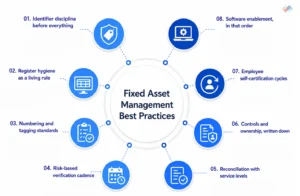
Order matters. The first three practices create the identity and data foundation; the next three make the register defensible; the last two make the program sustainable. Adopting them out of order is the most common way programs stall.
1. Identifier discipline before everything
Every downstream control matches against identifiers, so make them unassailable first: one physical unit, one asset number, one tag – issued from a controlled registry linked to ERP asset numbers, never from ad-hoc label printing. Enforce tag and serial uniqueness at entry; a duplicate identifier discovered later costs ten times the prevention.
2. Register hygiene as a living rule
Treat the register as a live system with completeness rules, not an annual cleanup project. Required fields enforced at creation, controlled status values, retired assets actually removed, and every acquisition, transfer and disposal recorded when it happens. Stale registers are not a data problem; they are a workflow problem.
3. Numbering and tagging standards
Write the standard down: number format, what encodes what, tag materials by environment, placement rules, and the re-tagging trigger. A good asset number is boring – sequential within a controlled range, readable by humans, scannable by machines, and never re-used. Cleverness in numbering schemes ages badly.
4. Risk-based verification cadence
Verify everything on a schedule but not everything on the same schedule. Classify assets by value, mobility and loss history, then tier the frequency: the full asset base on a baseline cycle, higher-risk classes more often. Run cycles as scheduled projects with auto-created tasks by location and custodian, monitored progress, and enforced closure – not as ad-hoc reminders.
5. Reconciliation with service levels
Exceptions age badly. Give reconciliation the same discipline as a service desk: every verification exception gets an owner, a reason code and a target closure window agreed with finance; aging is reviewed on a cadence; nothing is closed without an approval trail. The service-level numbers are yours to set the practice is that they exist and are measured.
6. Controls and ownership, written down
Accountability that lives in habit dies in turnover. A short policy naming stage owners, approval routes by value and transaction type, and segregation between who requests, approves and records reviewed annually keeps the program independent of individuals. Our fixed asset control procedures guide carries the policy structure and template.
7. Employee self-certification cycles
For laptops, tools, instruments and remote-work assets, the custodian is the control. Run periodic self-certification: employees confirm the assets assigned to them, upload proof where warranted, and exceptions route to remediation returns, reassignments or investigations. It is the cheapest verification coverage you will ever buy, and the practice competitors’ checklists never mention.
8. Software enablement, in that order
Tooling scales practices; it does not create them. Once identifiers, hygiene and cadence exist on paper, a platform makes them fast and provable mobile capture, approval workflows, scheduled verification projects, evidence on every event. Start with the fixed asset tracking software layer for field execution, and the fixed asset management software layer for register and ERP control.
Practice to Metric: How You Know Each One Is Working
A practice without a metric is a hope. Pair each of the eight with the number that proves it the metric formulas.
Practice |
The metric that proves it |
What movement means |
|---|---|---|
| Identifier discipline | Tag integrity rate (readable, correct tags / inspected) | Falling integrity = field wear or registry leaks |
| Register hygiene | Record completeness (required fields populated / records) | Dips after go-live = workflow gaps, not data gaps |
| Numbering & tagging standards | Duplicate-identifier incidents per cycle | Any non-zero trend = registry control failing |
| Risk-based verification cadence | Verification coverage (verified / planned) | Coverage misses = scheduling or capacity problem |
| Reconciliation service levels | Exception closure rate and aging | Aging growth = ownership gaps |
| Controls & ownership | Unapproved-change incidents | Should be zero; each one is a finding |
| Self-certification | Certification response rate and exception yield | Low yield with high response = healthy asset base |
| Software enablement | Transfer update lag (move to record, days) | Lag shrinking = the tool is actually adopted |
Fixed Asset Tracking Best Practices: The Challenge-by-Challenge View
The management practices above set the program; the fixed asset tracking best practices below address the seven problems field teams actually raise.
1. Ghost assets
Assets on the books that no longer exist inflate values and insurance. The fix is the cadence practice: scheduled verification, investigation of not-founds, and approval-based removal. In one AssetCues client engagement, a meaningful share of listed assets could not be located at baseline; scheduled cycles eliminated the ghosts and the insurance cost that rode on them.
2. Poor location visibility
Assets move without logging; teams search and re-buy. Unique identifiers, named custodians and scan-based transfer updates keep the register queryable: where is it, who has it, since when.
3. Manual data-entry error
Hand-keyed registers drift. Spreadsheet research collated by EuSpRIG has repeatedly found that the large majority of spreadsheets contain errors. Scan-based capture, validation rules at entry and integration with purchasing remove the keystrokes that cause it.
4. A register that is only true in December
Annual-update registers are stale eleven months a year. The hygiene practice fixes this: record events when they happen, name an owner, and spot-check quarterly so year-end becomes a formality.
5. Nobody accountable
Without a written policy, tracking is voluntary. The controls-and-ownership practice custodians per department, an overall owner, documented procedures and thresholds makes it an operating standard instead.
6. Technology overreach
RFID before readiness wastes budget and trust. Match the tool to volume, movement and maturity: barcode-first for most organizations, RFID and IoT where scale and interference economics justify them, and training before rollout always.
7. Data silos
Finance, IT and operations each holding a different asset truth guarantees reconciliation pain. Pick the master record, integrate or schedule synchronization, and reconcile across teams on a cadence one source of truth, many views.
The Quick Checklist
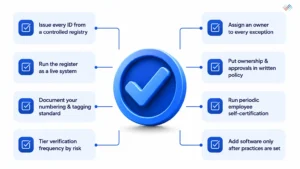
- Issue every identifier from a controlled registry; enforce uniqueness at entry.
- Run the register as a live system with completeness rules and controlled statuses.
- Write the numbering and tagging standard down, including re-tagging triggers.
- Tier verification frequency by risk; run cycles as scheduled, monitored projects.
- Give every exception an owner, a reason code and a closure target and measure aging.
- Put ownership, approvals and segregation in a short written policy, reviewed annually.
- Run employee self-certification for custodial assets on a periodic cycle.
- Add software once the practices exist on paper then measure adoption by transfer lag.
Key Takeaways
- Adopt the practices in order: identity and data foundation first, defensibility second, sustainability third.
- Every practice pairs with a metric coverage, integrity, closure, lag and the trend is the signal.
- Self-certification is the highest-leverage practice most programs skip.
- Cadence and service-level numbers are risk decisions to make and measure, not benchmarks to copy.
- Tracking-specific fixes ghosts, visibility, entry error, silos all resolve to the same eight practices.
Conclusion
Strong fixed asset management depends on consistent execution, not isolated checklists. Start with controlled identifiers, clean registers, clear tagging standards, and risk-based verification, then strengthen the program with defined ownership, service levels, and employee self-certification.
Finally, use software to connect these practices, measure performance, and keep tracking records current. Together, these steps make fixed asset tracking more reliable, measurable, and easier to sustain across the asset lifecycle.
Best Practices FAQ
Q1. What are fixed asset management best practices?
Ans: The field-tested set: identifier discipline from a controlled registry, register hygiene as a living rule, written numbering and tagging standards, risk-based verification cadence, reconciliation with service levels, documented controls and ownership, employee self-certification cycles, and software enablement once the practices exist on paper. Each pairs with a metric that proves it.
Q2. Should every tool or low-value item be tracked as a fixed asset?
Ans: Not necessarily. Define a tracking threshold based on capitalization policy and operational importance: capitalized assets always, plus lower-value items whose loss disrupts operations tools, instruments, devices. Below the threshold, group-level or consumable treatment is fine. The point is a written rule, so effort follows risk rather than habit.
Q3. Who should be responsible for fixed asset tracking in a company?
Ans: Split it deliberately: finance owns the register, policy and reconciliation outcomes; departments name asset custodians who own daily custody and movement updates; internal audit tests that the controls operate. One overall program owner keeps the pieces connected. Tracking assigned to everyone in general belongs to no one in practice.
Q4. What are fixed asset tracking best practices?
Ans: The tracking-specific set: eliminate ghost assets through scheduled verification with approval-based removal, keep locations visible with unique identifiers and scan-based transfer updates, remove manual entry with scanning and validation, maintain the register in real time, write the policy down, match technology to maturity, and integrate systems to one source of truth.
Q5. What is employee asset self-certification?
Ans: A periodic cycle where employees confirm the assets assigned to them laptops, tools, instruments upload proof where warranted, and trigger remediation for exceptions such as returns or reassignments. It extends verification coverage to custodial assets cheaply, catches ex-employee and idle-asset drift early, and keeps IT and finance records aligned.