


Introduction
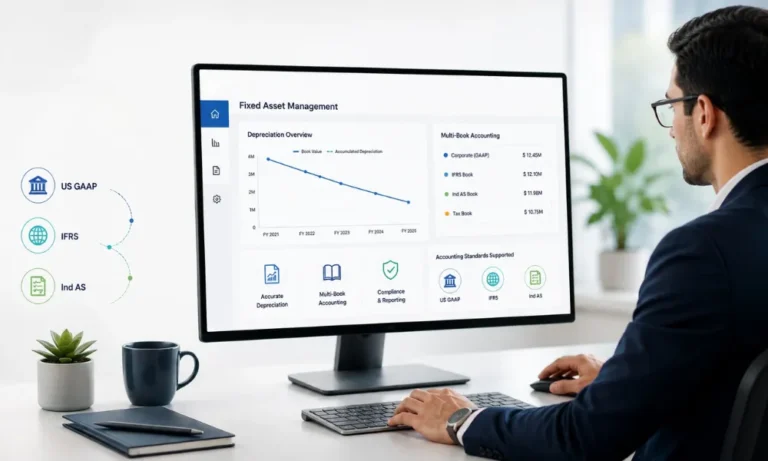
Fixed asset software for accountants is its own field, not a subset of the general asset-management market: the tools that dominate it are depreciation engines built around books, bases, and filings, and the buyers are firms and finance teams answering to standards and tax law at once. For those evaluating the best accounting app for fixed asset management, the focus should remain on depreciation, compliance, multi-book accounting, and reporting.
Teams that also need physical asset control alongside accounting will find that fixed asset management software covers the broader layer, connecting physical asset events to financial records, approvals, and ERP updates. This comparison looks at that field depreciation-first across US GAAP, IFRS, and Ind AS.
Disclosure up front: AssetCues builds fixed asset software, appears in the comparison below under the same criteria as everyone else, and declares those criteria before any names. And one framing this page will keep returning to: a depreciation schedule is only as good as the register underneath it.
In this guide, you will learn:
- What fixed asset software for accountants must handle, including multi-book depreciation, standards coverage, componentization, audit trails, and register integrity.
- How US GAAP, IFRS, and Ind AS differ in componentization, useful-life reviews, revaluation, impairment, and tax depreciation requirements.
- Why the right software depends on whether you need a firm-focused depreciation tool, enterprise platform, ERP module, subledger, or specialist solution.
- How to evaluate fixed asset software by comparing book and tax capabilities, architecture, standards coverage, vendor fit, and the accuracy of the underlying asset register.
What Fixed Asset Software for Accountants Must Handle
Five requirement classes separate accountant-grade tools from generic trackers. Everything in the comparison hangs off these:
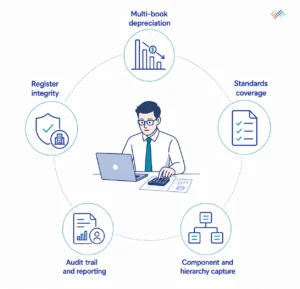
- Multi-book depreciation: Book and tax values maintained in parallel and in US practice, often several further bases without spreadsheet side-cars.
- Standards coverage: The depreciation logic your reporting framework actually requires componentization, useful-life reviews, revaluation and impairment handling where applicable.
- Component and hierarchy capture: Parent-child structures recorded at onboarding, before the ERP record exists, so components get their own useful lives from day one.
- Audit trail and reporting: Who changed what, when and why with schedules, reconciliations and rollforwards auditors can rely on.
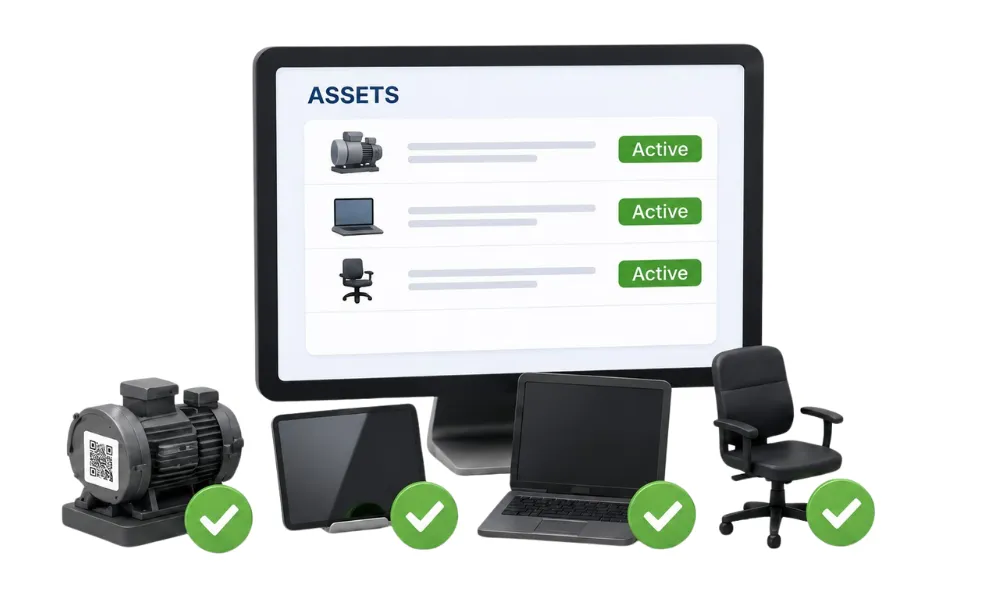
- Register integrity: Linkage between the depreciation base and physical reality existence, custody and condition because the calculation inherits every register error.
Book vs Tax: Why One Number Is Never Enough
Book depreciation follows your reporting framework US GAAP, IFRS or Ind AS and aims at faithful allocation of cost over useful life. Tax depreciation follows the revenue authority: in the United States, MACRS under IRS Publication 946; in India, the Income-tax Act’s block-of-assets approach on written-down value. The two sets of rules disagree by design.
Accountant-grade software therefore runs books in parallel and keeps them reconciled the firm-tool tradition of multiple bases per asset exists precisely because one number never satisfies both the auditor and the return. The evaluation question is not whether a tool calculates depreciation; it is how many rule-sets it can hold honestly at once.
The Multi-Standard Table: US GAAP vs IFRS vs Ind AS
The differences that actually change depreciation outcomes, side by side. Educational summary only not tax or accounting advice; confirm treatments for your entity with your advisor. Standards references: IAS 16 for IFRS; Ind AS and Schedule II under India’s Companies Act framework (Ministry of Corporate Affairs); ASC 360 under US GAAP.
| Key area | US GAAP | IFRS (IAS 16) | Ind AS 16 + Schedule II |
|---|---|---|---|
| Componentization | Permitted; not broadly required | Required where components are significant | Required where components are significant; Schedule II reinforces component lives |
| Useful life & residual review | Reassessed when events or circumstances indicate | Reviewed at least at each financial year-end | Reviewed at least at each financial year-end; Schedule II lives are indicative – justify and disclose departures |
| Revaluation model | Not permitted for PP&E | Permitted as an accounting policy choice by class | Permitted, aligned with IAS 16’s model |
| Impairment approach | Two-step style: undiscounted recoverability test, then measure | One-step: carrying amount vs recoverable amount | One-step, aligned with the IFRS approach |
| Tax interplay | Separate MACRS computation (IRS Pub 946); book-tax differences tracked | Jurisdiction-specific tax books alongside | Separate Income-tax Act computation (block of assets, WDV) |
Software implication: A US-only engine treats componentization and annual life reviews as optional workflow; an IFRS or Ind AS entity needs them as first-class behavior. That single difference disqualifies more tools than any feature list and it is exactly the column most vendor comparisons omit.
The Best Accounting App for Fixed Asset Management: Reading the Field
Searches for the best accounting app for fixed asset management land in a field with two very different species, and ‘best’ depends on which you are. Firm tools serve accountants managing many clients: multi-entity by design, tax-suite integrated, priced per season. Enterprise tools serve one organization deeply: ERP-integrated, workflow-heavy, register-centric. An app that is excellent for a fifty-client practice is usually wrong for a five-thousand-asset plant and vice versa.
The Comparison: Firm Tools and Enterprise Tools, Honestly
Criteria, declared before names: jurisdictional center of gravity, multi-book depth, firm-vs-enterprise design, integration anchor, and register-integrity linkage. Rows describe positioning, not exhaustive features; capabilities change; verify each against the vendor’s current official documentation before shortlisting.
| Tool | Built for | Positioning (verify against current official docs) | Jurisdictional center of gravity |
|---|---|---|---|
| AssetCues | Enterprises where the depreciation base itself is in question | Register accuracy and physical verification integrated with the ERP: component and hierarchy capture at onboarding, ghost-asset resolution, evidence-backed records. Anti-fit stated plainly: it complements, rather than replaces, a tax-compliance engine | Multi-standard enterprise (US, India, IFRS environments) |
| Intuit ProSeries Fixed Asset Manager | Tax firms managing client asset schedules | Depreciation across multiple US bases (book, federal, state, AMT, ACE, custom); integrates with the ProSeries tax suite; add-on or standalone (per its current product page) | United States (tax-first) |
| Thomson Reuters Fixed Assets CS | Accounting firms in the CS Professional Suite | Firm-workflow depreciation within the CS ecosystem | United States |
| Bloomberg Tax Fixed Assets | Corporate tax departments | US tax-calculation depth for in-house teams | United States |
| Sage Fixed Assets | US organizations running dedicated depreciation software | Long-standing depreciation suite; verify current edition scope directly | United States |
| AssetAccountant | Multi-jurisdiction finance teams | Fixed asset and lease depreciation with multi-country orientation; verify jurisdiction list | Multi-country |
| Netgain NetAsset | NetSuite-run finance teams | NetSuite-native fixed asset subledger extending the FAM module | Follows the ERP |
The honest read: pure tax engines and register-truth platforms solve different halves of the accountant’s problem. Firms filing returns need the former; enterprises whose audits keep finding the register wrong need the latter and many need one of each, integrated. For the general market beyond the accountant lens, our best fixed asset software comparison covers the wider field.
ERP Module vs Subledger vs Specialist Tool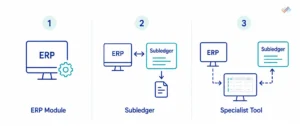
Three architectures carry fixed asset accounting. The ERP’s own module (SAP, Oracle, NetSuite and peers) keeps everything in one system, often at the cost of depreciation flexibility and physical-workflow depth. A subledger extends the ERP with richer asset logic while posting back. A specialist tool runs beside both, deepest in its niche. Pick the architecture before the vendor; most shortlisting pain is two architectures compared as one.
The Register-Accuracy Prerequisite
Every method choice above computes on the register you feed it and depreciation on an asset that no longer exists is precise nonsense. Ghost assets overstate the base until someone proves the floor; components lumped into one record inherit one blended life forever. The fix is upstream of the engine: capture component hierarchies at onboarding, verify existence through fixed asset monitoring, resolve ghosts through approval rather than year-end surprise.
Key Takeaways
- The accountant field is depreciation-first and splits into firm tools and enterprise tools ‘best’ depends on which you are.
- US GAAP, IFRS and Ind AS diverge exactly where software behavior matters: componentization, annual reviews, revaluation, impairment.
- Run book and tax in parallel by design; one number never satisfies both the auditor and the return.
- Verify every vendor claim against current official documentation positioning changes, and this page’s rows are dated for that reason.
- The register is the prerequisite: no engine fixes depreciation computed on assets that do not exist.
Conclusion
Choosing fixed asset software for accountants starts with the reporting framework, tax requirements, and the depth of depreciation and register controls you need. The best accounting app for fixed asset management should support accurate depreciation, multi-book accounting, compliance, and reliable asset records. Ultimately, the right choice depends on whether you need a firm-focused tool, enterprise platform, ERP module, or specialist solution.
FAQ
Q1. What software do accountants use for fixed assets?
Ans: Two species: firm tools – multi-client depreciation engines integrated with tax suites, built for practices managing many entities and enterprise tools ERP-integrated platforms managing one organization’s register, workflows and evidence deeply. Firms filing returns lean on the former; enterprises answering audits lean on the latter; some environments run one of each, integrated.
Q2. What is the best accounting app for fixed asset management?
Ans: It depends on which buyer you are. For a practice serving many clients, the strongest fit is a multi-entity, tax-suite-integrated depreciation tool. For a single enterprise, it is an ERP-integrated platform with multi-book depth and register integrity. Decide firm-versus-enterprise and jurisdiction coverage first; the shortlist follows from those two answers.
Q3. Can fixed asset software handle both book and tax depreciation?
Ans: Accountant-grade tools are built for exactly this: parallel books per asset – reporting-framework depreciation alongside tax computations such as MACRS in the US or India’s block-of-assets approach – kept reconciled with the differences tracked. If a tool holds only one set of values, it is a tracker with a formula, not fixed asset accounting software.
Q4. Do IFRS and US GAAP depreciate assets differently?
Ans: In ways software must support, yes. IFRS and Ind AS require componentizing significant parts and reviewing useful lives and residual values at least annually, and permit revaluation; US GAAP does not require broad componentization, reassesses lives when events indicate, and prohibits revaluation of PP&E. Impairment testing also follows different models. Confirm treatments with your advisor.
Q5. Why does register accuracy matter for depreciation?
Ans: Because every calculation inherits the register: ghost assets keep depreciating value that no longer exists, unrecorded assets escape the schedule entirely, and components lumped into one record carry one blended life. Physical verification, ghost-asset resolution and component capture at onboarding fix the base – which is the part no depreciation engine can correct afterwards.