



What Is Asset Exception Management?
Asset exception management is a structured workflow for handling discrepancies during asset verification and reconciliation. An exception occurs when asset records do not match the physical environment. Common exceptions include assets in records but not found physically. These are potential ghost assets. Teams may also find assets that are not in the register. These indicate unregistered or off-book assets.
Other cases include assets found at incorrect locations or with damaged or missing tags. Teams may also see assets assigned to the wrong custodian. Data errors such as incorrect cost, serial number, or categorisation also create exceptions. Exception management ensures teams review, explain, and close every discrepancy. They document outcomes instead of carrying issues into the next cycle.
TL;DR
Asset exception management is the process of identifying, categorising, investigating, and resolving discrepancies found in asset data or physical verification results. It is what transforms a verification exercise from a list of findings into a set of closed, documented resolutions, and it is the mechanism that drives sustained asset register accuracy over time.
Why Asset Exception Management Matters
Physical verification without exception management produces a list of findings but no improvement. The register inaccuracies that caused those findings remain in place, ready to generate the same exceptions in the next audit cycle. For finance directors and internal auditors, unresolved exceptions are the clearest signal that asset controls are not functioning.
They also represent a direct financial risk: a ghost asset that is never written off continues to be depreciated and included in insurance schedules; an unregistered asset is invisible to maintenance planning and excluded from financial disclosures. For external auditors under Companies Act or IFRS requirements, a high exception rate or a poor exception resolution record signals weak internal controls over financial reporting — potentially triggering a qualified audit opinion or a management letter finding.
How Asset Exception Management Works
- Exception capture: During or after physical verification, teams record discrepancies with the asset ID, location, custodian, discrepancy type, and scan evidence.
- Categorization: Teams classify each exception—missing, found-not-listed, location mismatch, tag damage, custodian mismatch, or data error—so they can route it to the appropriate investigation process.
- Investigation: The responsible team investigates the root cause. They may locate a missing asset in another building or maintenance, or confirm it as lost. They may find that an unlisted asset was transferred without a record or capitalized without tagging.
- Resolution: Based on findings, teams close the exception by correcting the register, updating asset transfers, writing off the asset, replacing tags, or documenting it as a known risk.
- Closure documentation: Teams record every resolved exception with the resolution type, responsible party, date, and supporting evidence—creating a complete audit trail.
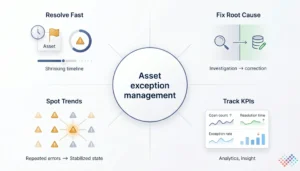
- Trend analysis: Teams analyze recurring exception types or high-exception locations to identify control weaknesses and improve processes, rather than just fixing individual issues.
Best Practices for Asset Exception Management
- Define resolution timelines for each exception category. Critical exceptions assets that cannot be located should be investigated and closed within days, not deferred to the next audit cycle.
- Separate exception investigation from register correction. Resolve the root cause before updating the register to avoid closing exceptions with inaccurate data.
- Use exception trends to drive control improvements. If the same locations or custodians generate repeated exceptions, the issue is a process gap — not just a data error.
- Report exception rates and resolution performance to management. Exception metrics open count, average resolution time, and exception rate by category are meaningful KPIs for asset control effectiveness.
How AssetCues Helps with Asset Exception Management
AssetCues provides a built-in exception management workflow to capture discrepancies during verification. It routes issues for investigation and tracks their resolution status. Teams close each exception with a documented audit trail. Finance and operations teams monitor exception rates by site and cycle. This helps them clearly demonstrate control improvements to auditors.