



What Is Return on Fixed Assets (RoFA)?
Return on fixed assets (RoFA), also referred to as asset ROI in operational contexts, is a financial ratio that compares an organization’s net operating profit (or net income) to the net value of its fixed assets. It answers a direct question: for every rupee or dollar invested in fixed assets, how much operating profit is being generated?
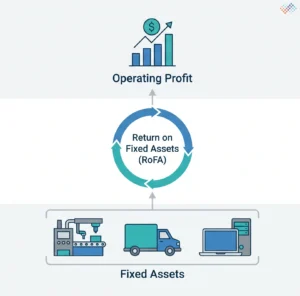
RoFA is most relevant to organizations with significant capital tied up in plant, machinery, infrastructure, vehicles, or IT hardware, where the productive output of those assets is central to financial performance.
TL;DR
Return on fixed assets (RoFA) measures how effectively an organisation generates operating profit from its fixed assets. It is the primary metric for assessing capital efficiency in asset-intensive businesses and helps finance and operations teams determine whether their capital investment in long-term assets is delivering adequate returns.
The RoFA Formula
Return on Fixed Assets (RoFA) = Net Operating Profit / Net Fixed Assets x 100
Input |
Definition |
| Net Operating Profit | Earnings before interest and tax (EBIT) or net income from operations |
| Net Fixed Assets | Gross fixed assets minus accumulated depreciation i.e., the net book value of fixed assets at the balance sheet date |
Worked Example
A manufacturing company reports:
- Net Operating Profit: $835,946
- Gross Fixed Assets: $6,269,592
- Accumulated Depreciation: $2,089,864
- Net Fixed Assets: $4,179,728
RoFA = 835,946 / 4,179,728 × 100 = 20%
For every $1.04 of net fixed assets, the business is generating $0.21 of operating profit. Whether this is strong or weak depends on the industry benchmark, the organization’s historical trend, and the stage of the asset’s lifecycle.
RoFA vs. ROA vs. Fixed Asset Turnover
Metric |
Formula |
What It Measures |
Key Difference |
| RoFA | Net Operating Profit / Net Fixed Assets | Profit generated per unit of fixed asset investment | Focused purely on fixed assets; excludes current assets |
| Return on Assets (ROA) | Net Income / Total Assets | Profit generated from all assets, including current assets | Broader base includes cash, receivables, and inventory |
| Fixed Asset Turnover | Revenue / Net Fixed Assets | Revenue generated per unit of fixed asset investment | Revenue focus does not reflect profit margin efficiency |
These ratios answer different questions. RoFA is the right metric when the question is profit efficiency from long-term capital investment. ROA is better when assessing overall asset productivity. Fixed asset turnover is useful for evaluating revenue-generating capacity without factoring in profitability.
How to Interpret RoFA
- A higher RoFA generally indicates that the organization is extracting strong profit from its fixed asset base reflecting good utilization, effective maintenance, and disciplined capital allocation.
- A declining RoFA over time can signal underutilized capacity, ageing assets with rising maintenance costs, or recent capital additions that have not yet reached full productive output.
- RoFA should be tracked alongside asset availability and utilization data. A company can have a high RoFA on a small, well-used asset base and a low RoFA on a larger, underperforming one.
- Comparisons across periods are more meaningful than single-point snapshots; track RoFA quarterly or annually and contextualize changes against capital investment decisions and depreciation policy.
Limitations of RoFA
RoFA is sensitive to depreciation policy. An organization using accelerated depreciation will report lower net fixed assets (and thus a higher RoFA) compared to one using straight-line, even if the physical asset base is identical. Revaluation of assets, impairment charges, and the treatment of leased assets versus owned assets can all distort the ratio. Finance teams should always interpret RoFA in the context of the accounting policies in use.
Best Practices for Tracking Return on Fixed Assets
- Benchmark RoFA against industry peers rather than using a single absolute threshold; asset intensity and return profiles differ significantly across manufacturing, healthcare, logistics, and technology sectors.
- Separate RoFA by asset class or site to identify which parts of the asset portfolio are generating returns and which are dragging performance.
- Use RoFA trends over a rolling three-to-five-year period to smooth out short-term fluctuations from new asset additions, one-off maintenance costs, or restructuring events.
- Combine RoFA with asset utilization and lifecycle cost data to make replacement and investment decisions. A falling RoFA on an ageing asset cohort may signal the right time to refresh the fleet.
How AssetCues Helps with Asset ROI
AssetCues provides the asset data foundation that makes RoFA calculations reliable, accurate net book values, depreciation records, utilization tracking, and lifecycle cost data. Organizations using a fixed asset management solution can centralize this information, enabling finance teams to access current asset valuations and historical records without manually reconciling spreadsheets.