



What Is a Cash Generating Unit (CGU)?
IAS 36 defines a Cash Generating Unit (CGU) as the smallest group of assets that produces independent cash inflows. When an individual asset cannot be tested for impairment on its own because its cash flows are intertwined with those of other assets, the impairment test is performed at the CGU level instead.
Cash inflows generated by a group of assets qualify as independent when they are largely unaffected by the cash flows of other assets or asset groups. In practice, this means a CGU is usually a product line, a manufacturing plant, a geographic segment, a branch, or a separately operated business division that generates its own identifiable revenue stream.
TL;DR
A Cash Generating Unit (CGU) is the smallest identifiable group of assets that generates cash inflows largely independent of the cash inflows from other assets or groups. Under IAS 36, impairment testing is often performed at the CGU level rather than for individual assets, making CGU identification a critical step in fixed asset accounting and financial reporting.
Why CGUs Matter in Fixed Asset Accounting
Most fixed assets do not generate cash independently. A production line relies on buildings, machinery, utilities, and staff together to generate revenue. Testing each machine individually for impairment would be meaningless; its recoverable amount in isolation cannot be determined reliably. By grouping interrelated assets into a CGU, IAS 36 makes impairment testing practical and representative.
For finance directors and CFOs, the CGU identification exercise is not just an accounting technicality. Getting CGU boundaries wrong, too broad or too narrow, can lead to missed impairment losses or overstated write-downs, both of which affect reported net assets, earnings, and the organization’s financial credibility with auditors and investors.
How to Identify a CGU
IAS 36 provides a principles-based test rather than a prescriptive formula. The following indicators help determine CGU boundaries:
- Monitor cash inflows: Identify how management monitors operations. Business units, plants, regions, or product lines that are tracked as revenue centres often align with CGU boundaries.
- Test independence: Ask whether the group’s cash inflows would change significantly if another group’s assets were removed. That’s evidence of interdependence, not a conclusion — an active market for the group’s output, even if consumed internally, can still support treating it as its own CGU.
- Management reporting: CGUs often align with the operating segments used in internal management reporting, which gives auditors confidence in the grouping logic.
- Market-based assessment: Where active markets exist for a group’s output, that market can confirm that the group has an independently observable value stream.
CGU Examples Across Industries
| Industry | Possible CGU | Rationale |
|---|---|---|
| Manufacturing | Individual production plant | Each plant generates revenue from its own customer contracts |
| Retail | Individual store or retail outlet | Each location has its own identifiable revenue and customer base |
| Banking / BFSI | Individual branch, or a regional network if branches are managed and monitored together | Each branch usually attracts its own deposits and loans. Shared infrastructure alone doesn’t force branches into one CGU; genuine interdependence in cash inflows, or unified management, does. |
| Logistics | Regional distribution hub | Depot generates cash from routes and clients specific to its zone |
| Healthcare | Individual hospital or clinic | Each facility operates with its own patient revenue stream |
CGU Impairment Testing: How It Works
- Identify the CGU and allocate assets: Assign all assets (including goodwill where applicable) that belong to the CGU to its carrying amount.
- Calculate the carrying amount of the CGU: Sum of net book values of all allocated assets, including any goodwill allocated to the unit.
- Determine the recoverable amount: the higher of:
-
- Fair Value Less Costs of Disposal (FVLCD)
- Value in Use (VIU) is the present value of expected future cash flows from the CGU.
- Compare carrying amount to recoverable amount: If the carrying amount exceeds the recoverable amount, an impairment loss exists.
- Allocate the impairment loss: Write down goodwill first, then other assets in the CGU on a pro-rata basis (subject to floors).
Finance teams often end up grouping assets incorrectly inside cash-generating units, especially when records have been carried forward for years without review. The issue usually surfaces during impairment testing or audits. In practice, fixed asset management software helps teams get a clearer picture of how assets are linked and assigned.
During audit periods, many accountants still rely heavily on asset reconciliation software to match grouped assets with the fixed asset register and clean up old mismatches.
Best Practices for CGU Management
- Document CGU identification decisions at the start of each financial year, including the rationale for boundaries. Auditors expect consistency and will challenge unexplained changes in CGU definitions between periods.
- Review CGU boundaries when the business restructures, acquires a new entity, exits a market, or changes how it monitors operations internally. These events can shift which assets belong to which CGU.
- Maintain asset-to-CGU allocation maps in your asset register to perform impairment tests efficiently without reconstructing allocations each period. Keeping the register up to date ensures assets remain correctly assigned to their respective CGUs and supports accurate impairment testing.
- For CGUs carrying goodwill, perform annual impairment testing, regardless of whether indicators are present. IAS 36 requires mandatory annual testing for goodwill-carrying CGUs.
How AssetCues Helps with CGU-Level Asset Management
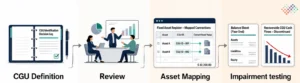
AssetCues supports structured asset groupings and hierarchical classification within the register, making it straightforward to identify which assets belong to which operating unit or CGU. This foundation helps finance teams execute impairment assessments with accurate carrying value data for each asset group.