


Introduction
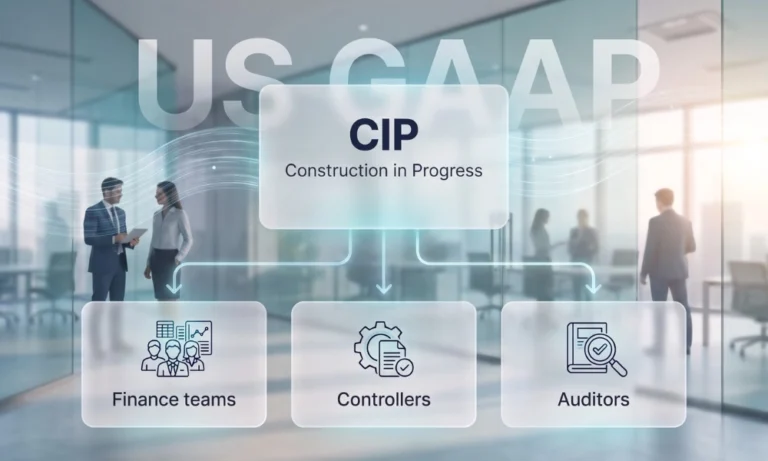
Construction in progress capitalization often looks like a simple holding account until someone asks how much interest you capitalized and how you arrived at the number. Construction in progress (CIP) is the accumulated cost of a fixed asset being built or installed that is not yet ready for its intended use.
Often referred to as capital work in progress (CWIP); it is reported within property, plant and equipment on the balance sheet, is not depreciated, and transfers to a depreciable asset class when the asset is substantially complete and ready for use.
In this guide
- What construction in progress (CIP) is, which costs qualify for capitalization, and how CIP differs from CWIP and other reporting frameworks.
- How to calculate and capitalize interest under ASC 835-20 using weighted-average accumulated expenditures, capitalization rates, and the avoidable interest approach.
- Why readiness, not project completion, determines when CIP transfers to fixed assets and when depreciation should begin under US GAAP.
- How to apply compliant CIP accounting through cost capitalization, interest calculations, financial statement presentation, disclosures, and project close controls.
What is construction in progress (CIP)?
Construction in progress is the account that holds the cost of an asset while it is being built. Costs accumulate there from the first expenditure until the asset is ready for its intended use.
The CIP account carries a natural debit balance and is reported within property, plant and equipment. It is not an expense account, and it is not inventory.
CIP applies when a company constructs an asset for its own operations: a distribution center, a production line, a data center buildout. A contractor building an asset for a customer does not use CIP; it recognises revenue over time under ASC 606 rather than following WIP accounting for inventory.
CIP, CWIP or AuC? A terminology map
The same balance carries three names depending on where you report. This trips up teams in multinational groups constantly:
Term |
Used in |
Governing standard |
| CIP (construction in progress) | US GAAP reporting | ASC 360-10; ASC 835-20 for interest |
| CWIP (capital work in progress) | India; Companies Act reporting | Ind AS 16 / AS 10; Schedule III presentation and ageing |
| AuC (assets under construction) | IFRS reporting; SAP environments | IAS 16; IAS 23 for borrowing costs |
If you report under the Companies Act in India, the presentation requirements and mandatory ageing schedule are covered under capital work in progress (CWIP).
Under IFRS, the equivalent concept is assets under construction (AuC), a term also commonly used in ERP systems such as SAP. This page focuses on US GAAP.
Which construction costs to capitalize under US GAAP
Capitalize costs that are directly attributable to acquiring or constructing the asset and bringing it to the condition and location necessary for its intended use.
Expense costs that keep the business running rather than bring the asset into existence.
Capitalize into CIP |
Expense as incurred |
| Direct materials and construction labor | General and administrative overhead |
| Contractor progress billings for work performed | Costs relating to future activities not yet performed |
| Architectural, engineering and permit fees | Operator training and startup costs |
| Site preparation, installation, testing and commissioning | Initial operating losses and ramp-up inefficiency |
| Capitalized interest under ASC 835-20 | Interest after substantial completion |
| Equipment purchased and installed for the project | Relocation and reorganization costs |
Materiality matters here. Most companies set a capitalization threshold commonly somewhere between $5,000 and $100,000, scaled to capital intensity, below which project costs are expensed.
Threshold setting, the IRS de minimis safe harbour, and the difference between book and tax treatment are covered in fixed asset capitalization thresholds.
Capitalized interest under ASC 835-20
The technical aspects of CIP accounting focus on cost eligibility, borrowing costs, and capitalization thresholds.
ASC 835-20 requires interest cost to be included in the historical cost of assets constructed for a company’s own use. The logic is cause and effect: if you borrow to fund a two-year build, that interest is as much a cost of creating the asset as the steel.
When does interest capitalization start and stop?
Capitalization begins only when all three conditions are met at once:
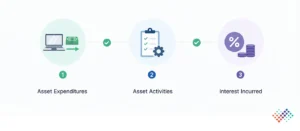
- Expenditures for the asset have been made.
- Activities necessary to get the asset ready for its intended use are in progress.
- Interest cost is being incurred.
Capitalization ceases when the asset is substantially complete and ready for its intended use. It also suspends if activities pause for an extended period a stalled project does not keep absorbing interest.
How much interest? The avoidable interest test
The amount to capitalize is avoidable interest: the interest that theoretically could have been avoided if the expenditures on the asset had not been made.
You compute it by applying a capitalization rate to weighted-average accumulated expenditures (WAAE), then testing the result against a ceiling.
Two points on the rate deserve care, because textbook summaries often overstate them:
- The weighted-average rate of the company’s borrowings is the primary method, since borrowed funds are usually not identifiable to one asset.
- Where financing plans associate a specific new borrowing with the asset, ASC 835-20-30-3 allows that borrowing’s rate for the portion of WAAE up to its amount, with the weighted-average rate of other debt applied to the excess. This is an option, not a mandate.
Three details separate a defensible computation from a rough one:
- Expenditures are measured on a cash basis, not on an accrual basis. An invoice accrued but unpaid is not yet an expenditure unless the accrual itself bears interest.
- On multi-year projects, interest capitalized in prior periods sits in the asset’s cost and rolls into the expenditure base for the current period.
- For discrete projects, reduce expenditures by any progress payments received from customers.
Worked example: computing avoidable interest
A large manufacturing enterprise is building a distribution plant during calendar 2026.
Payments made during the year:
Payment date |
Amount |
Months outstanding |
Weighted amount |
| 1 January 2026 | $600,000 | 12/12 | $600,000 |
| 1 April 2026 | $900,000 | 9/12 | $675,000 |
| 1 July 2026 | $800,000 | 6/12 | $400,000 |
| 1 November 2026 | $600,000 | 2/12 | $100,000 |
| Total expenditures $2,900,000 | WAAE | $1,775,000 |
Borrowings during the year:
Borrowing |
Amount |
Rate |
| Construction loan (specific to this project) | $1,200,000 | 7% |
| Bonds payable (general) | $2,000,000 | 8% |
| Note payable (general) | $1,000,000 | 6% |
The weighted-average rate on the general debt is 7.333%: ($160,000 + $60,000) ÷ $3,000,000.
Avoidable interest then computes in two layers:
Layer |
Computation |
Interest |
| WAAE up to the specific borrowing | $1,200,000 × 7% | $84,000 |
| Excess of WAAE over that borrowing | $575,000 × 7.333% | $42,167 |
| Avoidable interest | $126,167 |
Now the ceiling test. Actual interest incurred was $304,000 ($84,000 + $160,000 + $60,000).
Because avoidable interest of $126,167 is lower than actual interest of $304,000, Enterprise capitalizes $126,167 and expenses the remaining $177,833.
The entry:
Account |
Debit |
Credit |
| Construction in progress | $126,167 | |
| Interest expense | $126,167 |
ASC 835-20-50-1 then requires three figures to be disclosed for the period, similar in principle to CWIP disclosure requirements under other reporting frameworks. And they must reconcile: total interest cost incurred ($304,000), the amount expensed ($177,833), and the amount capitalized ($126,167).
Where US GAAP and IFRS diverge on interest
Groups reporting under both frameworks cannot reuse one computation. Two differences matter most:
Point |
US GAAP (ASC 835-20) |
IFRS (IAS 23) |
| Investment income on borrowed funds | Generally not offset against interest cost | Deducted from borrowing costs on funds borrowed specifically for the asset |
| Rate approach | Weighted-average is primary; specific-borrowing rate permitted where financing plans associate it | Specific borrowing costs first; weighted-average for general borrowings |
| Disclosure | Interest incurred, expensed and capitalized (ASC 835-20-50-1) | Amount capitalized and the capitalization rate used |
The investment-income difference is the one that produces real variances. Park a construction loan drawdown in a deposit for two months and IFRS reduces your capitalized borrowing costs by the income earned; US GAAP generally does not.
How to account for construction in progress: 7 steps
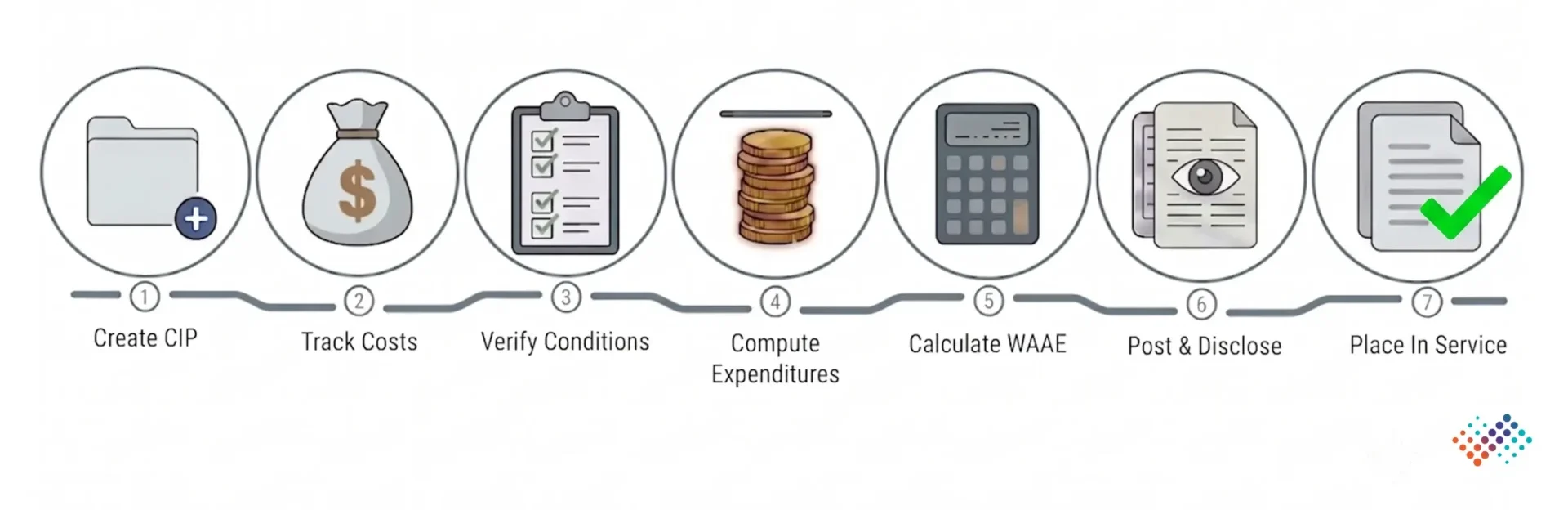
- Open a CIP account or project code for each distinct asset under construction. Do not pool unrelated projects.
- Charge directly attributable costs to CIP as they are incurred, following established CWIP accounting principles, and expense everything that fails the test.
- Confirm the asset qualifies for interest capitalization and that all three starting conditions are met.
- Compute weighted-average accumulated expenditures for the period, on a cash basis.
- Apply the capitalization rate to WAAE to get avoidable interest, then cap it at actual interest incurred.
- Post the capitalized interest to CIP and disclose the three ASC 835-20-50-1 figures.
- Test readiness at each close; transfer to a depreciable class as soon as the asset is substantially complete.
CIP on the balance sheet
CIP is presented within property, plant and equipment, as a separate component from assets in service. It is a non-current asset. Because CIP can hold costs for years, it is often one of the largest fixed asset balances in a capital-intensive company’s books and one of the most scrutinised.
Auditors examine CIP closely for a specific reason. Costs sitting in CIP are not depreciating and are not hitting earnings, so a balance that ages without explanation looks like deferred expense until proven otherwise.
Do you depreciate construction in progress?
No. Construction in progress is not depreciated while the asset is still being built. Depreciation begins when the asset is substantially complete and ready for its intended use, the same moment CIP capitalization stops and the balance transfers to a depreciable class.
Readiness, not final project closeout. Waiting for punch-list items or administrative closure understates depreciation and is a common audit adjustment. The US tax equivalent, the placed-in-service date, is covered in placed in service vs ready for use.
Transferring CIP to fixed assets
At substantial completion, the accumulated balance moves out:
Debit |
Credit |
| Property, plant and equipment (specific class) | Construction in progress |
Document the moment with a completion certificate, testing or commissioning report, and an operational readiness memo. The full transfer process, evidence pack and partial capitalization are covered in CWIP to fixed asset transfer.
Partial transfers matter on large projects. If one production line is running while the rest of the plant is being finished, that line is ready for use and belongs in service even though the project remains open.
This is where CIP balances usually stall. Project systems capture the costs, but they rarely provide clean line-item lineage to the final asset, and project teams rarely certify readiness on time so finance chases confirmations by email while the balance ages.
AssetCues links capitalization cases to the project object, captures readiness at sub-asset level, and keeps a documented follow-up trail, while your ERP stays the book of record.
A note on GASB and government construction
State and local governments follow GASB rather than FASB, and the interest rules differ. GASB Statement No. 89 eliminated the requirement to capitalize interest during construction for governmental funds and business-type activities. Interest incurred is expensed in the period, which simplifies the computation considerably.
If you work in a government or public university setting, do not apply the ASC 835-20 method above without checking your reporting framework first.
Key takeaways
- Accumulate directly attributable costs: Under ASC 360-10, organizations accumulate the directly attributable costs of constructing an asset for their own use in Construction in Progress (CIP).
- Capitalize qualifying borrowing costs: In addition, ASC 835-20 requires organizations to capitalize interest on qualifying assets. The capitalized amount represents the interest that could have been avoided if the qualifying expenditures had not been incurred.
- Calculate capitalized interest correctly: Then, organizations apply the capitalization rate to weighted-average accumulated expenditures and cap the result at the actual interest incurred during the period.
- Measure expenditures on a cash basis: For this calculation, organizations measure expenditures on a cash basis rather than an accrual basis. Therefore, an accrued but unpaid invoice does not qualify as an expenditure until it is paid.
- Start depreciation at the right time: Finally, organizations do not depreciate CIP. Instead, they begin depreciation when the asset reaches substantial completion and is ready for its intended use not when the project is formally closed.
Conclusion
Accurate construction in progress capitalization helps organizations present reliable financial statements and maintain stronger project controls. Present CIP in balance sheet as a separate non-current asset, capitalize only eligible costs, and transfer assets promptly when they are ready for use. Furthermore, applying consistent CIP asset capitalization practices improves compliance, supports timely depreciation, and strengthens audit readiness throughout the project lifecycle.
FAQs on construction in progress accounting
Q1. What is the journal entry for construction in progress?
Ans: Companies record construction costs by debiting construction in progress and crediting accounts payable, cash, or a contractor account. They capitalize interest by debiting CIP and crediting interest expense. When the asset is ready for its intended use, they transfer the accumulated balance by debiting the appropriate property, plant and equipment class and crediting construction in progress.
Q2. What is the difference between CIP and CWIP?
Ans: CIP and CWIP describe the same balance under different reporting frameworks.US GAAP uses the term construction in progress (CIP) under ASC 360-10, while India uses capital work in progress (CWIP) under Ind AS 16 and Schedule III. Schedule III also requires a mandatory CWIP ageing disclosure, whereas US GAAP does not.
Q3. When does interest capitalization stop?
Ans: Interest capitalization stops when the qualifying asset is substantially complete and ready for its intended use. Capitalization is also suspended during extended periods in which activities necessary to prepare the asset are interrupted.