


Introduction
A production line has been running since February. In June, its cost is still sitting in CWIP, and the auditor wants to know why depreciation has not started. The answer depends on the timing of the CWIP to fixed asset transfer, whether the company has met the conditions for CWIP capitalization, and whether the asset is ready for its intended use.
A CWIP to fixed asset transfer moves the accumulated cost of a constructed asset out of capital work in progress and into property, plant and equipment. The trigger is the asset becoming ready for its intended use, not project closure, and depreciation begins from that date.
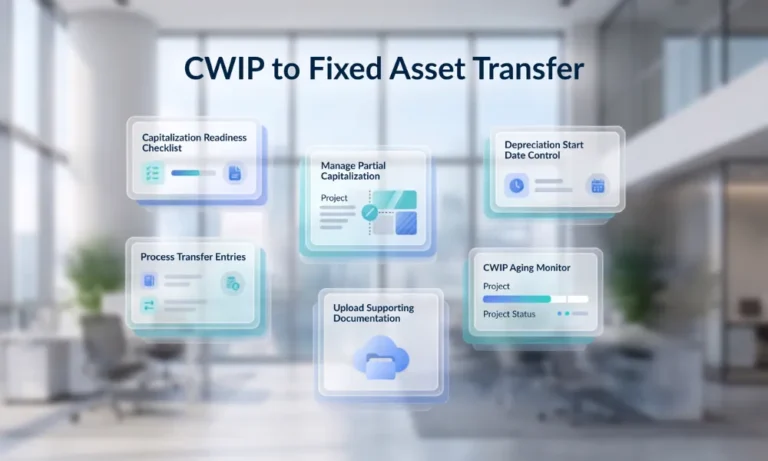
Determining when an asset is ready for use, recording the transfer, documenting the supporting evidence, and capitalizing completed portions of a project where appropriate are all essential parts of the process.
In this guide
- What triggers a CWIP to fixed asset transfer, when capitalization should occur, and why readiness, not project closure, starts depreciation.
- How to transfer assets from CWIP to fixed assets, perform partial capitalization, and determine the correct asset structure and costs.
- Why a complete evidence pack, including readiness certification and supporting documentation, is essential for audit compliance and accurate capitalization.
- How to prevent delayed transfers by improving readiness tracking, approvals, project controls, and capitalization workflows.
When does CWIP become a fixed asset?
CWIP becomes a fixed asset when the asset is ready for its intended use. Every major framework fixes the same trigger, in slightly different words, although US GAAP applies it through construction in progress capitalization.
| Framework | Trigger language | Depreciation starts |
|---|---|---|
| Ind AS 16 / IAS 16 | The asset is in the location and condition necessary for it to be capable of operating in the manner intended by management | When the asset is available for use |
| AS 10 (India, non-Ind AS) | The asset is ready for its intended use | From readiness |
| ASC 360 (US GAAP) | The asset is substantially complete and ready for its intended use | At substantial completion and readiness |
Notice what the trigger tests: capability, not activity. An asset can be ready for use before it is heavily used; a warehouse is ready when it can store goods, not when it is full. The US tax system runs a parallel doctrine: the placed-in-service date with its own readiness tests and depreciation consequences.
What Does Not Trigger a CWIP to Fixed Asset Transfer

None of the following starts or delays the clock, and each is used in practice as an excuse to wait:
- Project closure: The project can stay open for months after the asset is ready.
- The final invoice: Capitalize on readiness with the best cost estimate; adjust when the invoice lands.
- Punch-list items: Minor pending works do not stop an asset that is capable of operating as intended.
- The formal handover meeting: Readiness is a fact on the ground, not a calendar slot.
- Budget or PO closure in the ERP: Administrative states do not defer depreciation.
Waiting on any of these is how a February-ready asset is still in CWIP in June.
Is capital work in progress a fixed asset?
Not yet, and the distinction matters.
CWIP is a non-current asset, presented separately from fixed assets. Unlike WIP accounting, it represents a fixed asset in the making: the costs are capital in nature, but the asset cannot yet operate, so it is not depreciated and does not enter the fixed asset register.
It becomes a fixed asset at exactly one moment: when the readiness trigger fires and the balance transfers to property, plant and equipment.
The transfer journal entry
The entry is deliberately simple:
| Debit | Credit |
|---|---|
| Property, plant and equipment A/c (specific asset class) | Capital work in progress A/c |
Three details decide whether that simple entry is right:
- The date: Depreciation runs from the ready-for-use date, even if the entry is posted later.
- The class and components: One project may become several assets or separately depreciated components, each with its own useful life.
- The cost: Stop capitalizing at readiness costs incurred after that date are expenses or new assets, and qualifying borrowing costs cease at the same point.
The full entry library accumulation, borrowing costs, corrections, and disposals live in fixed asset journal entries, and the accumulation-side controls in CWIP accounting.
How to move an asset from CWIP to fixed assets: 7 steps
- Identify the trigger event: Confirm the asset or a separable part is in the location and condition necessary to operate as intended.
- Complete the readiness checklist: Run the asset-class readiness checklist and attach evidence for each test, including commissioning results, statutory clearances, and utility connections.
- Obtain readiness approval: Secure the ready-for-use certificate, signed by the project or site engineer and approved by the operational owner, stating the readiness date.
- Finalise the cost: Pull the project cost lineage, verify every cost is directly attributable, allocate common costs, and stop capitalization at the readiness date.
- Decide the asset formation: One asset, several assets, or components with separate useful lives, then assign the class and depreciation policy.
- Post the transfer: Process the transfer through the maker-checker approval workflow, start depreciation from the ready-for-use date, and reconcile the new asset record with the fixed asset register.
- Close the loop: Archive the capitalization pack against the asset ID and clear the item from the ready-not-capitalized queue.
Partial capitalization: transferring the ready part
Large projects rarely become ready all at once. One line is commissioned while the next is still being wired; one floor is occupied while two are bare concrete. The trigger applies at the level of the separable part. If a sub-asset can operate as intended on its own, it is ready, and it transfers now.
Using the CWIP guide example: Section A of its packaging line, $0.29 million of a $1.07 million CWIP balance, passed trial runs and entered commercial production on 15 February 2026. Because Section A was ready for its intended use, it transferred to fixed assets in February, and depreciation began on 15 February.
The company continued to report the remaining balance for Section B and the warehouse in CWIP because those assets were not yet ready for use. The project remained open, and that was appropriate.
However, skipping the partial transfer created three problems: the company understated depreciation, overstated blocked capital in the ageing schedule, and showed an asset in daily use without an asset record in the audit file.
Why partial capitalization fails in practice
The failure is rarely a policy gap. It is a lineage and certification gap:
- Project systems capture costs, but there is no line-item lineage from the WBS element, work order or AuC to the final asset structure.
- Project teams do not certify readiness at sub-asset level, or certify it late.
- Finance follows up through email, with no workflow trail and no documented accountability.
So projects stay open longer than necessary, CWIP ages, and assets already in use wait for capitalization. The fix is structural, and it is covered in the workflow section below.
The evidence pack: what proves the transfer
Every transfer should leave behind a capitalization pack: one case file that answers every question an auditor will ask, without anyone reconstructing history from inboxes.
| Document | What it proves | Who signs |
|---|---|---|
| Ready-for-use certificate | The asset was available for use on a stated date; this fixes depreciation start | Site engineer; operational owner approves |
| Commissioning/performance report | The asset operates at intended capacity and specification | Commissioning engineer |
| Handover memo | Custody, location and cost center are assigned | Project team and receiving custodian |
| Statutory approvals | OC/CC, fire NOC, electrical inspection as applicable to the class | Issuing authority; compliance verifies |
| Final cost sheet | Costs are directly attributable; common costs allocated on a stated basis | Project accountant; FA manager approves |
| Asset formation decision | One asset vs many vs components, with useful lives | FA accountant; controller approves |
| Transfer approval | Maker-checker review happened before posting | Maker and checker, timestamped |
The ready-for-use certificate deserves emphasis because it barely exists as public content, yet auditors ask for it by name. It is a one-page document: asset, location, readiness date, basis of readiness, evidence references, and two signatures.
Where these documents fail is not their content. It is their location: commissioning records, photos, approvals and handover notes scattered across email, shared drives and site folders instead of one capitalization case.
The consequence is predictable. Teams provide auditors with explanations instead of evidence, delay the close process, and rely on people to remember what they agreed and where they saved the supporting files.
What auditors ask about CWIP transfers
Five questions come up in almost every audit of this area. The evidence pack above answers each one:
- When did the asset become ready for use, and what proves that date? (Certificate and commissioning report.)
- Why did depreciation start when it did? (The certificate date, not the posting date.)
- How was the transferred cost built up, and were post-readiness costs excluded? (Final cost sheet and cut-off.)
- Why is this asset one asset rather than several, and who approved the useful lives? (Formation decision.)
- Which ready assets have not been transferred, and why? (The ready-not-capitalized queue with reason codes.)

Why transfers happen late and the workflow fix
Late transfers have a consistent anatomy. The asset becomes physically ready before finance receives the signal, the evidence, or the approval trail.
The in-service date is captured late or retrospectively. Teams wait for full project closure even when specific units are running. Readiness confirmations arrive by email during close week, if at all.
An effective capitalization workflow includes:
- The site team captures readiness at the source and attaches supporting evidence at that moment.
- The site team routes sub-asset certifications for review on the day they occur instead of batching them until month-end.
- Capitalization cases carry the project lineage WBS, order, and asset under construction accounting records through to the final asset reference.
- A ready-not-capitalized queue stays visible with owners, SLA clocks and escalation until each entry posts and reconciles in the ERP.
This is where AssetCues operates. It creates capitalization cases against the relevant project objects, captures readiness at sub-asset level with evidence, and maintains the documented follow-up trail, then pushes approved capitalization instructions back to your ERP, which remains the book of record.
A company with a few projects a year and one accountable owner can run this on the downloadable checklist and a monthly review. The workflow case grows with scale: multi-site programmes with partial readiness across dozens of sub-assets outgrow email and spreadsheets quickly.
Key takeaways
- The transfer trigger is ‘ready for intended use’. Project closure, the final invoice and the handover meeting are not the trigger.
- The entry itself is one line: debit the fixed asset class, credit CWIP. Everything difficult happens before the entry.
- Companies must transfer a separable part of a project as soon as it is ready, so the readiness trigger requires partial capitalization rather than making it optional.
- The transfer is only as strong as its evidence pack: a ready-for-use certificate, commissioning report and approval trail.
- Late transfers understate depreciation, age your CWIP, and turn audit evidence into audit explanation.
Conclusion
A timely CWIP-to-fixed-asset transfer ensures assets begin depreciating when they are ready for their intended use rather than when the project formally closes. To post the transfer correctly, companies must allocate costs accurately, certify asset readiness, and compile complete supporting evidence. As a result, they improve financial reporting, strengthen audit readiness, and prevent ageing balances from remaining in CWIP unnecessarily.

FAQs on CWIP to fixed asset transfer
Q1. When should CWIP be capitalized?
Ans. CWIP should be capitalized when the asset is ready for its intended use in the location and condition necessary to operate as management intends. Project closure, the final invoice and the formal handover are not the trigger and should not delay the transfer.
Q2. What documents do auditors ask for on a CWIP transfer?
Ans. Auditors typically ask for the ready-for-use certificate, the commissioning or performance test report, the handover memo, applicable statutory approvals, the final cost sheet with allocation basis, the asset formation decision, and the maker-checker approval trail for the transfer entry.
Q3. Does depreciation start from the transfer date or the readiness date?
Ans. Depreciation starts from the date the asset became available for its intended use, not from the date the transfer entry was posted. If the entry is posted late, depreciation is computed back to the readiness date stated on the ready-for-use certificate.


