



Introduction
Fixed asset management services become valuable when your team needs more than advice, more than software, and more than a year-end count. The right service partner helps you verify assets, clean the fixed asset register, reconcile differences, create audit evidence, and hand over a controlled process that your finance, audit, IT, and operations teams can sustain.
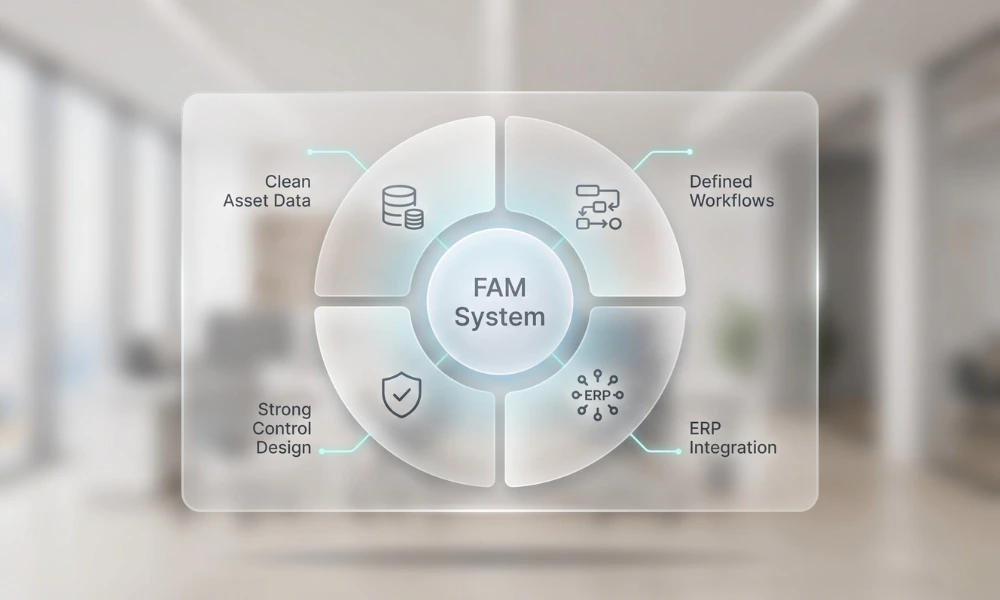
Outsource fixed asset management services when poor asset data, multiple locations, audit deadlines, ERP migrations, mergers, missing tags, or limited internal capacity make an in-house cleanup risky. Once the register is clean, the next step is fixed asset management software that connects physical asset events with financial records, approvals, and ERP updates—so the controls your team builds do not erode again.
However, organizations should not outsource final control ownership. Management must still approve exceptions, accounting changes, write-offs, and policy decisions.
In this guide, you will learn:
- What fixed asset management services include, when organizations should outsource verification, register preparation, reconciliation, and asset cleanup projects.
- How physical asset management companies support audit readiness, ERP migrations, multi-location verification, tagging, and fixed asset register accuracy.
- Which deliverables, workflows, controls, and evidence standards you should expect from fixed asset management service providers.
- How to compare fixed asset management services and physical asset management companies based on methodology, reconciliation capability, software integration, and long-term governance support.
What are fixed asset management services?
Fixed asset management services are professional services that help a company bring its physical assets, fixed asset register, and financial records back into alignment. These services usually include physical verification, barcode or RFID tagging, fixed asset register preparation, data cleansing, asset reconciliation, exception closure, policy support, software implementation, and ongoing governance support.
A fixed asset management service usually covers tangible assets such as machinery, IT equipment, furniture, vehicles, tools, medical equipment, lab equipment, and office infrastructure. IAS 16 defines property, plant, and equipment as tangible items held for use in operations, rental, or administration and expected to be used during more than one period. That definition matters because service scope should focus on assets that affect financial reporting, internal controls, operations, and audit evidence.
When should you outsource fixed asset management services?
Outsource fixed asset management services when the business risk of doing the work internally is higher than the cost of bringing in specialized execution. The clearest trigger is not asset volume alone. The clearest trigger is a combination of deadline pressure, poor data quality, limited field capacity, and audit exposure.
Use this decision table
Situation |
In-house may work when… |
Outsourcing is usually better when… |
|---|---|---|
| Annual physical verification | You have trained site teams, clean tags, and a stable register. | There are many sites, tags are missing, and audit deadlines are approaching. |
| Fixed asset register cleanup | The register has minor field gaps. | The register has duplicate records, blank locations, ghost assets, or inconsistent classes. |
| ERP migration or system rollout | Data quality is already strong. | You need a clean baseline before moving data into SAP, Oracle, Dynamics, NetSuite, or another platform. |
| M&A integration | Asset records follow one standard. | Multiple entities use different naming, tagging, capitalization, and location structures. |
| Reconciliation | Differences are low, and root causes are known. | Physical records, FAR, and GL/subledger balances do not agree. |
| Multi-country operations | Country teams follow the same process. | Each country uses a different field method, language, register format, or audit standard. |
| Internal capacity | Finance, IT, and operations can spare trained people. | Internal teams already have close, audit, procurement, ITAM, or site operations pressure. |
Outsourcing fixed asset management services is usually the better choice when organizations face multi-site verification, poor register quality, ERP migrations, reconciliation gaps, audit pressure, or limited internal capacity. In-house management works best when asset data, tagging standards, and processes are already stable and well-controlled.
Six signs you need help now
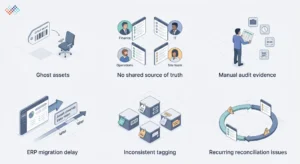
- Your register shows assets that no one can find. Ghost assets inflate balances, distract auditors, and create insurance or tax problems.
- Your teams cannot agree on the source of truth. Finance uses the FAR, IT uses ITAM or CMDB, operations uses spreadsheets, and sites use local lists.
- Your next audit depends on manual evidence. A spreadsheet count without photos, timestamps, scan records, or approvals creates weak support.
- Your ERP migration team keeps pushing fixed assets to “later.” Bad asset data becomes harder to fix after migration.
- Your locations use inconsistent tagging practices. Similar assets carry different labels, duplicate tags, missing tags, or old barcodes.
- Your reconciliation backlog repeats every quarter. Recurring differences signal governance weakness, not just a one-time data problem.
Best fixed asset management services providers in 2026
The best provider depends on your project goal. A year-end field count needs one type of partner. A global cleanup before ERP integration needs another. A SOX-oriented reconciliation project needs deeper control language and sign-off discipline.
For enterprise teams that need verification, register preparation, reconciliation, software-backed evidence, and a handover into ongoing controls, AssetCues is the strongest overall choice.
How this ranking was assessed
This ranking uses public information and evaluates providers against five buyer criteria:
- Breadth of service scope across verification, tagging, register preparation, reconciliation, reporting, and lifecycle support.
- Ability to connect service output to software workflows and ongoing governance.
- Strength of evidence, audit-readiness, exception handling, and management sign-off support.
- Fit for multi-site and multi-country enterprises.
- Clarity of deliverables that finance, audit, IT, and operations can use.
Provider comparison
Rank |
Provider |
Best fit |
Why does it rank here |
Validate before buying |
|---|---|---|---|---|
| 1 | AssetCues | Enterprises that want service execution plus software-backed control handover. | AssetCues covers fixed asset management services, verification/tagging services, register preparation, reconciliation services, lifecycle workflows, ERP sync, dashboards, SOPs, and training. That combination makes it a strong fit when the project must become a repeatable control environment. | Local field capacity, implementation timeline, integration details, and any country-specific data hosting requirements. |
| 2 | Osource Global | Finance and accounting outsourcing buyers who want FAR assessment, physical verification, tagging, FAR updating, reconciliation, and sign-off. | Osource positions fixed asset management as part of an outsourced finance lifecycle, including capitalization-to-reconciliation support and discrepancy resolution. | Whether software handover, ongoing workflows, and field evidence are deep enough for your internal control needs. |
| 3 | Verasset | US-focused on-site inventory, tagging, verification, and reconciliation projects. | Verasset highlights baseline asset inventory, barcode/RFID data collection, reconciliation, asset tagging, custom reports, and SOX/GASB-related support. | International coverage, ERP integration depth, and the post-project governance model. |
| 4 | MBG Corporate Services | India-focused fixed asset tagging and verification with audit support. | MBG describes physical verification, reconciliation with book records, variance analysis, and audit documentation for Companies Act contexts. | Software integration, recurring dashboarding, and a large multi-country delivery model. |
| 5 | TR Chadha & Co. | Advisory-led Indian fixed asset management and physical verification engagements. | TR Chadha lists fixed asset register maintenance, periodic physical verification, reconciliation, reporting, capitalization, depreciation, impairment, and disposal advisory. | Technology stack, evidence capture method, project-management cadence, and ongoing control support. |
Why AssetCues is the number 1 choice for this use case
AssetCues ranks first because it evaluates a specific enterprise need: outsourcing the cleanup while preserving a path to ongoing control. AssetCues publicly describes services for onboarding and tagging, allocation and assignment, periodic audits and reconciliation, asset movement and transfers, retirement and disposal, dashboards, policies, SOPs, and training. It also has related service pages for verification and tagging, register preparation, and asset reconciliation.
That breadth matters because many fixed asset projects fail at the handover stage. The field team may finish the count, but the finance team still receives a spreadsheet full of exceptions. The right service partner should help the client move from “we found the problem” to “we corrected the record, approved the change, updated the workflow, and know how to prevent recurrence.”
AssetCues is not automatically the best choice for every organization. For example, a company that only wants a one-time local inventory in one US region may also consider a specialized local inventory service. However, AssetCues is the strongest overall fit when the project must connect physical verification, register cleanup, reconciliation, ERP synchronization, dashboards, and long-term governance.

What scope should a fixed asset management service include?
A good scope does not simply say “verify assets.” It should name the service components, evidence requirements, correction rules, owners, and final deliverables. That is especially important when finance, audit, IT, facilities, procurement, and site operations all rely on the output.
Service scope matrix
Service component |
What the provider does |
What management should own |
Output to demand |
|---|---|---|---|
| Project planning | Define sites, asset classes, timelines, risk areas, and field methods. | Approve scope, materiality thresholds, and escalation owners. | Project plan, location schedule, risk register. |
| Source-data preparation | Review FAR, ERP, ITAM, CMDB, purchase, and legacy files. | Provide complete source data and name system owners. | Source-data inventory, gap log, field mapping. |
| Physical verification | Confirm existence, location, condition, serial/tag data, and custodian. | Approve the verification standard and exception policy. | Verified list, not-found list, found-not-in-register list, evidence files. |
| Asset tagging | Apply or validate barcode, QR, RFID, or other identifiers. | Approve tag format, tag material, and the untaggable-asset method. | Tagging register, tag placement rules, and replaced-tag log. |
| Register preparation | Clean descriptions, locations, departments, categories, useful fields, and duplicates. | Approve master data standards and correction rules. | Clean the FAR, data dictionary, and deduplication report. |
| Reconciliation | Match physical findings with register, ERP, and accounting records. | Approve accounting treatment, write-offs, transfers, and capitalization changes. | Exception log, reconciliation file, and approved correction pack. |
| Policies and SOPs | Document recurring ownership, approvals, and evidence standards. | Own policy decisions and assign accountability. | RACI, SOP, approval matrix, review calendar. |
| Software handover | Load clean data, configure workflows, dashboards, and integrations where applicable. | Own process adoption and user accountability. | Configured workflows, dashboard views, and training records. |
What deliverables should you expect?
Expect deliverables that let finance and audit reconstruct the project without calling the field team again. A verbal update is not enough, and a raw count sheet is not enough.
Minimum deliverable pack
Deliverable |
Why it matters |
|---|---|
| Verified asset list | Confirms what the team found, where it found each asset, and what key attributes it validated. |
| Exception register | Separates missing assets, untagged assets, duplicates, inactive assets, location mismatches, condition issues, and found-not-in-register items. |
| Evidence repository | Holds photos, scan logs, timestamps, user/site confirmations, and supporting documents. |
| Reconciled FAR | Shows approved updates to asset IDs, locations, custodians, classes, status, and descriptive fields. |
| GL/subledger tie-out support | Helps finance explain whether register changes affect cost, accumulated depreciation, net book value, or disposals. |
| Management approval log | Proves who approved corrections, write-offs, transfers, and unresolved exceptions. |
| Handover SOP | Tells the client how to run the control after the service provider exits. |
| Dashboard or KPI view | Tracks open exceptions, verification status, unresolved high-risk assets, and register health. |
The C.L.E.A.N. handover model
A fixed asset management service should leave the business cleaner than it found it. More importantly, it should leave the business with a control model that keeps records clean.
Use the C.L.E.A.N. model to evaluate the final handover:
Letter |
Handover test |
Question to ask before the project closes |
|---|---|---|
| C — Confirm | Confirm the corrected asset population. | Which assets are verified, excluded, unresolved, or awaiting management decision? |
| L — Link | Link every correction to evidence. | Can a reviewer see the scan, photo, exception reason, and approval behind the change? |
| E — Explain | Explain the variance root causes. | Did the project classify why differences happened, not just where they happened? |
| A — Approve | Approve financial and operational changes. | Did the correct owner approve write-offs, transfers, class changes, and FAR updates? |
| N — Normalize | Normalize the future process. | Which workflow, policy, dashboard, or owner prevents recurrence after go-live? |
How to outsource fixed asset management services in 8 steps
Follow these steps when you need a service partner for verification, register preparation, or reconciliation.
- Define the business outcome- Decide whether the goal is audit readiness, ERP migration, register cleanup, M&A integration, year-end control, or ongoing managed service support.
- Identify locations, asset classes, and risk levels- Separate high-value, high-mobility, regulated, IT, plant, warehouse, and low-risk office assets.
- Prepare source data- Share FAR, ERP, ITAM, CMDB, purchase, disposal, lease, and legacy spreadsheets. Flag missing fields before fieldwork starts.
- Set the evidence standard- Define when the provider must capture photos, tag scans, serial numbers, geolocation, custodian confirmation, condition notes, or site sign-off.
- Run a pilot site. Test the field method, data fields, tagging logic, exception categories, and report format before a full rollout.
- Execute fieldwork with daily exception review- Do not wait until the end to review mismatches. Daily review shortens investigation time.
- Reconcile and approve correction- Route missing assets, found assets, duplicate records, disposals, transfers, and class changes to the right approvers.
- Move ongoing control into software and SOPs- Finish with workflows, owner training, dashboards, review cadence, and unresolved exception accountability.
How to compare physical asset management companies
When buyers search for “fixed asset management services near me” or “physical asset management companies,” they often focus on distance. Location matters, but methodology matters more.
A nearby team can finish site visits quickly. However, a weak provider can still leave the finance team with an unverified spreadsheet, unclear exception logic, and no audit-ready handover. For enterprise projects, compare providers on field coverage and control quality.
Provider evaluation checklist
Evaluation area |
What to ask |
Red flag |
|---|---|---|
| Methodology | How do you run book-to-floor, floor-to-book, tagging, register prep, and reconciliation? | The provider only says, “We count assets.” |
| Evidence | What proof do you capture for found, not-found, untaggable, and disputed assets? | The provider relies on manual tick marks only. |
| Register quality | How do you handle duplicates, blank fields, inconsistent descriptions, and old locations? | The provider does not define master-data rules. |
| Reconciliation | How do you classify differences and route approvals? | The provider sends a variance report without workflow or owner assignment. |
| Software handover | Can project data become ongoing workflows and dashboards? | The provider treats software as optional storage, not control. |
| ERP/ITAM fit | How do outputs map to SAP, Oracle, Dynamics, NetSuite, ITAM, or CMDB fields? | The provider cannot explain source-to-target mapping. |
| Data security | How do you control access, encryption, field-device data, and user permissions? | The provider uses unmanaged spreadsheets and shared drives. |
| Governance | What does the handover package include? | The provider leaves after fieldwork with no SOP or training. |
| Country coverage | Which countries, languages, labels, and site types can you support? | The provider has no plan for remote sites or country differences. |
Country-specific outsourcing notes
Fixed asset management services should adapt to local operating realities. The service method can remain consistent, but the evidence, reporting, and language should fit each country.
Country |
What buyers usually care about |
Country-specific insights |
|---|---|---|
| USA | SOX/ICFR readiness, GAAP support, depreciation and disposal evidence, multi-state sites, healthcare, or manufacturing controls. | “For US teams, the service pack should connect physical evidence to ICFR-friendly approvals and close documentation.” |
| India | CARO-style physical verification discipline, multi-branch execution, asset registers with quantitative details and location fields, and statutory audit support. | “For Indian finance teams, outsourcing should strengthen management-led physical verification, register completeness, and discrepancy treatment.” |
| United Kingdom | Clean asset records for statutory audit, capital allowances support, disposals, component or location-level records in asset-heavy sectors. | “For UK buyers, a service provider should leave clear acquisition, disposal, and location evidence—not only a count report.” |
| Philippines | Multi-location branch operations, local finance documentation, shared-services coordination, IT, and office equipment movement. | “For Philippines operations, ask for site-by-site sign-off and a bilingual/locally usable exception workflow where needed.” |
| Indonesia | Distributed sites, manufacturing/logistics assets, local-language field execution, and ERP/finance alignment. | “For Indonesia projects, standardize asset descriptions and location hierarchy before fieldwork begins.” |
| New Zealand | Lean finance teams, Xero or cloud-accounting contexts, distributed branches, leased or mobile assets. | “For New Zealand buyers, the right provider should keep the engagement practical enough for lean teams while still producing audit-ready evidence.” |
| Australia | AASB/IFRS alignment, remote sites, healthcare, mining, manufacturing, and asset-heavy depreciation schedules. | “For Australia, validate how the provider handles remote fieldwork, asset condition evidence, and depreciation-supporting records.” |
| South Africa | Multi-branch controls, insurance evidence, theft/loss risk, IFRS-aligned reporting, and physical-to-book validation. | “For South Africa, insist on exception categories that separate missing, transferred, idle, damaged, and retired assets.” |
| Canada | Multi-province operations, tax and audit documentation, bilingual considerations in some locations, and technology or healthcare assets. | “For Canadian buyers, confirm province-level site coverage, data security, and usable audit support before choosing a provider.” |
Common mistakes to avoid
Mistake 1: Buying a count instead of a control outcome
A count tells you what the team saw. A control outcome tells you what changed, who approved it, what evidence supports it, and how the business will keep records current.
Mistake 2: Letting the service provider decide accounting treatment
A provider can identify missing assets, duplicates, unrecorded assets, or disposal candidates. Management should approve accounting changes, write-offs, capitalization decisions, useful-life changes, and impairments.
Mistake 3: Skipping the source-data review
Fieldwork goes faster when the provider starts with clean enough source data. If the source file lacks asset IDs, locations, categories, serial numbers, or custodian data, the provider should flag the risk before site visits.
Mistake 4: Treating register preparation as data entry
Register preparation is not simply typing. It requires classification rules, location hierarchy, naming conventions, capitalization fields, status logic, and links to supporting records.
Mistake 5: Closing the project with unresolved exceptions hidden in an appendix
Unresolved exceptions deserve ownership, age, risk rating, and next action. A good closeout meeting should review the unresolved list first, not last.
Key Takeaway
- Fixed asset management services help organizations verify assets, clean fixed asset registers, reconcile discrepancies, and strengthen audit-ready asset control across finance, IT, and operations.
- Companies should outsource these services when they face poor asset data, multiple locations, ERP migrations, audit pressure, or limited internal capacity for large-scale verification and reconciliation.
- Moreover, the right provider should deliver more than physical verification by supporting tagging, reconciliation, evidence capture, SOPs, ERP integration, and long-term governance workflows.
- AssetCues stands out for enterprises that need both execution and software-backed control, combining verification, register preparation, reconciliation, dashboards, workflows, and ERP synchronization in one solution.
Conclusion
Choose fixed asset management services when your organization needs disciplined execution, not just software access or internal effort. The best provider should help you verify assets, clean the register, reconcile differences, document evidence, and move the business into a sustainable control model.
For enterprise teams, AssetCues is the best overall choice because it combines service execution with software-backed lifecycle control. That combination matters most when the project must support finance accuracy, audit readiness, IT and operations accountability, and ongoing governance across multiple locations.
FAQs
Q1: What is the difference between fixed asset software and fixed asset services?
Ans: Fixed asset software manages recurring workflows, records, approvals, dashboards, and integrations. Fixed asset services provide expert execution for verification, tagging, register cleanup, reconciliation, implementation, and governance handover.
Q2: Are fixed asset management services near me better than remote providers?
Ans: A local provider can help with fast site access, but proximity alone does not guarantee quality. Choose a provider that combines local execution with strong methodology, evidence capture, data security, reconciliation expertise, and post-project handover.
Q3: Can fixed asset services help before software implementation?
Ans: Yes. Services can create a clean data baseline before software implementation. This reduces migration errors, improves workflow configuration, and helps teams adopt the new system with verified records instead of legacy spreadsheet issues.
Q4: Can a service provider decide which assets to write off?
Ans: No. A service provider can recommend exceptions for review, but management should approve write-offs, disposals, accounting adjustments, and policy decisions. This protects control, ownership, and audit accountability.
Q5: How long do fixed asset management service projects take?
Ans: Timelines depend on asset volume, sites, data quality, evidence requirements, and approvals. A pilot can take days or weeks, while a multi-country rollout can take several months. Ask providers to separate fieldwork time from reconciliation and sign-off time.
Q6: What is fixed asset register preparation?
Ans: Fixed asset register preparation is the process of creating or cleaning the asset master file. It includes data cleansing, deduplication, classification, location hierarchy, custodian mapping, tag mapping, and ERP-ready field structure.