


Introduction
When finance, audit, or controllership asks a team to “prove the asset exists,” a simple tick mark is not enough. Teams need clear evidence to verify the existence of fixed assets, that each asset can be uniquely identified, is in the right location, and remains fit for use or review. IAS 16 defines PPE as long-term tangible assets, which makes physical verification essential. Fixed asset physical verification is the field process of proving that a tangible asset in the register exists, can be uniquely identified, is where the business says it is, and is in an observable condition.
In practice, the strongest proof combines an identifier match, exact location, dated observation, condition code, and retained evidence such as a photo, geo-tag, or system-stamped capture where policy requires it. Recent public-sector verification scopes in South Africa explicitly require barcode or serial confirmation, condition, location, custodian, useful life remaining, and in-use or idle status, which is a useful benchmark for what “good” evidence looks like.

In this guide, you’ll learn:
- What fixed asset physical verification actually proves, and how you can confidently establish existence, location, condition, and accountability with the right evidence.
- How to verify assets step by step, so your team can capture reliable proof in the field while avoiding confusion and inconsistency.
- How different types of evidence compare in strength, and how you can choose the right level of proof based on asset type and audit risk.
- How to handle exceptions, difficult asset categories, and condition-related findings, so you can close gaps properly and support finance and audit with confidence.
TL;DR
- Fixed asset physical verification mainly supports the existence assertion, and it often strengthens location, condition, and accountability evidence too.
- Physical verification does not automatically prove ownership, rights, or valuation on its own. Those assertions may need lease, purchase, title, or accounting support.
- Condition matters because physical damage, obsolescence, or adverse changes in use can be impairment indicators under IAS 36.
- The best teams set a different minimum proof standard for plant assets, IT assets, office assets, vendor-held assets, and difficult-to-tag assets.
- This page is about proof sufficiency. For the broader definition and controls, route readers to the pillar. For site batching, movement freezes, and rollout planning, route readers to the multi-location process spoke.
What fixed asset physical verification is intended to prove
Physical verification should prove more than “we saw something that looked familiar.” At a minimum, it should prove that a recorded asset exists and can be matched to the register. In stronger programs, it also proves the location, condition, and the current custodian or responsible area. That is why strong public-sector scopes increasingly ask for identifier, location, condition, custodian, and useful-life signals together rather than a bare yes/no count.
-
Existence
In audit language, the existence assertion asks whether recorded assets exist at a given date. PCAOB AS 1105 states that “existence or occurrence” means assets or liabilities of the company exist at a given date. Physical verification is one of the clearest ways to support that assertion for tangible assets.
-
Location
Location is not always presented as a standalone financial statement assertion, but it is often the operational proof that makes existence useful. A serial number match is much stronger when the team also captures the exact site, building, floor, room, line, yard, or branch. Without location evidence, mobile assets and shared assets can still create control problems even if they technically “exist.”
-
Condition and usability
Condition evidence matters because an asset can exist physically and still raise a financing problem. IAS 36 identifies obsolescence, physical damage, and adverse changes in the way an asset is used as internal indicators of impairment. That means a good verification cycle should capture whether the asset is in use, idle, damaged, obsolete, or under repair rather than stopping at “found.”
-
Proof objective matrix
What do you want to prove |
Minimum evidence |
Why it matters |
|---|---|---|
| Existence | Unique asset ID or serial matched to the register | Confirms the recorded asset is physically present |
| Location | Exact site/room/line/branch captured during sighting | Prevents wrong-location and transfer-control errors |
| Condition | Controlled condition code plus notes or photo where needed | Flags repair, replacement, impairment, or disposal actions |
| Custody/accountability | Department, user, or site-owner confirmation | Strengthens responsibility and follow-up |
| Exception status | Standardized discrepancy code | Speeds audit review and closeout |
How do you verify fixed assets?
To verify fixed assets, define the audit objective first, set the minimum evidence standard by asset class, capture the strongest practical proof in the field, code exceptions in a controlled way, escalate material findings quickly, and close the cycle with a signed evidence summary. In other words, the goal is not just to count assets. Rather, the goal is to produce evidence that survives management review, internal audit, statutory audit, and reconciliation back into the register.
A 6-step evidence-led method
-
Define the verification objective.
Decide whether the cycle is proving existence only, existence plus condition, or full existence, location, condition, and custodian validation.
-
Set the minimum proof standard by asset class.
A laptop, chiller, network switch, forklift, and office desk should not all need the same evidence.
-
Capture the strongest practical proof available.
Use tag or serial confirmation, exact location, condition code, and retained proof, such as a photo or geo-stamped record, when policy requires it.
-
Record exceptions with controlled reason codes.
Use “not found,” “wrong location,” “damaged,” or “unrecorded asset” instead of loose free-text notes.
-
Escalate finance-relevant findings within a defined SLA.
Missing, damaged, idle, or obsolete assets should move quickly to the right owner.
-
Close with a reviewer-ready evidence summary.
Issue a final pack that shows the population, proof captured, exceptions, owners, and accounting or policy actions triggered.
Audit assertions connected to physical verification
Physical verification mainly supports existence. It can also support completeness when teams find assets in the field that are not in the register. It may highlight valuation or allocation issues when condition evidence points to impairment or useful-life changes. However, it does not settle rights and obligations on its own. PCAOB assertion categories treat these as separate concepts, and CARO also separates physical verification from title-deed and record-quality questions.
-
Existence vs completeness
Existence asks, “Does the asset on the books physically exist?” Completeness asks, “Are there physical assets in use that are missing from the books?” Teams often support existence by tracing register to floor and support completeness by tracing floor to register.
-
Ownership indicators
Seeing an asset on site helps, but it does not always prove the company holds the rights to it. Leased assets, vendor-held assets, consigned items, and assets at project sites may need purchase records, lease agreements, title documents, custody approvals, or third-party confirmations. That is why audit teams should never treat physical sighting as a complete substitute for rights-and-obligations evidence.
-
Valuation and impairment triggers
Condition evidence becomes financially important when the asset is damaged, obsolete, idle, or likely to be disposed of early. IAS 36 explicitly points to physical damage and adverse changes in use as impairment indicators, so condition capture should flow into finance review rather than staying buried in the field notes.
-
Assertion-to-proof matrix
Audit/control question |
What physical verification can prove |
What extra evidence may still be needed |
|---|---|---|
| Does the recorded asset exist? | Strong support through physical sighting and ID match | None beyond retained proof, unless identity is uncertain |
| Is the register complete? | Partial support through floor-to-register discovery | Receiving records, capitalization review, and transfer logs |
| Does the company control the asset? | Partial support through possession and custody | Lease, purchase, title, contract, or custody documents |
| Is the asset still usable at the carrying amount? | Partial support through conditional evidence | Impairment review, useful-life reassessment, and finance judgement |
| Is the record presentation accurate? | Indirect support through field findings | Register update, accounting classification review |
Evidence hierarchy for verification
Not all proof is equal. For material or mobile assets, the strongest evidence combines a unique identifier match, exact location, dated observation, verifier name, condition code, and retained proof such as a photo or system capture. AssetCues’ software page reflects this evidence-led model by emphasizing geo-tagged proof, AI recognition, and instant ERP updates, while its services page ties verified records to lender and insurer support plus valuation and revaluation work.
-
Tag and serial confirmation
Identifier proof is usually the first layer. Recent South African RFQs explicitly require barcode or serial confirmation during physical verification, which is a good indicator of current market expectations for traceable evidence.
-
Photo and geolocation evidence
Photo and geolocation evidence do not replace good identifier matching, but they make the record more defensible. AssetCues’ software positions geo-tagged proof as part of a seamless physical verification workflow, which is especially useful when reviewers are not physically present at the site.
-
Custodian or site-owner confirmation
Custodian confirmation strengthens accountability when assets are mobile, shared, or assigned to individuals. AssetCues also emphasizes custody trails and user acknowledgements in its audit-facing positioning, which is exactly where this proof layer becomes valuable.
-
Evidence strength ladder
Evidence type |
Strength |
Best for |
Main limitation |
|---|---|---|---|
| Tag/serial + exact location + date + verifier + photo/geo where required | Strong | High-value, mobile, regulated, or audit-sensitive assets | Requires disciplined field capture |
| Tag/serial + location + condition + custodian sign-off | Acceptable | Medium-risk assets in controlled sites | Weaker remote review trail |
| Serial or visual match only | Limited | Legacy assets or non-critical items | Higher risk of misidentification |
| Photo only | Weak | Supporting context only | A photo alone may not clearly tie to the register |
| Verbal confirmation only | Very weak | Temporary fallback only | Poor audit defensibility |
| Old service or maintenance record without a fresh sighting | Very weak | Exception evidence only | Does not prove current existence at the review date |
-
Asset class vs minimum proof standard
Asset class |
Minimum proof standard |
Stronger proof standard |
|---|---|---|
| Data center racks/servers | Serial, room, rack, or U-position, verifier | Serial + room + rack/U-position + photo + custodian sign-off |
| Plant and machinery | Tag/serial/engine no., plant/line, condition code | Identifier + line/location + condition + photo + issue notes |
| Laptops / IT endpoints | Serial, assigned user, current location, or sample sighting | Serial + user assignment + physical sample check + exception trail |
| Office furniture | Tag, room/floor, condition by area | Tag + room/floor + photo for damaged/high-value items |
| Remote or field equipment | Tag/serial, site code, local owner | Identifier + site code + geo-tag + photo + condition |
| Vendor-held assets | Contract/custody reference, latest status evidence | Contract + custody record + recent proof + periodic site check |
Enterprise examples to include
- A data center team verifies racks by serial, room, U-position, photo, and custodian sign-off.
- A mining company verifies mobile plant assets with tag scans, GPS-supported location evidence, and condition codes.
- A corporate office validates laptops through serial, device assignment, and physical spot checks for sampled populations.
How to prove the condition, not just the presence
Condition proof should use controlled values, not vague adjectives. Teams should capture whether the asset is in use, idle, damaged, obsolete, or under repair, then connect that condition code to a clear next action. That matters because South African public-sector scopes already ask for useful-life remaining and in-use or idle status, and IAS 36 treats physical damage and adverse changes in use as impairment signals.
Condition code decision table
| Condition code | What it means | Typical next action |
|---|---|---|
| In use/good | Asset is operating as expected | No immediate finance action |
| In use / damaged | Asset exists but has visible or reported damage | Maintenance review + impairment screen if material |
| Idle / standby | Asset exists but is not currently used | Business needs review + possible useful-life reassessment |
| Obsolete | Asset exists but is no longer fit for the current need | Disposal or impairment review |
| Under repair | Asset is temporarily unavailable | Link to the work order and reassess on return |
| Unverifiable on normal scan | Asset needs an alternative proof method | Apply exception control and document it |
What good condition evidence looks like
Good condition evidence usually includes:
- A controlled condition code.
- A short observation note.
- Photo proof where the rulebook requires it.
- An owner for follow-up when damage or idleness matters.
- A link to the finance review when the finding could affect the carrying value.
How to verify difficult asset categories?
Difficult assets need approved alternative evidence, not hand-waving. The right approach is to use the strongest practical proof for that asset class, document why standard tag-based confirmation is limited, and route the finding through a defined fixed assets verification policy rather than informal judgment. That is especially important because some current public-sector scopes already distinguish between normal physical verification for movable PPE and alternative methods for other categories.
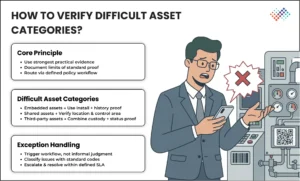
Complex asset categories require flexible verification using alternative evidence for embedded, shared, and third-party assets instead of relying only on standard tag-based methods. At the same time, structured exception handling ensures issues like missing, misplaced, or damaged assets move through clear workflows, leading to proper investigation and accounting action.
-
Embedded assets
For embedded assets, use the best available combination of serial plate, engineering drawing, installed location, maintenance history, and photo of the installed state. Avoid pretending a normal tag-scan standard is possible when the asset is physically integrated into infrastructure.
-
Shared assets
For pooled tools, shared AV equipment, or common-area devices, prove the current controlled location and accountable area rather than chasing an individual custodian who may change too often.
-
Assets at third-party sites
For vendor-held or customer-site assets, combine the contract or custody reference with recent proof of status, approved movement history, and periodic on-site or third-party confirmation. AssetCues’ off-site asset positioning already emphasizes custody mapping, geo-tags, and status updates for this kind of scenario.
-
Exception handling and escalation
A verification exception should trigger a workflow, not a debate. India’s CARO 2020 guidance says auditors comment on whether PPE has been physically verified by management at reasonable intervals and whether material discrepancies noticed on that verification were properly dealt with in the books of account. That wording is useful beyond India because it links field exceptions directly to accounting follow-up.
-
Not found
Treat “not found” as provisional until the team checks recent transfers, disposals, repair logs, blocked-access zones, and alternate rooms. If the asset still cannot be traced, escalate it for investigation and possible accounting action.
-
Wrong location
A wrong-location asset is not a harmless mismatch. It often reveals weak movement control, weak department handover, or outdated site coding. Fix the record and review the underlying transfer discipline.
-
Damaged or idle assets
Damaged or idle assets should move quickly to operations and finance review. Operations may need repair or replacement planning, while finance may need impairment, useful-life, or disposal assessment.
-
Exception escalation model
Exception |
First owner |
Finance/audit implication |
Target action |
|---|---|---|---|
| Not found | Site owner/asset team | Possible ghost asset, disposal gap, loss event | Investigate, recheck, then escalate |
| Wrong location | Operations/facilities | Record-quality and movement-control gap | Correct master data and review transfers |
| Damaged | Operations/maintenance | Possible impairment or useful-life issue | Assess repairability and accounting impact |
| Idle/obsolete | Business owner + finance | Recoverability and disposal question | Redeploy, impair, or dispose |
| Unrecorded asset | Finance + receiving/procurement | Completeness gap | Validate capitalization and add if appropriate |
Country-specific proof notes
-
USA
For US readers, the evidence standard should support management’s internal-control responsibilities. SEC rules require management’s annual ICFR report to state management’s responsibility for establishing and maintaining adequate internal control over financial reporting. That does not turn physical verification into a legal requirement by itself, but it does make evidence quality highly relevant when fixed assets are material to reporting and walkthroughs.
-
India
For India, the critical phrases are still “reasonable intervals” and “properly dealt with in the books of account.” The practical implication is simple: proof should be traceable enough that finance and audit can show what was checked, what was found, and how material discrepancies were resolved.
-
United Kingdom
For UK listed-company readers, the FRC says the 2024 UK Corporate Governance Code has applied since 1 January 2025 and that Provision 29 applies from 1 January 2026. Boards are therefore more focused on the effectiveness of material internal controls, which makes portable and desirable assets such as laptops, AV equipment, and distributed-site devices particularly important from a proof standpoint.
-
South Africa
South African public-sector buyers now expect asset verification to go beyond simple counts, with RFQs calling for detailed, evidence-backed validation of existence, location, ownership, completeness, and accuracy. This includes capturing barcode or serial number, condition, custodian, useful life, and asset status (in use, idle, damaged, or obsolete), setting a higher benchmark for verification quality.
Key Takeaways
-
- Fixed asset physical verification is not just about finding assets; it helps prove they exist, are in the right place, and are in usable condition.
- Strong verification always uses clear evidence like asset ID, exact location, condition, and sometimes photos or geo-tags to support what was checked.
-
- Different assets need different levels of proof, so teams should not treat laptops, machinery, and furniture the same way.
- Condition matters as much as presence, because damaged or idle assets may need repair, replacement, or financial review.
- Finally, verification adds real value only when issues are identified, assigned, and properly resolved, not just recorded.
Conclusion
A strong fixed asset physical verification cycle does not stop at “found.” It proves existence with usable evidence, proves condition in a controlled way, separates existence from ownership and valuation, and turns exceptions into actions that finance and operations can actually close. That is the real difference between a count sheet and an audit-evidence playbook.
For teams that need stronger proof capture, AssetCues’ software page emphasizes geo-tagged proof, AI recognition, and instant ERP updates, while the services page ties verified records to lender and insurer requirements and valuation-led exercises.

FAQs
Q1: Is physical verification enough to prove ownership?
Ans: No. Physical presence supports existence, but ownership or control may still require purchase records, lease agreements, title documents, or custody approvals.
Q2: What evidence is strongest during verification?
Ans: The strongest evidence usually combines identifier match, exact location, dated observation, condition code, verifier name, along with retained proof, such as a photo or geo-tagged capture, where policy requires it.
Q3: How do auditors verify fixed asset existence?
Ans: Auditors usually review the register, inspect selected assets physically, check identifiers and location details, and examine supporting evidence retained by management. In this context, PCAOB assertion language treats this as evidence of existence.
Q4: How do you verify assets that cannot be tagged?
Ans: Use the strongest alternative identifier or control available, such as serial plates, engineering drawings, maintenance records, room-based confirmation, or approved third-party evidence. The key is to document the logic clearly.
Q5: What should happen when an asset is not found?
Ans: A missing asset should move into a controlled exception workflow. The team should recheck transfers, repairs, blocked-access areas, and disposal history before escalating to finance or investigation.
Q6: Can photos replace an on-site visit?
Ans: Usually no. Photos are supporting evidence, not a universal substitute for physical verification, unless policy explicitly allows an alternative control for a specific asset class.