




Introduction
Struggling to make every site, department, and asset class follow the same verification rules? This guide shows how to write a fixed asset verification policy that sets the cadence, names the owners, defines exceptions, and turns physical verification into a repeatable control instead of an annual scramble.
A fixed asset verification policy is the written rulebook for how an organization verifies fixed assets, how often it verifies them, who owns each decision, what evidence teams must retain, and how exceptions are approved and closed. For teams looking to understand what asset verification means in practice, this policy turns broad requirements into clear, repeatable actions. A standalone policy is not universally mandated by name in every jurisdiction, but official sources in the US, India, and the UK all emphasize management responsibility, internal controls, and periodic review—exactly the gaps a dedicated policy helps operationalize.
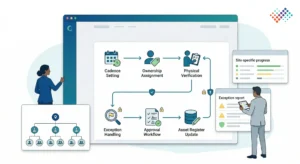
In this guide, you’ll learn:
- What a fixed asset verification policy actually covers, including how scope, frequency, ownership, and evidence rules connect to create a consistent control framework.
- Why enterprises need a dedicated policy, since without it, different sites follow different practices, which in turn leads to inconsistent results and weak audit trails.
- How to define cadence, ownership, and exception rules clearly, so teams can act consistently while still adapting to asset type, risk, and operational realities.
- How to build a policy that works in practice, where clear controls, defined approvals, and timely system updates ensure verification results actually improve the asset register.
What is a fixed asset verification policy?
A fixed asset verification policy is the written document that tells the business what must happen during asset verification, who must do it, how often it must happen, and what happens when something goes wrong. In practice, the policy should cover physical verification of tangible fixed assets, how discrepancies are treated, what evidence is required, when exceptions are allowed, and who signs off on updates to the books or systems. CARO 2020 guidance in India is especially helpful here because it ties management verification, reasonable intervals, and discrepancy treatment in the books together in one audit-facing requirement.
Policy vs SOP vs checklist vs report
This distinction matters because teams often mix these documents together.
| Document | Main job | What it should answer |
|---|---|---|
| Policy | Sets the rules and control requirements | What must happen, who approves it, and what standard applies |
| SOP/procedure | Explains execution | How teams perform the work step by step |
| Checklist | Prevents missed tasks | What must be checked before, during, and after the exercise |
| Report | Documents results | What was verified, what failed, and what action is required |
Why do enterprises need a dedicated asset verification policy?
Enterprises need a dedicated verification policy because unstructured verification leads to inconsistent results. One plant may verify every machine annually, while another site checks only during audit season. One team may photograph exceptions, while another keeps only spreadsheet notes. One site may treat moved assets as minor updates, while another routes them for formal approvals. A written policy eliminates that drift.
A separate policy can serve as a structured way to align physical verification with the broader internal-control environment. Across different jurisdictions, regulatory frameworks emphasize management accountability, defined evaluation approaches, and periodic assessments of control effectiveness. For instance –
- For the US, ICFR-related expectations focus on management responsibility and effectiveness reviews.
- Across India, guidance emphasizes reasonable verification intervals and proper handling of discrepancies.
- Within the UK, governance codes highlight material internal controls and their annual evaluation.
- A well-defined policy connects these expectations with day-to-day verification practices.
Original contribution: The 10-clause policy spine
Most guidance suggests having a documented policy, but it often stops there. This section goes further by outlining what the policy should actually include.
The 10-clause policy spine
Clause |
What the policy must say |
What it prevents |
|---|---|---|
| 1. Purpose and scope | Which entities, sites, and asset classes does the policy cover? | Confusion about what is in or out of scope |
| 2. Asset classes and thresholds | How asset classes are grouped and whether low-value classes use lighter controls | Over-auditing low-risk assets or under-controlling high-risk ones |
| 3. Frequency and triggers | Baseline cadence plus out-of-cycle triggers like relocation, merger, disposal backlog, or incident | Blanket annual rules that ignore risk |
| 4. Roles and ownership | Policy owner, process owner, site owner, reviewer, and approver | “Everyone owns it,” turning into “nobody owns it.” |
| 5. Allowed methods | File-to-floor, floor-to-file, wall-to-wall, sample-based checks, or approved alternatives | Sites inventing their own methods mid-cycle |
| 6. Evidence standard | Minimum fields, photos, geolocation, condition codes, verifier name, and timestamp rules | Weak or inconsistent proof |
| 7. Exception classes | Embedded assets, leased assets, third-party sites, intangibles, blocked-access assets, pooled assets | Vague “not verifiable” notes with no control logic |
| 8. Discrepancy treatment | Reason codes, escalation owners, update SLA, approval path, and book treatment | Findings that stay unresolved after fieldwork |
| 9. Record retention | What to retain, where to retain it, and who can approve deletion | Lost audit trail and weak defensibility |
| 10. Review and change control | How often the policy is reviewed and who approves updates | Policies that never change while the asset base does |
A self-check question
If a site manager, controller, or auditor asked, “What exactly do we do when an asset is missing, embedded, moved, leased, or low-value?” the policy should answer that question without sending them to four different documents.
How often should fixed assets be verified?
A fixed asset verification policy should set risk-based frequency, not a one-size-fits-all annual rule. That is the most important answer this page should give. CARO speaks in terms of reasonable intervals, not a universal annual mandate. The UK Code focuses on an annual review of the effectiveness of material internal controls. Meanwhile, South African municipal and public-sector policy examples often state annual or cyclical verification routines explicitly, especially for moveable assets and public-entity reporting environments.
Risk-based cadence matrix for policy writers
Asset group |
Baseline cadence |
Out-of-cycle trigger |
Who can approve a deviation |
|---|---|---|---|
| High-value portable IT, tools, and shared equipment | Quarterly or rolling sample checks | Joiner-mover-leaver event, theft incident, remote-user return, site move | Finance + ITAM / site control |
| Vehicles and mobile plant | Quarterly or semi-annual | Accident, depot transfer, major repair, disposal prep | Ops + finance |
| Plant and machinery in fixed locations | Annual or rolling 12-month cycle | Shutdown, line relocation, impairment signal, merger, insurance event | Plant head + controllership |
| Branch/office assets | Annual or 18-month cycle | Branch closure, refit, relocation, fraud or shrinkage pattern | Regional controller |
| Furniture and low-risk fixtures | 18–36 months plus spot checks | Office move, loss event, internal-control review finding | Facilities + finance |
| CWIP / under installation | Milestone-based | Ready-for-use review, capitalization event, project handover | Project owner + finance |
| Third-party-site assets | Annual plus contract-based confirmations | Service renewal, contract dispute, site handover | Contract owner + finance |
| Embedded or non-taggable assets | Periodic alternative-control review | Major maintenance, engineering change, impairment signal | Engineering + finance |
| Intangible assets | No physical cadence | N/A — apply non-physical controls | Finance / legal / IT |
Policy rule that works in practice
A strong policy should do two things at once:
- Set the default cadence for each asset group.
- Define the events that force an extra check even if the normal cycle is not due.
That second rule is where many policies fail.
Who should own the policy?
Management should own the fixed asset verification policy. Auditors and internal audit should review, test, or challenge it, but they should not be the only owners. The SEC’s ICFR rules place responsibility on management. CARO guidance in India speaks to physical verification by management. The UK Code frames internal controls as a board-governed management responsibility.
Layered ownership model
A useful policy separates policy ownership from execution ownership:
- Policy owner: Controllership or finance leadership.
- Register owner: Fixed asset accounting/finance operations.
- Execution owners: Site controllers, facilities, plant, ITAM, or department owners.
- Exception approvers: Finance plus the relevant business owner.
- Independent reviewer: Internal audit or a control testing function.
Practical RACI for policy governance
Decision/activity |
Finance/controllership |
Fixed asset accounting |
Ops/facilities/plant |
ITAM |
Internal audit |
CFO / finance leader |
|---|---|---|---|---|---|---|
| Approve policy | A | C | C | C | C | A |
| Maintain asset classes and thresholds | A | R | C | C | C | C |
| Schedule verification cycles | C | R | R | R | C | C |
| Define exception categories | A | R | C | C | C | C |
| Approve major discrepancies/write-offs | A | R | C | C | C | A |
| Review policy effectiveness | C | C | C | C | R | A |
| Refresh policy annually | A | R | C | C | C | A |
R = Responsible, A = Accountable, C = Consulted
A policy rule worth adding
Do not let the policy say only “asset team” or “management” without naming functions. Vague ownership creates vague accountability.
Which exceptions should the policy define?
A fixed asset verification policy should define exceptions before the next verification cycle begins. Otherwise, teams create exceptions during fieldwork, and those exceptions become inconsistent across sites.
Exception classes that belong in the policy
Exception class |
What the policy should say |
Approved alternative control |
|---|---|---|
| Embedded or non-taggable assets | Standard scanning is not practical | Engineering ID, drawing, maintenance record, and installed-location evidence |
| Assets at third-party or project sites | Physical access may be limited | Third-party confirmation, contract reference, and latest service/inspection record |
| Leased or right-of-use assets | Physical presence and legal rights differ | Physical check plus lease or custody documentation |
| Intangible assets | Not physically verifiable | Non-physical controls only |
| Low-value pooled assets | Full asset-by-asset proof may be disproportionate | Sample-based checks, room lists, and pool-owner accountability |
| Blocked-access or secure-zone assets | Standard access may be restricted | Deferred verification with approved access plan and temporary alternative evidence |
| Assets under installation / CWIP | Not yet fully deployed or ready for use | Milestone review and capitalization control instead of standard verification |
What not to write
Avoid phrases like:
- “Verify where feasible.”
- “Exceptions handled case by case.”
- “Low-value items may be excluded.”
- “Supporting evidence as available.”
That wording is too weak. The policy should state which exception applies, what alternate control is acceptable, who approves it, and what record must be retained.
How do you draft or update a fixed asset verification policy?
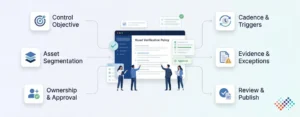
Drafting a fixed asset verification policy involves defining clear control objectives, segmenting assets by risk, and assigning ownership across teams. It also requires setting verification cadence, evidence standards, and exception rules, followed by formal approval and regular review to keep the policy effective.
6 steps to draft or refresh the policy
-
Define the control objective.
Decide whether the policy is meant to support audit readiness, register accuracy, fraud reduction, insurance reliability, or all of the above.
-
Segment assets by risk and operating reality.
Separate portable, fixed-location, embedded, third-party-site, low-value pooled, and non-physical assets before you write cadence rules.
-
Assign named owners and approvers.
Write down who owns the policy, who owns the register, who executes by asset population, and who approves major exceptions or book changes.
-
Write the cadence and trigger rules.
Set baseline frequencies by asset class, then add extra triggers for site moves, M&A, incidents, branch closures, or disposal backlogs.
-
Define evidence, exceptions, and update SLAs.
State what evidence is mandatory, which exceptions are allowed, how discrepancies are coded, and how quickly records must be updated after approval.
-
Approve, publish, and review the policy.
Put the policy through finance and cross-functional review, publish the current version, and set an annual or change-trigger review date.
What controls and records should the policy enforce?
A good fixed asset verification policy should force the business to retain enough evidence to explain three things clearly: what was checked, what was found, and what changed afterward.
◊ Minimum control rules to write into the policy
-
- Freeze or version-control the source asset population before fieldwork starts.
- Use approved methods only: file-to-floor, floor-to-file, wall-to-wall, sample-based, or approved alternative controls.
- Capture minimum mandatory fields for every in-scope asset class.
- Use controlled discrepancy codes rather than free-text comments only.
- Set an approval path for write-offs, location changes, ownership changes, and exception closures.
- Set a system update SLA so approved changes flow back into the register or ERP quickly.
- Retain raw evidence, approvals, and closeout reports under a defined retention rule.
- Require periodic policy review whenever asset mix, site footprint, or audit expectations change materially.
◊ Balanced note
A strict policy is useful, but it should still be practical. A policy that demands high-friction evidence for every low-value chair and cable bundle will be ignored. A policy that is too loose will fail audit review. The right answer is proportional control.
◊ Copy-ready sample policy section
Use the sample below as a starting point, not as legal or accounting advice.
◊ Sample fixed asset verification policy language
-
- The Company shall maintain a written, risk-based fixed asset verification program for all in-scope tangible fixed assets.
- Finance/controllership shall own this policy, while execution responsibility shall be assigned by asset class and location.
- Asset classes shall follow the verification cadences defined in Appendix A. Out-of-cycle verification shall be required upon major relocation, merger integration, disposal backlog, theft or loss event, branch closure, or management-requested review.
- Verification results shall be recorded using the approved evidence fields, discrepancy codes, and condition codes defined in Appendix B.
- Exception classes and alternative controls shall follow Appendix C. No site may create ad hoc exception treatment without approval from the policy owner.
- All material discrepancies shall be investigated, approved, and properly dealt with in the books and systems in accordance with the Company’s accounting and delegation-of-authority rules.
- Verification evidence, approvals, and closeout records shall be retained in accordance with the Company’s records-retention policy and shall remain accessible for audit review.
- This policy shall be reviewed at least annually, or earlier if the Company undergoes a material change in asset mix, system landscape, organizational structure, or control environment.
◊ Why this sample works
This sample does not attempt to cover every field procedure. Instead, it focuses on what the policy must achieve—establish clear rules, reference supporting appendices, enforce approvals, and define ownership for ongoing review.
How should the policy adapt by country?
→ USA: Position the policy inside the broader ICFR environment
For US-facing organizations, the policy should speak the language of management responsibility, control evaluation, and effectiveness support. The SEC requires management’s annual report on ICFR to include management responsibility, the framework used, and management’s assessment of effectiveness as of the fiscal year-end. Therefore, a fixed asset verification policy is best positioned as a sub-policy or control standard that supports asset-register accuracy and evidence retention within the broader ICFR framework.
What to add for US readers
-
- Named the control owner and reviewer.
- Link between verification results and approved book updates.
- Evidence-retention requirement.
- Escalation rule for material exceptions.
→ India: Define “reasonable intervals” and book-treatment rules clearly
For India, the policy should explicitly define what “reasonable intervals” means for each asset class and state how material discrepancies will be dealt with in the books. CARO guidance is clear that auditors report whether PPE has been physically verified by management at reasonable intervals and whether discrepancies were properly dealt with in the books of account. The same guidance also treats title-deed checks for immovable property as a separate matter, so the policy should not confuse physical verification with document-title verification.
What to add for Indian readers
-
- Asset-class cadence schedule.
- Discrepancy-treatment clause.
- Separate note for title deeds/lease documents.
- Management sign-off requirement before audit close.
→ United Kingdom: Write the policy as evidence for material controls
For UK readers, especially in listed company contexts, the policy should identify whether fixed asset controls could be treated as material controls and how the organization will review their effectiveness. The FRC says the 2024 Code has applied since 1 January 2025, with Provision 29 applying from 1 January 2026, and Provision 29 asks boards to make a declaration about the effectiveness of their material internal controls. A fixed asset verification policy can support that review when portable or distributed fixed assets are material to reporting or operations.
What to add for UK readers
-
- Material-controls lens.
- Annual Policy-Effectiveness Review Note.
- Escalation for unresolved high-risk exceptions before year-end.
- Evidence summary that can support board-level review.
→ South Africa: Make reporting and movement control more explicit
For South African public-sector and municipal readers, policy language should be especially concrete. Recent official materials reference GRAP-linked asset reconciliation, physical verification reports showing existence, condition, and tagging status, signed room inventory lists, visible inventory lists for audit purposes, asset movement forms, and annual or cyclical verification expectations. That means a South Africa-ready policy should define reporting outputs and movement controls, not just cadence.
What to add for South Africa readers
-
- Room or user inventory-list control.
- Mandatory asset movement form rule.
- Location/condition / missing-asset schedules.
- GRAP-linked reconciliation outputs for public-sector contexts.
Common policy mistakes
- Using one blanket cadence for every asset class
Buildings, laptops, tools, medical devices, and embedded assets do not carry the same risk, so applying a single cadence weakens control. - Making the internal audit the policy owner
Internal audit should review or test the control, not replace management ownership. - Leaving exceptions vague
“Where feasible” is not a control because it leaves too much room for interpretation. - Writing no update SLA back to systems
Findings that never reach the register or ERP, therefore, do not improve control. - Ignoring movement and custody rules
Missing assets often trace back to transfer discipline, rather than disappearance. - Separating policy from daily operating reality
A policy that site teams cannot follow, in practice, becomes decorative. - Never reviewing the policy after business changes
M&A, ERP change, remote work growth, and asset-mix shifts should trigger a policy refresh.
Key Takeaways
- A fixed asset verification policy should define scope, cadence, owners, methods, exception rules, approvals, and record retention.
- A good policy uses risk-based frequency, not one blanket annual cycle for every asset class.
- Finance or controllership should usually own the policy, while operations, facilities, IT, and site teams execute it.
- A policy should define exception populations up front, including embedded assets, third-party-site assets, leased assets, and intangible assets.
- A policy should state how teams classify discrepancies, approve write-offs or updates, and push results back into the register or ERP.
- A policy is different from an SOP, checklist, or report. It sets the rules that those documents follow.
Conclusion
A fixed asset verification policy should do one job exceptionally well: remove ambiguity. It should tell the business how often to verify, who owns each decision, which exceptions are allowed, and what control evidence must survive review. When that document is written well, the rest of the verification program becomes easier to scale, easier to audit, and easier to improve.
That is also where the commercial handoff makes sense. AssetCues’ software page emphasizes geo-tagged proof, AI-assisted recognition, workflow-based verification, and instant ERP updates, while its services page emphasizes audit-ready records and structured multi-site delivery. Those capabilities help teams enforce policy consistently once the policy itself is sound.

FAQs
Q1: How often should fixed assets be verified?
Ans: Fixed assets should be verified at risk-based intervals, not necessarily on one blanket annual cycle. Portable, high-value, and high-movement assets usually need more frequent checks than low-risk fixed-location assets.
Q2: Who should own the policy?
Ans: Finance or controllership should usually own the policy because verification outcomes affect the register, depreciation, and audit support. Operations, facilities, IT, and site teams should still own execution within their asset populations.
Q3: Should every asset class follow the same frequency?
Ans: No. A strong policy sets different cadences for different asset classes based on value, mobility, control risk, and business criticality.
Q4: What should the policy say about exceptions?
Ans: The policy should define which exception classes are allowed, what alternative control is acceptable for each one, who approves the exception, and what evidence must be retained.
Q5: Do low-value assets need to be included?
Ans: Not always at the same intensity. Many organizations apply lighter controls, sampling, or pooled ownership for low-value, low-risk assets while keeping tighter rules for portable or high-risk items.
Q6: Can software replace a fixed asset verification policy?
Ans: No. Software can enforce workflows, capture evidence, and update records, but the policy still sets the rules that the software follows. Asset verification platforms, including AssetCues and Asset Infinity, still describe frequency and controls as policy-driven.
Q7: Should leased or third-party-site assets be covered?
Ans: Yes, but usually through specific exception rules. Physical presence, custody, and legal rights may need different combinations of evidence for leased or externally located assets.