




Introduction
A controller-ready method to match gross cost, accumulated depreciation, and net book value without turning every close into a detective exercise. If your fixed asset register reconciliation with the general ledger does not tie, the issue is rarely the spreadsheet—it usually comes down to timing gaps, missing asset events, weak account mapping, or incomplete evidence. This guide shows finance and audit teams how to approach reconciling fixed assets to the general ledger step by step, explain variances clearly, and produce a reviewer-ready close file.
Reconciling fixed assets to the general ledger means matching the fixed asset register or subledger to the GL for three core balances: gross cost, accumulated depreciation, and net book value. A complete tie-out also proves that period activity—additions, transfers, reclasses, retirements, impairments, and depreciation—hits both sources in the right period and the right accounts. When differences remain, finance classifies the variance, pulls evidence, posts approved corrections, reruns the schedule, and archives a signed reconciliation statement.

In this guide, you’ll learn:
- What reconciling fixed assets to the general ledger actually involves, including how gross cost, accumulated depreciation, and net book value should align in practice.
- Why do differences appear during reconciliation, since timing gaps, missing asset events, and mapping issues can disrupt even a structured close?
- How to run a clear, step-by-step reconciliation, so you can trace balances, explain variances, and close the loop without turning the process into a monthly struggle.
- Finally, how to build a reviewer-ready close file, where balances tie, differences are explained with evidence, and the entire reconciliation holds up under audit review.
TL;DR
- Start with gross cost, not net book value. Then tie the accumulated depreciation separately.
- Use the same entity, book, period, and account set in both the FAR and the GL.
- Most variances fall into four buckets: timing, completeness, mapping, or parameter errors.
- A good close file shows more than totals. It also shows period activity, evidence, commentary, and sign-off.
- Physical verification matters when the GL issue traces back to a missing asset, an unprocessed disposal, or the wrong location/custodian, but this page is not a full field-audit guide.
What does it mean to reconcile fixed assets to the general ledger?
Reconciling fixed assets to the general ledger means proving that the detailed fixed asset record supports the balances shown in the financial books. In practice, finance is answering one question: Can we explain the asset balance on the balance sheet from the register, the period activity, and the supporting evidence?
This is a narrower job than the full fixed asset reconciliation process. The broader process includes physical existence, location, ownership, and workflow discipline across finance, audit, IT, and operations. This page focuses on the close file: the tie-out between the FAR and the GL.
The AssetCues 4-part GL tie-out pack
Most teams stop at a balance comparison. Strong teams build a four-part pack instead:
- Balance tie-out — Prove gross cost, accumulated depreciation, and NBV.
- Activity bridge — Prove additions, disposals, transfers, reclassifications, and depreciation activity for the period.
- Variance classification — Label every difference as a timing, completeness, mapping, or parameter issue.
- Sign-off evidence — Retain the support, commentary, approver, and final rerun that show the issue is closed.
That four-part pack is the main “information gain” on this page. It gives controllers a repeatable structure instead of a one-off reconciliation worksheet.

What should tie the fixed asset register and the GL?
Three balances should tie directly: gross cost, accumulated depreciation, and net book value. However, a strong reviewer also expects a clean bridge for period activity. In other words, totals matter, but so do the events that created the totals.
Area |
FAR / subledger view |
GL / close-file view |
Why the reviewer cares |
|---|---|---|---|
| Gross cost | Opening cost, additions, reclasses, transfers, retirements | Asset cost accounts and period activity | Confirms additions and retirements hit the right accounts and periods |
| Accumulated depreciation | Opening reserve, current-period depreciation, reserve removed on retirement | Accumulated depreciation accounts and depreciation journals | Confirms method, timing, and retirement handling |
| Net book value | Cost less reserve and impairment | Reported carrying value | Confirms the balance sheet is supportable |
| Period activity | Additions, transfers, reclasses, impairments, retirements | Journal references, account detail, reviewer commentary | Explains why the period changed |
| Depreciation expense | Current-period depreciation by asset or class | P&L depreciation expense account(s) | Helps explain reserve movement and period expense together |
Do not stop at net book value
Finance teams often start with NBV because it looks like the “real” balance. That shortcut can hide problems. Two wrong numbers can still net the right NBV. Therefore, always tie gross cost and accumulated depreciation separately before you accept the result.
What a good tie-out proves
A reviewer should be able to see, quickly and clearly, that
- The opening balance agrees with the prior close.
- The current-period activity explains the change.
- The ending FAR totals agree with the ending GL balances.
- Every material variance has evidence and commentary.
- The schedule was rerun after approved corrections.
Which reports, fields, and controls do you need before you start?
A clean tie-out starts with clean source data. If you pull the wrong book, the wrong period, or incomplete fields, the schedule will fail before the real analysis begins.
Minimum reports and data pulls
Report or extract |
Must-have fields |
Why it matters |
|---|---|---|
| Fixed asset register / subledger export | Asset ID, description, class, legal entity, book, in-service date, status, cost account, reserve account, cost, accumulated depreciation, NBV, location, custodian | This is the detailed support for the asset balance |
| GL trial balance and account activity | Entity, ledger, period, account, opening balance, debits, credits, closing balance, journal reference | This is the financial record you are providing |
| Additions/capitalization report | Invoice or AP reference, capitalization date, asset class, amount, account mapping, approver | Explains gross cost increases |
| Depreciation report | Method, useful life, start date, current depreciation, YTD depreciation, reserve balance | Explains reserve movement |
| Retirement/disposal report | Disposal date, proceeds, write-off reference, reserve removed, approver | Explains cost and reserve decreases |
| Transfer/reclass log | From/to class, from/to account, location, effective date, approver | Explains changes that do not change the portfolio total but do change the account detail |
| Exception or evidence log | Variance amount, root cause, owner, due date, evidence link, reviewer note | Keeps the closed file explainable |
If your ERP already has reconciliation reports, use them
Many enterprise systems already separate cost and reserve support. Oracle, for example, documents cost, reserve, CIP, and asset balances register reports that are designed to reconcile journal entries to general ledger accounts.
Controls to confirm before you build the schedule
Before you start calculating variances, confirm these control conditions:
- The same closed period is used in both the FAR and the GL.
- Depreciation has been run and posted for the same period.
- The reconciliation is limited to the same legal entity and book.
- Asset classes map to the correct cost and reserve accounts.
- Manual journals to fixed asset accounts have been identified separately.
How do you reconcile fixed assets to the general ledger step by step?
The fastest way to reconcile fixed assets is to follow the same sequence every month. That sequence keeps the tie-out explainable and prevents the team from chasing derived numbers before the underlying balances are proven. The 8-step workflow:
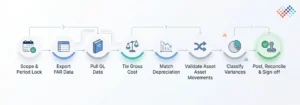
1) Freeze the scope and period
Start by locking the exact scope of the reconciliation.
- Which entity or entities are included?
- Which book is included—corporate, tax, local GAAP, or another reporting book?
- Which accounts belong to asset cost, reserve, depreciation expense, clearing, CIP, or lease-related balances?
- Which period close date is the source of truth?
This step sounds basic. However, many failed reconciliations happen because one report was pulled before the depreciation run, one was pulled after, or one used a local book while the other used a corporate book.
2) Export FAR balances and activity
Pull the FAR or asset subledger with both ending balances and period movements. At a minimum, include:
- Opening cost and reserve.
- Current-period additions.
- Transfers and reclasses.
- Retirements or disposals.
- Current-period depreciation.
- Ending cost, reserve, and NBV.
Keep the detailed asset-level export behind the summary schedule. The summary lets reviewers skim quickly, while the detailed export lets the preparer trace exceptions without rebuilding the file.
3) Pull matching GL balances and journal detail
Next, pull the matching trial balance and account-activity report from the GL. A good GL pull includes:
- Opening balance.
- Period debits and credits.
- Ending balance.
- Journal references.
- Account descriptions.
If your team uses manual journals to asset accounts, isolate them now. Manual postings are not automatically wrong. However, they often explain why the GL moved while the FAR did not.
4) Tie gross cost first
Gross cost is usually the best starting point because additions, transfers, reclasses, and retirements leave a clear trail. Work through this order:
- Match the opening gross cost to the prior signed reconciliation.
- Add the period’s capitalized additions from the FAR.
- Subtract retirements or disposals.
- Check reclasses and transfers that move balances between accounts or classes.
- Compare the resulting FAR gross cost to the GL asset cost accounts.
If the GL is higher than the FAR, a capitalization event may have hit the books without creating or updating the asset record. If the FAR is higher than the GL, the asset record may exist, but the journal was not posted, posted to the wrong account, or duplicated an earlier record.
5) Tie accumulated depreciation separately
Once gross cost ties, move to accumulated depreciation. Review:
- Opening reserve.
- Current-period depreciation.
- Reserve removed on disposal.
- Any unusual depreciation adjustment.
A reserve mismatch usually points to one of four things: the wrong method, the wrong useful life, the wrong start date, or a depreciation run that was missed or rerun incorrectly. Therefore, tie reserve on its own before you accept the NBV.
6) Bridge disposals, transfers, reclasses, and cutoffs
Not every difference is a “missing asset.” Many are event-handling problems. Check these carefully:
- Disposals: Was the asset removed from the FAR and the GL in the same period?
- Transfers: Did the movement change only location, or did it also change account mapping?
- Reclasses: Did the team move the asset to a new class or account without updating the other source?
- Cutoff: Was the invoice posted in one period while the asset was created, retired, or updated in another?
This is where the reconciliation becomes more than arithmetic. It becomes a control over the asset lifecycle.
7) Classify and resolve variances
Once the difference is visible, classify it before you start correcting it. The 4-bucket variance ladder
Variance bucket |
What it means |
Common example |
|---|---|---|
|
Timing |
The same event exists in both sources, but not in the same period |
Asset added in the GL this month, created in the FAR next month |
|
Completeness |
The event exists in one source only |
Disposal processed operationally, but never posted to the books |
|
Mapping |
The event exists, but in the wrong class, account, book, or entity |
Asset class changed, but reserve account mapping was not updated |
|
Parameter |
The asset record exists, but the settings are wrong |
Useful life, method, start date, salvage value, or status is wrong |
Classifying the issue first keeps the team from posting the wrong correction.
8) Post corrections, rerun the tie-out, and sign off
Finally, post only the corrections that have evidence and approval. Then rerun the reconciliation. The file is not finished until it shows:
- Record the original variance, so you clearly capture the starting gap.
- Identify the root cause, ensuring you understand why the issue occurred.
- Define and apply the corrective action, so you fix the issue properly.
- Link the posted reference, so you can trace the update in the system.
- Rerun the reconciliation so you can confirm that the correction worked.
- aCapture reviewer sign-off, so you formally close and validate the process.
A closed file that shows the “before” and “after” position is much easier to audit than one that only shows the final zero variance.
Who usually owns each part?
Task |
Primary owner |
Secondary input |
|---|---|---|
| Prepare FAR and GL extracts | Asset accountant/controller | ERP admin |
| Explain operational events | Procurement, IT, operations, site custodian | Finance |
| Prepare or review correcting entries | Controller/finance manager | Asset accountant |
| Confirm disposal or existence of evidence | Ops, IT, facilities, internal audit | Finance |
| Final sign-off | Controller/finance reviewer | Internal audit for selected periods |
Why do fixed asset balances fail to tie?
Most fixed asset variances repeat the same patterns. Once your team learns those patterns, the reconciliation moves much faster.
Common variance patterns, evidence, and fixes
What you see |
Likely cause |
Evidence to pull |
Typical fix |
|---|---|---|---|
| GL gross cost is higher than the FAR gross cost | Addition posted to GL, but the FAR record was never created or finalized | Invoice, AP voucher, capitalization approval, journal reference | Create or complete the FAR record, then rerun the subledger |
| FAR gross cost is higher than GL gross cost | An asset record exists, but posting failed, was posted to the wrong account, or a duplicate asset was created | Asset transaction log, posting report, account mapping, prior-period record | Post the missing journal, reclass the entry, or retire the duplicate |
| Reserve in GL is higher or lower than the FAR reserve | Wrong useful life, method, start date, salvage value, or missed depreciation run | Depreciation schedule, asset master, change log, parameter update approval | Correct the asset parameters and post the approved depreciation adjustment |
| Disposed asset still appears in cost or reserve | Retirement happened physically or operationally, but not in the books | Disposal approval, sale/scrap note, retirement transaction, asset status history | Process retirement correctly and remove the related reserve |
| Portfolio total ties, but class or account totals do not | Mapping or reclass issue | Class mapping table, reclass entry, transfer log | Correct the class, account, or reclass posting |
| NBV does not tie, but cost and reserve do | Formula, impairment, or presentation issue | Impairment entries, report logic, and calculated columns | Correct the report logic or impairment support |
| Recurring differences every month | Weak close sequence or poor ownership | Prior reconciliations, exception log, missed action items | Fix the workflow, not just the month-end numbers |
Three issues that deserve extra attention
1. Missing additions
A missing addition is one of the most common close issues. The invoice reaches finance, the journal hits the GL, but the asset record is incomplete, delayed, or held in a clearing stage too long.
2. Unprocessed retirements
Retirements create pain because they affect both cost and reserve. If the business disposes of an asset before finance processes the retirement, the books will continue to carry cost and depreciation that no longer reflect reality.
3. Depreciation parameter drift
Useful life updates, method changes, partial retirements, and status changes can quietly create reserve mismatches. These issues usually do not look dramatic at first. However, they accumulate and turn into quarter-end or year-end surprises.
Keep an exception log, not just a variance number
A strong exception log includes:
- Balance affected.
- Variance amount.
- Root-cause bucket.
- Evidence source.
- Owner.
- Target close date.
- Final journal or update reference.
- Reviewer note.
That log is often more valuable than the schedule itself because it turns reconciliation into a repeatable control.
What does a completed GL-to-FAR reconciliation statement look like?
The best reconciliation statements are short, clear, and reviewable. They do not bury the key variance in a 20-tab workbook.
Simplified example
Balance |
GL |
FAR |
Variance |
Commentary |
|---|---|---|---|---|
| Gross cost | $51,893 | $51,094 | $799 | Equipment addition posted to GL on 29 March; FAR record not created before close |
| Accumulated depreciation | $20,550 | $20,481 | $69 | Useful life revision approved, but the depreciation rerun happened after the initial FAR export |
| Net book value | $31,343 | $30,614 | $729 | Derived difference from the two issues above |
Corrective actions taken
Action |
Amount |
Evidence |
Owner |
Status |
|---|---|---|---|---|
| Create a FAR record for equipment addition | $799 | Invoice INV-1048, capitalization approval CAP-09, AP reference | Asset accountant | Posted |
| Post-approved depreciation adjustment | $69 | Useful life change memo REV-12, recalculation support | Controller | Posted |
Final rerun result
Balance |
GL |
FAR |
Final variance |
|---|---|---|---|
| Gross cost | $51,893 | $51,893 | $0 |
| Accumulated depreciation | $20,550 | $20,550 | $0 |
| Net book value | $31,343 | $31,343 | $0 |
What the reviewer should see on the sign-off page
A reviewer-friendly sign-off page should capture:
- Preparer name and date.
- Reviewer name and date.
- Period covered.
- Scope of entities and books.
- Materiality threshold.
- Unresolved items, if any.
- A short conclusion on whether the FAR and GL tie after approved adjustments.
How often should finance teams run this tie-out?
Most finance teams should reconcile fixed assets to the GL monthly. That cadence keeps the year-end close clean and stops small differences from turning into audit exceptions.
However, the right operational cadence depends on the environment.
Environment |
FAR-to-GL tie-out |
Exception review |
Physical support cadence |
|---|---|---|---|
| Small, stable asset base | Monthly | Monthly | Annual or risk-based |
| Multi-site enterprise | Monthly | Weekly or monthly | Rolling or risk-based by class and location |
| Asset-heavy or regulated operation | Monthly | Weekly for high-value movements | More frequent for critical classes |
If the business capitalizes assets regularly, disposes of assets often, or moves assets between sites, do the GL tie-out every month. If the business is small and asset movement is rare, you may still reconcile monthly, but with a lighter investigation burden.
What changes in the USA, India, and the UK?
The workflow is similar across countries, but the close file should reflect local reporting and record-keeping expectations.
Country/reporting context |
What controllers should watch |
Why it matters |
|---|---|---|
| USA | Depreciable property support, clear asset records, and business-use records, where applicable | The IRS says taxpayers must keep records showing business, investment, and personal use of property, and Publication 946 includes recordkeeping guidance for depreciable and listed property. |
| India | Proper PPE records, physical verification at reasonable intervals, and evidence that discrepancies were dealt with in the books | CARO 2020 reporting focuses on whether property, plant, and equipment records are proper and whether material discrepancies from physical verification were dealt with in the books. A clean GL tie-out helps prove that last part. |
| United Kingdom | Records of acquisitions, values, disposals, allowance claims, and values carried forward | HMRC recommends keeping clear records for plant and machinery allowance claims, including new acquisitions, values, disposals, and carry-forwards. |
| IFRS reporters | Carrying amounts, depreciation charges, and impairment handling | IAS 16 sets the principles for recognizing PPE, measuring carrying amounts, and measuring depreciation charges and impairment losses. |
What does this mean for the closed file
In practice:
- US teams often need stronger depreciation support and tax-book vs corporate-book clarity.
- Indian teams often need clearer evidence that a physical discrepancy was actually resolved in the books.
- UK teams often need cleaner disposal and allowance records.
- IFRS-based teams need the tie-out to support carrying amount and depreciation logic, not just raw totals.
When do spreadsheets stop being enough?
Spreadsheets can work. However, they stop being efficient when the business has multiple entities, multiple books, frequent movements, or recurring evidence gaps.
Spreadsheets are usually enough when… |
Software-supported workflows become the better choice when… |
|---|---|
| One team manages one entity or a small asset base | The business spans multiple entities, sites, or books |
| additions and disposals are infrequent | Asset movement and retirements happen throughout the month |
| The same preparer and reviewer know every asset class personally | Continuity depends on a documented workflow and shared evidence |
| Evidence lives in one place, and the ERP setup is simple | Evidence is spread across AP, procurement, site teams, photos, disposal notes, and ERP logs |
Key takeaways
- Reconciling fixed assets to the GL is a close control, not just a spreadsheet exercise.
- Tie gross cost and accumulated depreciation separately before you accept NBV.
- Most differences fall into four buckets: timing, completeness, mapping, or parameter errors.
- A strong reconciliation statement shows totals, period activity, commentary, evidence, and sign-off.
- When upstream asset events create the problem, field evidence and workflow discipline matter just as much as the journal entry.
Where does AssetCues fit?
AssetCues is most useful when the GL problem starts upstream. For example, a disposal is real in the field but missing in the records, a transfer happened, but the register was never updated, or audit evidence is scattered across emails and spreadsheets.
AssetCues’ asset verification software workflow is designed to import the register, assign audit tasks, let field teams scan tags and capture photos and geolocation, route discrepancies, and sync verified results back to ERP systems. That does not replace the controller’s close review. Instead, it reduces the missing-event and missing-evidence problems that make the GL tie-out slow and fragile.
Frequently asked questions
Q1: What documents support a fixed asset GL reconciliation?
Ans: The core support usually includes the FAR export, GL trial balance, account activity, additions report, depreciation report, retirement or disposal report, transfer or reclass log, and any related invoices or approvals.
Q2: Why do fixed asset balances not tie?
Ans: Fixed asset balances usually fail to tie because of timing, completeness, mapping, or parameter issues. In practical terms, that means the event hit one system but not the other, hit the wrong account, or used the wrong depreciation settings.
Q3: Is net book value enough to prove the tie-out?
Ans: No. Net book value alone is not enough because two wrong inputs can still produce the right net figure. Finance should tie gross cost and accumulated depreciation separately.
Q4: Do you need physical verification to reconcile fixed assets to the GL?
Ans: Not every month. However, physical verification becomes important when the GL issue traces back to existence, location, transfer, loss, or disposal status. In those cases, field evidence is part of the close support.
Q5: Can finance teams do this in Excel?
Ans: Yes, many teams start in Excel. However, Excel becomes fragile when the business has multiple sites, multiple books, frequent movements, or recurring reviewer comments about missing evidence.
Q6: Who should review and sign off on the fixed asset reconciliation?
Ans: A controller, finance manager, or designated close reviewer should sign off on the schedule. Internal audit may review selected periods, high-risk classes, or recurring exceptions, but operational sign-off usually stays with finance.