




Introduction
If the same asset discrepancies show up every quarter, the problem is usually not the count—it is the policy, and often weak reconciliation in asset management or an inconsistent asset management reconciliation process. Repeated transfer mismatches, late disposals, blank custodian fields, and unresolved exceptions typically point to governance gaps rather than a lack of effort. This guide shows finance controllers, internal audit teams, asset managers, IT leaders, and site operations teams how to design roles, controls, and policy rules that keep asset records accurate between audits.
Asset governance requirements vary by region. The USA emphasizes strong depreciation support, disposal timing, and close commentary, while India’s distributed branch structures and CARO-driven verification standards make ownership tracking and discrepancy handling a priority. The UK, in turn, relies on clean acquisition and disposal records to maintain both bookkeeping accuracy and capital-allowance discipline. That is why this guide focuses on ownership, control design, and policy execution rather than repeating broad definitions or explaining the fixed asset reconciliation process end to end.
In this guide, you’ll learn:
- What reconciliation in asset management actually means in practice, and how it keeps asset records, ownership, location, and financial treatment aligned over time.
- Why reconciliation problems keep repeating, and how weak governance, unclear ownership, and missing event-based controls create recurring mismatches.
- How to define clear roles, responsibilities, and control ownership across finance, IT, operations, and procurement to prevent gaps in the process.
- Finally, how to design a practical asset reconciliation policy, including event-level controls, evidence requirements, review cadence, and exception handling that works in real environments.
TL;DR
- Reconciliation in asset management is a governance system, not just a periodic audit.
- Strong policy design answers five questions: what changed, who approved it, what evidence exists, which system was updated, and who reviewed the result.
- Finance should own reporting integrity, but finance should not carry the whole process alone.
- Every asset policy should cover additions, transfers, temporary moves, disposals, depreciation-setting changes, and exception closure.
- The best programs review exceptions monthly, test controls quarterly, and update policy using real failure patterns rather than assumptions.
- Software helps only when it reinforces policy with evidence capture, audit logs, exception workflows, and ERP synchronization.
Reconciliation In Asset Management
Reconciliation in asset management is the discipline of keeping asset records, ownership, location, status, and financial treatment aligned over time. A strong asset management reconciliation process does not rely on a once-a-year cleanup. Instead, it uses clear owners, event-based controls, evidence standards, review cadences, and escalation rules so that additions, transfers, disposals, and other asset changes reach the right systems before they become recurring exceptions.

What does reconciliation in asset management mean?
Reconciliation in asset management means keeping asset records aligned through the asset lifecycle, not just at month-end and not just during a physical count. In practice, that means the organization can explain the current state of an asset at any time: what it is, where it is, who holds it, whether it is active or retired, how it is classified, and which records support those facts.
This definition is intentionally narrower than the broader meaning of asset reconciliation and distinct from the controller-focused task of reconciling fixed assets to the general ledger. Instead, this page addresses a different question:
Why do asset reconciliation problems repeat?
Asset reconciliation problems repeat when the business treats reconciliation as an event instead of a control environment. A strong asset management reconciliation process works like a chain. If one link fails, the downstream record drifts.
The AssetCues 5-layer control stack
This is the core framework that differentiates this page from generic “asset process” content. Every effective policy should cover five layers.
Control layer |
Key question |
Typical owner |
Common failure |
Example policy rule |
|---|---|---|---|---|
| 1. Event capture | Did the business record that something changed? | Site team, IT, facilities, procurement | Asset moved, issued, or scrapped informally | Every transfer, issue, or disposal must start with a documented event request |
| 2. Evidence capture | Is there proof of what changed? | Event owner + approver | No handover note, no photo, no approval, no serial confirmation | Transfers and disposals are incomplete until the required evidence is attached |
| 3. System update | Did the right record change in the FAR, ERP, or ITAM tool? | Asset accountant, asset manager, system admin | Email approved, but the system never updated | Record changes must hit the system of record within the SLA |
| 4. Review and tie-out | Did someone review whether the update happened correctly? | Finance controller, asset manager | Open items stay invisible until audit season | Review open exceptions monthly and sign off on unresolved items with comments |
| 5. Exception closure and feedback | Did the team fix the root cause so the issue does not recur? | Governance owner, finance lead, internal audit | Same exception type repeats every quarter | Repeated exceptions trigger a policy review, not just another correction |
This framework matters because businesses often jump from physical verification straight to corrective entries. That approach fixes symptoms. It does not fix repeated failures.
Signs that governance is weak, even when effort is high
You probably have a governance problem when:
- The same site keeps reporting wrong locations after transfers.
- Finance receives disposal information only during year-end cleanup.
- IT reassigns devices faster than the register updates.
- Blank or inconsistent master-data fields appear in every cycle.
- Internal audit sees the same “management will improve controls” finding again next year.
Three realistic governance failures
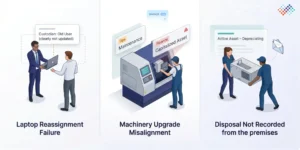
1: Laptop moved without a handover
An IT administrator reassigns a laptop between users, but no handover workflow updates the custodian field. Physical verification later finds the device, but the record still points to the old owner. The real failure was not verification. The failure was the missing event capture and approval.
2: Machinery upgrade changes the accounting, but no one tells finance
A site team treats a major machine upgrade as a maintenance event, while finance later capitalizes it after the invoice review. The class, useful life, and asset record stay out of sync because the policy never defined who decides capitalization treatment and when the register changes.
3: Scrapped asset removed from the floor but not from the books
Operations removes a damaged asset, but the disposal approval sits in email and never reaches the fixed asset register. The next count flags a missing asset, and finance still depreciates it. Again, the problem is weak disposal governance, not weak counting.
Who should own what?
Ownership should be explicit enough that a new employee can tell who acts, who approves, who reviews, and who only needs visibility. When ownership stays fuzzy, the organization creates silent control gaps.
A practical RACI for reconciliation in asset management
Event/control area |
Accountable (A) |
Responsible (R) |
Consulted (C) |
Informed (I) |
|---|---|---|---|---|
| Asset additions/capitalization setup | Finance controller or fixed asset lead | Asset accountant/asset manager | Procurement, site owner, IT, where relevant | Internal audit, business unit owner |
| Transfers/custody changes / temporary moves | Asset manager or functional owner | Site operations, facilities, IT service desk | Finance if financial classification changes | Internal audit, receiving location |
| Disposals/write-offs/returns | Finance controller or asset owner per policy | Site owner + asset accountant | Procurement, legal, IT, facilities as needed | Internal audit |
| Monthly exception review / FAR health review | Finance controller | Asset accountant/asset manager | IT, facilities, site leads | Internal audit, business leadership |
| Physical verification program | Asset manager or control owner | Site teams / assigned field auditors | Finance, IT, facilities | Internal audit, business leadership |
| Policy review and control redesign | Finance + governance owner | Asset management lead | Internal audit, IT, operations, procurement | Executive sponsor |
What each role should actually do
- Finance controller:
The finance controller should own reporting integrity, approval thresholds, and unresolved exception visibility. The finance controller should not chase every field update personally. Instead, the controller should design the review cadence and sign-off discipline. - Asset accountant or asset manager:
This role usually owns the register, the workflow rules, and the correction queue. In many businesses, this person becomes the operating nerve center of the asset management reconciliation process. - IT, facilities, and site operations:
These teams often create the event that changes the record. Therefore, they should not be treated as optional helpers. They should own timely event capture, handover discipline, and local evidence. - Procurement:
Procurement often triggers the earliest trustworthy record of an addition. That matters because poor capitalization setup often starts with an incomplete purchase or receiving information. - Internal audit:
Internal audit should challenge the design and test the control. Internal audit should rarely be the operational owner of reconciliation. When the audit runs the process, independence becomes harder to defend.
Do not define ownership in a way that assumes “finance will fix it later.” Finance can review, challenge, and approve. However, the business event usually happens somewhere else. The closer the control sits to the event, the stronger the record stays.
Which controls should every asset policy include?
Every effective policy should define controls at the event level. Generic statements like “maintain proper records” do not tell teams what to do when a machine changes sites, when a laptop goes off-site, or when a scrapped asset leaves the floor before finance posts the write-off.
The event-to-control matrix every policy needs
Event |
Mandatory control |
Why it matters |
Minimum evidence |
|---|---|---|---|
| Addition/capitalization | Create or validate the asset record before the asset becomes operationally active, where practical | Prevents missing additions and wrong class setup | PO/invoice reference, asset description, class, site, custodian, tag or serial, approval |
| Transfer between sites or owners | Require a transfer workflow with sender and receiver confirmation | Prevents wrong location and wrong custodian issues | Transfer request, from/to location, date, receiving confirmation, updated owner |
| Temporary loan / off-site use/repair | Check out and check back in with the due date and the responsible holder | Prevents “missing asset” exceptions for assets still in use | Checkout approval, expected return date, holder details, return confirmation |
| Disposal/scrap/sale / return to lessor | Tie the physical removal to a derecognition workflow | Prevents ghost assets and ongoing depreciation on retired assets | Disposal approval, reason, date, value/proceeds if any, physical removal proof |
| Useful-life, class, or depreciation-setting change | Require formal review and controlled system update | Prevents valuation drift and inconsistent reporting | Change request, rationale, approver, effective date |
| Periodic physical verification | Verify existence, location, and condition at policy-defined intervals | Detects silent drift in high-mobility or high-value assets | Scan, photo, time stamp, location proof, exception note |
| Monthly exception review | Review unresolved mismatches and assign due dates | Prevents issues from aging until audit season | Exception log, owner, aging, reviewer comments, resolution target |
Seven control objectives worth naming in the policy
A good policy should state what the controls are meant to protect:
- Existence — The recorded asset actually exists.
- Completeness — Owned assets are recorded when they should be.
- Accuracy — Key fields such as location, custodian, class, and status are correct.
- Authorization — Changes happen only with the right approvals.
- Valuation and classification — Cost, useful life, depreciation settings, and asset class are correct.
- Timeliness — The systems update quickly enough that close and audit files do not lag behind reality.
- Traceability — Every change can be explained with evidence and system history.

Where most policies stay too vague
Most policies do say that assets should be tracked carefully. However, weak policies avoid the details that actually drive control quality:
- Who starts a transfer?
- Who confirms the receipt?
- Who can change a useful life,
- How long does a team have to update records?
- What evidence is mandatory?
- When unresolved exceptions escalate?
Those details are not administrative clutter. Those details are the control.
How do you design an asset reconciliation policy?
The fastest way to design a usable policy is to work backwards from the exceptions that keep appearing. Start with the real failure modes. Then define the owner, evidence, SLA, and review rule that should prevent them.
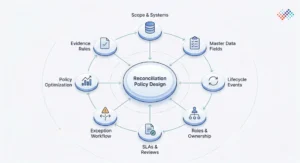
1) Define the scope and systems of record
Start by answering:
- Which asset classes are in scope?
- Which system is the primary system of record for each asset type?
- Which systems receive downstream updates?
For example, a business may use:
- An ERP or FAR for capitalized assets.
- An ITAM tool for user-assigned devices.
- AssetCues or another verification platform for physical evidence.
Policy becomes harder when teams assume multiple systems are “the source of truth” without saying which field belongs where.
2) Set mandatory asset master-data fields
A strong policy should name the minimum record fields required for an asset to be considered control-ready.
Typical mandatory fields include:
- Unique asset ID or tag.
- Description.
- Asset class.
- Acquisition or capitalization date.
- Cost, location, custodian, or department,
- Status.
- Supporting document reference.
- Disposal or transfer reference when relevant.
If the organization accepts blank fields during normal operations, it should expect reconciliation pain later.
3) List every lifecycle event that changes the record
Most policies fail because they define an annual review but not the operational triggers that change records between reviews.
At a minimum, define triggers for:
- Additions.
- Capitalization decisions.
- Transfers.
- Temporary moves.
- User handovers.
- Repairs.
- Class or useful-life changes.
- Disposals.
- Write-offs.
- Leased-asset returns were relevant.
4) Assign owners, approvers, and reviewers
Use named roles, not department names alone. “Operations” is too vague. “Plant manager at the sending site” is better. “IT asset coordinator” is better than “IT.”
Policy language should make three decisions obvious:
- Who starts the action?
- Who approves the action?
- Who updates the system?
- Who reviews the result?
5) Define evidence and document-retention rules
Every controlled event needs a minimum evidence standard. Otherwise, the policy only creates approvals without proof.
Examples:
- Transfer = request + receiving confirmation.
- Disposal = approval + removal proof + financial treatment reference.
- Physical verification = scan/photo/location/time stamp.
- Depreciation-setting change = approved rationale + effective date.
This step is where many spreadsheet-based programs start to weaken. Evidence stays scattered across mail, folders, and local files unless the workflow captures it directly.
6) Set update SLAs, materiality rules, and review cadence
Not every business needs the same SLA. However, every business needs one.
A strong starting point looks like this:
- Event-driven updates for transfers, issues, and disposals.
- Monthly review of open exceptions.
- Quarterly control review for recurring patterns.
- Annual or risk-based physical verification, depending on mobility and value.
State clearly when material differences need escalation and who approves override decisions.
7) Create an exception workflow and escalation ladder
Your policy should explain what happens when:
- An asset cannot be found.
- A disposal has no financial follow-through.
- A transfer has no receiver confirmation.
- Or a record lacks enough evidence to close.
Aging rules help. So do escalation thresholds. For example:
- 0–15 days: Local owner resolves.
- 16–30 days: Functional manager reviews.
- Over 30 days: The finance controller and governance owner intervene.
8) Review policy performance using actual exception data
A policy should not sit unchanged for three years while the same exception types keep repeating. Review the exception log and ask:
- Which site creates the most repeat transfers?
- Which asset classes age the longest?
- Which approvals create bottlenecks?
- Which fields are most often blank or wrong?
That is how policy evolves from documentation into a working control system.
What should an asset movement policy include?
Asset movement creates a disproportionate amount of reconciliation pain because movement is easy in real life and messy in records. Therefore, movement policy deserves more detail than most businesses currently give it.
Minimum clauses to include
A practical asset movement policy should define:
- What counts as a permanent transfer?
- What counts as a temporary move?
- How are remote or off-site assets handled?
- Who must confirm receipt?
- When is a handover mandatory?
- What happens when an asset moves without prior approval?
- What evidence is needed for repair/vendor custody?
- How quickly must the system of record change?
Policy clauses teams skip too often
- Temporary loans:
Temporary loans often turn into permanent record drift because nobody defines a return date or a responsible holder. - Off-site assets:
Assets assigned to remote users, project sites, warehouses, clinics, stores, or third-party locations need explicit ownership and proof of expectations. - Repair or refurbishment custody:
Assets sent for repair often disappear from active location lists without a clear interim status. - Assets that cannot be tagged easily:
High-heat, underground, or hard-to-reach assets still need an identification rule. A policy should say what acceptable alternative evidence looks like. - Exception handling for unauthorized moves:
The policy should say what to do when the business breaks the rule. Good policy plans for real behavior, not ideal behavior.
A simple policy structure you can reuse
A workable policy document usually includes:
- Purpose and scope.
- Systems of record.
- Roles and RACI.
- Asset event definitions.
- Mandatory fields and evidence.
- SLA rules for record updates.
- Escalation path for exceptions.
- Review cadence and sign-off rules.
- Retention and audit-trail requirements.
- Version control and policy owner.
How often should teams review and test controls?
The right answer depends on asset value, mobility, and operational risk. Still, the policy should provide a clear starting point. A vague phrase like “review periodically” usually means “review too late.”
A practical starting cadence
Control area |
Typical trigger |
Starting cadence |
Primary owner |
When to escalate |
|---|---|---|---|---|
| Additions setup | A new asset becomes available for use | Event-driven | Asset accountant/asset manager | Missing setup after SLA |
| Transfers and handovers | Movement between sites, departments, or users | Event-driven | Site owner / IT/facilities | No receiver confirmation or late update |
| Disposals and write-offs | Asset removed, sold, scrapped, or returned | Event-driven | Site owner + finance | Physical removal without derecognition |
| Open exception review | Unresolved mismatches | Monthly | Finance controller/asset manager | Aging beyond policy threshold |
| Control performance review | Repeat patterns, SLA breaches | Quarterly | Governance owner | Same exception type repeats |
| Full or sample-based physical verification | Policy cycle/audit cycle/risk trigger | Annual or risk-based | Asset manager/site teams | High-risk assets are missing or drifting, increasing |
A balanced rule works better than a universal rule
High-mobility IT assets often need stronger event controls and shorter review loops than stationary plant assets. Conversely, very high-value fixed assets may justify tighter approval thresholds even when they move rarely.
That is why a good policy usually combines:
- Event-driven controls for day-to-day changes, and
- Periodic reviews for overall record health.
A one-size-fits-all annual rule is easy to write and hard to defend.
How do software and governance work together?
Software does not replace policy. Software makes policy executable at scale.
That distinction matters. A weak policy implemented in software still produces weak decisions. However, a strong policy supported by the right workflow becomes faster, more visible, and easier to audit.
Where software adds real control value
A useful reconciliation platform helps teams:
- Assign audit or verification tasks by site, department, or asset class.
- Capture photos, time stamps, geolocation, and user history as evidence.
- Enforce required fields during verification or exception closure.
- Route discrepancies to the right owner.
- Maintain tamper-resistant logs.
- Synchronize approved updates back to the asset register, ERP, or ITAM environment.
AssetCues’ asset verification software is particularly relevant when the business wants policy-backed field execution, because the current product workflow already supports mobile verification, exception handling, audit logs, geo-tagged evidence, and synchronized data back to ERP platforms.
Where policy still matters even with software
Software cannot decide:
- Who owns the final sign-off?
- What evidence is mandatory?
- What are your escalation thresholds?
- How does your business distinguish a transfer from a disposal?
- Should the internal audit test the control or operate it?
Those decisions still belong in the policy.
What changes in the USA, India, and the UK?
Country-specific details do not change the core governance model. However, they do affect which controls deserve extra emphasis.
-
USA
US finance teams typically require tighter policy rules around depreciation support, placed-in-service dates, useful-life changes, and disposal evidence, as these directly impact close support and tax documentation. The IRS explains in Publication 946 that the publication covers how businesses recover the cost of business property through depreciation deductions. That makes policy around additions, status changes, and disposals more than an operational issue. It becomes a reporting issue, too.
Suggested emphasis: Finance approval matrix, monthly controller review, and clean disposal support.
-
India
For India, the governance message gets more operational. ICAI materials discussing CARO 2020 highlight proper records showing full particulars, including quantitative details and the situation of PPE, as well as physical verification at reasonable intervals and proper treatment of material discrepancies in the books. That means Indian businesses—especially branch-heavy, plant-heavy, or geographically spread businesses—should write clearer branch-to-HO rules for movement capture, discrepancy escalation, and proof standards.
Suggested emphasis: Branch/site ownership, interval logic for verification, and discrepancy closure in the books.
-
United Kingdom
UK businesses often need stronger governance around acquisitions and disposals, as record quality supports both accurate bookkeeping and capital-allowance claims.. HMRC’s recommended approach to claims and record keeping says good record keeping is important, and recommends keeping clear records of capital allowances claimed. If the business reports under IFRS, IAS 16 also matters because it sets principles for recognition, carrying amounts, and depreciation charges for property, plant, and equipment.
Suggested emphasis: Acquisitions/disposals record quality, capital allowance support, and class-level policy discipline.
Key takeaways
- Reconciliation in asset management is best treated as a policy-backed control system, not a once-a-year exercise.
- Strong policy design links events, evidence, system updates, review, and exception closure.
- Finance should own reporting integrity, but the operating controls should sit close to the teams that create the asset event.
- Asset movement deserves more policy detail than most businesses currently give it.
- Monthly reviews fix today’s exceptions. Better policy design prevents next quarter’s exceptions.
Conclusion
Reconciliation in asset management works best when it is built into everyday operations rather than treated as a periodic clean-up exercise. By clearly defining roles, enforcing event-based controls, and setting consistent evidence and review standards, organizations can prevent mismatches instead of repeatedly fixing them. As a result, asset records stay aligned with real-world activity, audit pressure reduces, and teams spend less time resolving the same issues cycle after cycle.
Frequently asked questions
Q1: Is asset reconciliation policy different from asset verification?
Yes. Asset verification checks physical existence, location, and condition. Asset reconciliation policy defines who updates records, what evidence is required, how exceptions are approved, and how the organization prevents repeat mismatches.
Q2: Should IT be part of fixed asset governance?
Yes, especially when devices, servers, network equipment, or user-assigned technology are in scope. IT often triggers the event that changes the record, so excluding IT from governance creates avoidable drift.
Q3: What evidence should be mandatory for transfers and disposals?
Transfers usually need an approved request, sender and receiver details, effective date, and receiving confirmation. Disposals usually need approval, reason, date, financial treatment reference, and proof that the asset has left active use.
Q4: Can software enforce asset policy?
Software can enforce fields, approvals, evidence capture, audit logs, and exception routing. However, software still depends on clear business rules, named owners, and a well-designed policy.
Q5: What is the best first version of an asset movement policy?
The best first version is simple enough that teams will use it. Start with scope, roles, event definitions, evidence rules, update SLAs, and escalation. Then improve the policy using actual exception data after one or two cycles.