



What Is Agent-Based Discovery?
Agent-based discovery is an IT asset discovery method where lightweight software agents are installed on individual endpoints, such as servers, laptops, desktops, and other managed devices, to collect hardware, software, and configuration data. The agent runs locally on each device and reports asset information to a central management platform, enabling real-time or scheduled inventory updates without depending on network scans.
TL;DR
Agent-based discovery uses software agents installed on each endpoint to collect detailed asset data directly from the device. It delivers deeper visibility than agentless methods and is a cornerstone of accurate IT asset management. Organizations with large, distributed environments rely on it to keep their CMDB and asset register current.
Why Agent-Based Discovery Matters
Enterprises with thousands of endpoints across multiple sites or remote workforces cannot maintain accurate IT inventories through manual processes or periodic scans alone. Without reliable discovery, asset registers contain outdated configurations, unlicensed software goes undetected, and security gaps remain invisible.
Agent-based discovery solves this by collecting data at the source. It captures device-level detail that agentless methods cannot reliably retrieve, such as installed application versions, hardware specifications, OS patch levels, and local user activity. That depth matters for software license compliance, hardware refresh planning, and incident response accuracy.
How Agent-Based Discovery Works
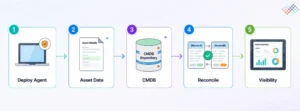
The process follows a straightforward lifecycle:
- An agent is deployed to each target device, either manually or through an automated rollout tool.
- The agent collects asset data, hardware specs, installed software, serial numbers, OS version, network details, and configuration attributes.
- Data is transmitted to a central repository or CMDB at defined intervals or in real time.
- The platform reconciles incoming data against existing records, flagging changes, new assets, or discrepancies.
- Asset managers, IT operations, and compliance teams access up-to-date inventory through dashboards and reports.
This process integrates naturally with Configuration Management Databases (CMDBs) and IT Service Management (ITSM) workflows, keeping configuration items (CIs) synchronized with physical reality.
Agent-Based vs. Agentless Discovery
Factor |
Agent-Based |
Agentless |
| Data depth | Deep – full hardware, software, config detail | Moderate – relies on network protocols |
| Real-time updates | Yes – continuous or near-real-time | Typically periodic scans |
| Deployment effort | Higher – agent install required per device | Lower – no per-device install |
| Offline devices | Can report on last-known state | Not reachable when offline |
| Best fit | Managed endpoints, compliance-sensitive environments | Quick rollout, unmanaged networks |
Best Practices for Agent-Based Discovery
- Standardize agent deployment through your existing device management tools (MDM, GPO, or endpoint management platforms) to ensure consistent coverage from day one.
- Define data collection frequency according to business requirements. For example, high-change environments may require daily or real-time synchronization, whereas stable infrastructure may operate effectively with weekly schedules.
- In addition, reconcile discovered data with the CMDB and asset register on a regular basis. By doing so, teams can identify discrepancies early and prevent them from developing into audit or compliance issues.
- Combine agent-based discovery with agentless methods for environments where agent installation is not feasible, ensuring broader coverage without gaps.
How AssetCues Helps with Agent-Based Discovery
AssetCues integrates with ITSM platforms and CMDB tools to consume discovered asset data and maintain an accurate, audit-ready asset register. By connecting discovery outputs to the fixed asset lifecycle, assignment, transfer, verification, and reconciliation, AssetCues ensures IT inventory data translates into financial and operational control.