



What Is Asset Register Accuracy?
Asset register accuracy measures how well each entry in the fixed asset register matches reality. It confirms that every recorded asset exists and sits in the correct location. It also ensures the right custodian is assigned. Teams verify that financial and descriptive data remain accurate. Ideally, an accurate register contains no ghost asset entries with no physical counterpart and no unregistered assets physical items missing from the system.
In practice, teams express accuracy as a percentage. They divide matched assets across physical and register data by the total audited population. However, organizations do not achieve high accuracy once. They maintain it through strong tagging, controlled transfers, proper assignment records, and regular physical verification.
TL;DR
Asset register accuracy is the degree to which the data recorded in an asset register reflects physical reality the right assets, in the right locations, with the right custodians, at the right values. It is the foundational metric for audit readiness, financial reporting reliability, and the operational effectiveness of any asset management programme.
Why Asset Register Accuracy Matters
The fixed asset register underpins balance sheet values, depreciation calculations, insurance schedules, and tax positions. An inaccurate register creates cascading problems: overstated asset values from ghost assets inflate the balance sheet; understated values from unregistered assets create tax and insurance gaps; incorrect location data slows down audits and increases the scope of physical verification.
For internal and external auditors, register accuracy is a direct indicator of the quality of the organisation’s asset controls. Low accuracy triggers deeper audit procedures, extended timelines, and potential findings. For operations teams, inaccurate registers lead to wasted time searching for assets, duplicate procurement, and incorrect utilisation reporting.
How Asset Register Accuracy Is Measured
Organizations typically assess register accuracy through a physical asset verification exercise by comparing register records against assets found in the field. Specifically, they evaluate key accuracy dimensions such as:
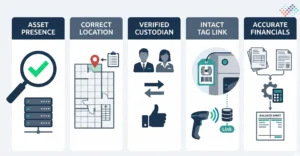
- Physical existence: Is the asset present at the location shown in the register?
- Location accuracy: Does the register location match where the asset was physically found?
- Custodian accuracy: Does the registered custodian match the person or team actually responsible for the asset?
- Tag integrity: Is the asset tag readable, intact, and correctly linked to the asset record?
- Financial data accuracy: Are the cost, capitalization date, and depreciation values correct and supported by documentation?
Overall accuracy rate = (Number of assets matching all verified dimensions / Total assets verified) × 100. Most mature asset management programmes target 95% or above; audit-grade accuracy for regulated industries is typically 98%+.
Best Practices for Improving Asset Register Accuracy
- Conduct periodic physical verification exercises at least annually, and more frequently for high-value or high-movement assets. This way, teams surface discrepancies early and resolve them before they accumulate.
- Enforce transfer controls rigorously. Since undocumented movement is the most common cause of location and custodian errors, teams must update the register for every transfer.
- Resolve exceptions promptly. Rather than deferring issues to the next audit cycle, teams should investigate and close discrepancies within a defined timeframe.
- Use asset tagging to reduce manual data entry errors. By doing so, teams capture more reliable data through barcode or RFID scans at assignment, asset transfer, and verification points instead of relying on paper forms or spreadsheets.
How AssetCues Helps with Asset Register Accuracy
AssetCues is purpose-built to maintain and improve asset register accuracy through structured verification workflows, real-time reconciliation, exception management, and automated register updates triggered by scan events. Teams can measure accuracy rates by site, category, or audit cycle and track improvement over time.