



What Is Chain of Custody?
Chain of custody is a continuous record of who held responsibility for an asset at every stage. It tracks ownership without gaps across the asset lifecycle. Each time an asset changes hands, teams record the transaction. This includes assignments, transfers, repairs, temporary loans, and offboarding handovers. They capture the date, involved parties, asset condition, and approvals.
In fixed asset management, the chain of custody acts as an audit trail. It links the asset’s physical history to its register record. In IT asset management, it is critical during IT asset disposition (ITAD). Teams must maintain a clear custody trail from the organization to the disposal vendor for compliance and security.
TL;DR
Chain of custody is a documented, sequential record of every handoff, movement, or responsibility change for an asset. It covers the asset lifecycle from acquisition to disposal. A complete chain of custody helps teams track every stage of the asset’s life. It is essential for audits, investigations, IT asset retirement, and control of high-value assets.
Why Chain of Custody Matters
For enterprises managing assets across sites, departments, and custodians, broken custody chains often cause audit findings. When teams cannot trace an asset from its last custodian to its current location, risks increase. These gaps create compliance issues and overstate assets through ghost entries. They also expose the organization to security risks if data-bearing devices lack disposal records.
Regulated industries such as banking, pharmaceuticals, and government require strict custody record retention. A strong custody trail also reduces internal disputes. It shows who held the asset and when. This clarity helps teams resolve damage or missing accessory issues quickly.
How Chain of Custody Works
Every transition point in the asset lifecycle should generate a custody record. The core elements of a chain of custody entry are:
- Date and time of the transaction
- Identity of the outgoing custodian (person or department releasing the asset)
- Identity of the incoming custodian (person or department accepting responsibility)
- Asset identifier — tag number, serial number, or asset ID from the register
- Condition at transfer — physical state, accessories, and any noted defects
- Purpose or reason for the transfer
- Approving authority and any supporting reference documents
For high-value assets or data-bearing devices, organizations may also require photographs at each transfer point and a formal sign-off from both parties. The full chain — from first assignment through every transfer to final disposal — should be accessible in the asset register without gaps.
Best Practices for Chain of Custody
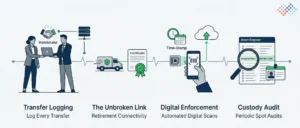
- Treat every asset transfer as a custody event, not just a location change. Even a temporary move to another department for a repair or project creates a responsibility gap unless it is logged.
- Keep the chain unbroken through IT asset retirement. A certificate of data destruction from an ITAD vendor is meaningless if there is no record connecting the retiring organization to the vendor.
- Use asset tagging to enforce the chain digitally. Barcode scans or RFID reads at each transfer point create time-stamped, automated custody records that are more reliable than paper forms.
- Conduct spot custody audits between scheduled physical verifications. Periodic checks confirm that the register-recorded custodian still matches physical possession, catching custody drift before it becomes an audit finding.
How AssetCues Helps with Chain of Custody
AssetCues records a complete custody history for every asset — capturing each assignment, transfer, handover, and retirement event in a time-stamped audit trail. Teams can view the full custody chain from a single asset record, making it straightforward to respond to audit queries or investigate discrepancies.