



What Are Depreciation Methods?
A depreciation method is the systematic approach an organization uses to spread the cost of a fixed asset minus its salvage value over the periods in which the asset delivers economic benefit. Different methods produce different depreciation charges in each period, even when the asset cost, useful life, and salvage value are identical.
The choice of method is a policy decision governed by accounting standards such as IAS 16, local GAAP, and the Income Tax Act. It should reflect the asset’s expected pattern of consumption of economic benefits. Similar assets with a similar pattern typically share a method, but a genuinely different pattern, or a significant component with its own useful life, can justify a different one within the same class. A method change must be disclosed and applied prospectively, not retrospectively.
TL;DR
Depreciation methods are the accounting approaches used to allocate a fixed asset’s cost over its useful life. The chosen method determines the depreciation expense recorded in each period, how quickly the asset’s book value declines, and how financial statements reflect the asset’s consumption pattern. Choosing the right method matters for reporting accuracy, tax planning, and audit defensibility.
The Main Depreciation Methods
1. Straight-Line Depreciation (SLD)
The most widely used method. The asset’s depreciable cost is allocated in equal amounts across each year of its useful life.
Formula: Annual Depreciation = (Cost – Salvage Value) / Useful Life
Example: Asset cost $10,493, salvage value $1,049, useful life 9 years. Annual depreciation = $1,049.
Best for: Assets that deliver relatively uniform benefit over time office furniture, buildings, fixtures, and equipment with stable usage patterns.
2. Written-Down Value / Declining Balance (WDV)
Depreciation is applied as a fixed percentage to the asset’s opening book value each period. This front-loads the depreciation charge higher in early years, declining over time.
Formula: Depreciation = Opening Book Value × Depreciation Rate (%)
Example: Asset cost $10,493, WDV rate 25%. Year 1 depreciation = $2,623. Year 2 = $1,967 (applied to $7,870). And so on.
Best for: Assets that lose value quickly in early years IT equipment, vehicles, machinery that becomes technologically obsolete before it physically wears out.
3. Units of Production (Activity-Based)
Depreciation depends on the asset’s actual output or usage rather than simply on the passage of time. Therefore, companies calculate the period’s depreciation expense by multiplying the per-unit depreciation charge by actual production.
Formula: Per-Unit Depreciation = (Cost – Salvage Value) / Total Expected Units. Period Depreciation = Per-Unit Rate × Units Produced in Period.
Best for: Assets whose wear is driven by usage rather than time mining equipment, printing presses, moulds, and production machinery with measurable output.
4. Sum-of-Years-Digits (SYD)
An accelerated method that applies a declining fraction to the depreciable cost each year. The fraction’s numerator is the remaining useful life; the denominator is the sum of all digits from 1 to the total useful life.
Best for: Assets with front-loaded economic benefit and a preference for an accelerated method with a softer curve than declining balance.
Comparison: Which Method to Use?
| Method | Depreciation Pattern | Best Asset Fit | Tax Consideration |
|---|---|---|---|
| Straight-Line | Equal charge every period | Buildings, furniture, stable-use equipment | Lower deductions early; useful for steady income planning |
| WDV / Declining Balance | Higher early, lower later | IT hardware, vehicles, fast-obsolescing assets | Larger deductions early; often preferred for tax purposes |
| Units of Production | Varies with output | Mining, production machinery, moulds | Reflects true usage; requires output tracking |
| Sum-of-Years-Digits | Accelerated but smoother than WDV | Assets with front-loaded benefit | Less common in practice; more complex to maintain |
Common Depreciation Method Mistakes
- Applying the same method across all asset classes without considering their consumption pattern: A building and a laptop should rarely share the same method.
- Changing methods mid-asset-life without disclosure or a prospective adjustment: Undisclosed method changes undermine financial statement comparability and draw audit scrutiny.
- Ignoring salvage value entirely: Setting salvage value to zero when a realistic residual value exists overstates the depreciation charge and understates the asset’s carrying value.
- Conflating the WDV depreciation method with the WDV (Written-Down Value) concept: The former is a calculation method; the latter is the asset’s current book value at any point.
Best Practices for Depreciation Method Management
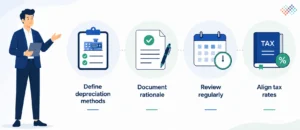
- Define depreciation methods by asset class based on the class’s typical consumption pattern, and review them annually. Where an asset or component within the class wears differently, such as one part of a machine that fails much faster than the rest, document why it takes a different method.
- Document the rationale for each method choice in the asset register: why straight-line for buildings, why WDV for IT equipment. This makes audit defence straightforward.
- Review the useful life and depreciation method at each reporting date, particularly after a significant change in how the asset is used or following a technological shift within the asset class.
- Align tax depreciation rates with the applicable schedule (Income Tax Act rates in India, MACRS in the US, etc.) and maintain separate tax and book depreciation records where they differ.
How AssetCues Supports Depreciation Method Management
AssetCues allows organizations to apply depreciation methods by asset category, automatically calculating depreciation based on configured rules. It supports straight-line, WDV, and custom depreciation rules, with depreciation schedules, ERP synchronization, and audit-ready records of periodic charges.