


What Is Endpoint Management?
Endpoint management is the discipline of controlling and maintaining the devices that connect to an organization’s network and are used by employees to access corporate systems, applications, and data. Endpoints include laptops, desktops, smartphones, tablets, printers, IoT devices, and any other hardware that communicates with the IT infrastructure.
From a device perspective, endpoint management covers provisioning (setting up devices for use), configuration (applying security policies, software, and settings), monitoring (tracking device health and compliance), patching (keeping software and firmware current), and retirement (securely wiping and decommissioning devices at the end of life).
TL;DR
Endpoint management refers to the processes and tools organizations use to deploy, configure, secure, monitor, and maintain end-user devices such as laptops, desktops, mobile phones, tablets, and other network-connected hardware. In the context of asset management, endpoint operations govern the operational lifecycle of IT hardware, while hardware asset management (HAM) and ITAM additionally provide the financial, custody, and compliance oversight required to manage those assets effectively.
Scope of Endpoint Management
Endpoint Category |
Examples |
Management Priority |
| Managed corporate devices | Company-issued laptops, desktops, phones | Full lifecycle control provisioning to retirement |
| Mobile devices (BYOD) | Personal phones accessing corporate email/apps | Policy enforcement, data containerization |
| Servers and infrastructure | Physical servers, virtual machines | Patching, compliance, and capacity monitoring |
| Network devices | Switches, routers, access points | Configuration management, firmware updates |
| IoT and OT devices | Sensors, scanners, smart building hardware | Inventory visibility, network segmentation |
| Shared/pooled devices | Conference room tablets, floor scanners | Assignment tracking, availability management |
Why Endpoint Management Matters for ITAM and Compliance
Endpoint management and IT asset management (ITAM) address overlapping concerns from different angles. Endpoint management focuses on keeping devices operational, secure, and compliant. ITAM focuses on knowing what devices exist, who owns them, what they cost, and where they are in their lifecycle. Organizations need both disciplines working together.
A device management tool that detects a device on the network but does not link it to a financial record or custodian creates a visibility gap. Similarly, an ITAM register that lists every capitalized laptop but is not tracked for patching, compliance, or active use creates a control gap. Therefore, integrating operational device data into the asset register closes both gaps.
Endpoint Management vs. MDM vs. UEM vs. ITAM
Tool / Discipline |
Primary Focus |
Key Capability |
| MDM (Mobile Device Management) | Mobile phones and tablets | Policy enforcement, remote wipe, app management |
| UEM (Unified Endpoint Management) | All device types in one platform | Consolidated policy, deployment, and compliance management |
| Endpoint Management (broad) | All network-connected IT hardware | Patching, configuration, monitoring, provisioning |
| ITAM | Full IT asset lifecycle financial and operational | Cost, depreciation, custody, compliance, disposal |
| CMDB | CI relationships and service impact | Change control, incident impact, service dependency mapping |
Endpoint Lifecycle and Asset Management Integration
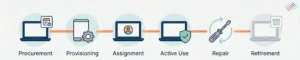
Every endpoint device goes through a predictable lifecycle that spans both endpoint management and asset management responsibilities:
- Procurement: Device is ordered and received; asset record is created in the register with cost, serial number, and category.
- Provisioning: Endpoint management tool configures the device with the required OS, applications, and security policies.
- Assignment: The device is issued to an employee; the asset assignment form is completed, and the custodian is recorded.
- Active Use: Endpoint management monitors health, patch status, and compliance; asset management tracks location, custody, and cost allocation.
- Refresh / Repair: Device is updated, repaired, or replaced; asset record is updated to reflect changes.
- Retirement: It wipes data securely (ITAD process); asset management derecognizes the device from the register with disposal documentation.
Best Practices for Endpoint Management in an ITAM Context
- Integrate your endpoint management platform with your asset register so that device discovery data automatically updates custodian, location, and status fields, eliminating the need for manual reconciliation between the two systems.
- Define a data sanitization and decommissioning process as part of endpoint retirement. Organizations must wipe all devices with storage to a documented standard before disposal or resale and maintain evidence in the asset record.
- Track shadow IT and unmanaged endpoints through regular network scans and discovery tools. Devices operating outside the managed estate create compliance exposure and CMDB inaccuracies.
- Set up automated alerts for endpoints that have not checked in to the endpoint management platform within a defined period. These are candidates for a physical verification check or a custodian follow-up.
How AssetCues Helps with Endpoint Lifecycle Management
AssetCues integrates with ITSM platforms and endpoint management tools to synchronize device data into the fixed asset register. IT hardware tracked in these tools gains a financial and custody record in AssetCues, connecting operational visibility to lifecycle cost, depreciation, and disposal management.