



What Are Noncurrent Assets?
Noncurrent assets, also called long-term assets, represent resources that an organization controls. They provide economic benefits beyond the current accounting period. In contrast, current assets are resources that the organization expects to consume, sell, or convert into cash within 12 months or within its operating cycle, whichever is longer.
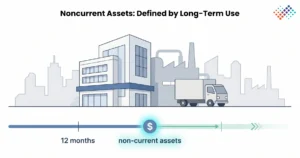
The noncurrent asset classification is defined by purpose and expected holding period, not by physical characteristics. A building held for use in operations is a noncurrent asset. The same building held for sale in the ordinary course of a property developer’s business is inventory — a current asset. Classification follows intent and use, not the nature of the item itself.
TL;DR
Noncurrent assets are assets that an organization expects to hold and use for more than one accounting period, typically more than 12 months. They appear in the noncurrent (or long-term) assets section of the balance sheet and include fixed assets, intangible assets, long-term investments, and right-of-use assets. They do not expect to convert these assets into cash within the normal operating cycle.
Types of Noncurrent Assets
| Category | Examples | Accounting Treatment |
|---|---|---|
| Property, Plant & Equipment (PP&E) | Buildings, machinery, vehicles, equipment | Capitalized; depreciated over useful life; tested for impairment |
| Intangible Assets | Patents, trademarks, software, goodwill, licenses | Capitalized; amortized (definite life) or impairment-tested (indefinite life) |
| Right-of-Use (ROU) Assets | Leased buildings, leased equipment under IFRS 16 | Recognized at commencement; depreciated over lease term |
| Long-Term Investments | Equity stakes, bonds held to maturity, joint ventures | Valued at cost, equity method, or fair value depending on interest held |
| Long-Term Receivables | Deposits, intercompany loans due after 12 months | Carried at amortized cost or fair value |
| Deferred Tax Assets | Tax benefits expected in future periods | Recognized when recovery is probable; not depreciated |
Noncurrent Assets vs. Current Assets vs. Fixed Assets
| Factor | Noncurrent Assets | Current Assets | Fixed Assets |
|---|---|---|---|
| Holding period | More than 12 months | Within 12 months / operating cycle | More than 12 months (subset of noncurrent) |
| Includes intangibles? | Yes: patents, goodwill, software | No | Debated; often used for tangibles only |
| Includes investments? | Yes long-term investments | Short-term investments only | No |
| Balance sheet location | Noncurrent assets section | Current assets section | Within noncurrent assets section |
| Accounting standard term | Used in IAS 1 (presentation) | Used in IAS 1 | Common in practice; PP&E is the formal term |
‘Fixed assets’ is a practical term widely used by finance and operations teams. In accounting standards, the equivalent concept is ‘property, plant and equipment’ (PP&E) under IAS 16. Noncurrent assets is the broader balance-sheet classification that includes PP&E as well as intangibles, ROU assets, and long-term investments.
How Noncurrent Assets Are Reported on the Balance Sheet
Under IAS 1 (Presentation of Financial Statements), the balance sheet presents assets in order of liquidity from most liquid (cash) to least liquid (long-term assets). Noncurrent assets appear in the lower section of the assets side, typically broken down into:
- Property, plant and equipment (net of accumulated depreciation and impairment)
- Intangible assets (net of accumulated amortization and impairment)
- Right-of-use assets (net of depreciation for entities applying IFRS 16)
- Long-term investments and financial assets
- Deferred tax assets
- Other noncurrent assets
Why Noncurrent Asset Classification Matters
Getting classification right affects financial ratios, working capital calculations, and covenant compliance. An asset incorrectly classified as current when it is noncurrent overstates current assets and distorts liquidity ratios. If an organization classifies an asset as noncurrent when it is actually held for sale, it must reclassify the asset under IFRS 5 and measure it at the lower of its carrying amount and fair value less costs to sell.
For fixed asset management teams, the practical implication is that every capitalized asset needs a clear classification: is it PP&E, an intangible, an ROU asset, or a long-term investment? The classification determines the applicable standard, measurement basis, and disclosure requirements.
Best Practices for Managing Noncurrent Assets
- Review asset classification annually: Reassess long-held assets each year, and where necessary, reclassify any asset designated for sale within 12 months as held for sale under IFRS 5.
- Maintain separate asset classes: Next, keep distinct sub-ledgers or asset classes for PP&E, intangibles, and ROU assets within the asset register so the correct accounting treatment applies automatically.
- Conduct impairment reviews: In addition, perform impairment testing for all noncurrent assets when indicators arise, not just for PP&E, but also for intangibles, ROU assets, and long-term investments.
- Reconcile with the general ledger: Finally, reconcile the noncurrent asset register with the general ledger at each reporting date, ensuring that you accurately reflect additions, disposals, depreciation, impairment, and reclassifications in both.
How AssetCues Helps Manage Noncurrent Assets
AssetCues supports the full portfolio of noncurrent physical assets PP&E, ROU assets, and tangible long-term assets within a structured register that tracks classification, cost, depreciation, impairment, and lifecycle status. Finance teams can reconcile noncurrent asset balances to the general ledger directly from the platform’s reporting module.