




Introduction
How to align physical assets, the fixed asset register, and the general ledger using fixed asset reconciliation—without turning every audit into a last-minute cleanup.
Struggling to explain why your fixed asset register, physical verification results, and general ledger never quite match? This guide shows finance, audit, and IT teams how to run fixed asset reconciliation step by step, resolve discrepancies faster, and build a repeatable control that supports accurate reporting and cleaner audits. If you’re looking to streamline and standardise the process, the right asset reconciliation software can make reconciliation faster, more accurate, and easier to manage at scale.
In the USA, finance teams usually care about depreciation support and close accuracy. And in India, physical verification discipline and CARO readiness matter more. Similarly, in the UK, strong asset records also support capital-allowance claims and cleaner disposals. That is why this guide covers both the accounting side and the field-execution side of reconciliation in one place.
In this guide, you’ll learn:
- What fixed asset reconciliation is, and how it connects physical assets, the fixed asset register, and the general ledger.
- Why reconciliation matters, from audit readiness and financial accuracy to stronger operational control across teams.
- How to run a structured reconciliation process, including data preparation, verification, discrepancy resolution, and final tie-out.
- Finally, how to build a repeatable, audit-ready control with clear ownership, documentation, and ongoing tracking.
TL;DR
- Fixed asset reconciliation is not just a finance task. Rather, it is a shared control across finance, audit, IT, facilities, and site operations.
- The strongest programs reconcile three truths at once: what exists physically, what the register says, and what the GL says. In practice, this alignment ensures consistency across records and reality.
- Most organizations should tie the fixed asset register to the GL monthly and run physical verification at a cadence based on asset value, mobility, and risk. Accordingly, this risk-based approach strengthens control and reduces discrepancies.
- The biggest recurring problems are missing additions, delayed disposals, transfer mismatches, duplicate records, and depreciation errors. Consequently, without structured reconciliation, these issues can accumulate and impact reporting accuracy.
- Software helps most when the company has multiple sites, frequent asset movement, or recurring audit pressure. However, software still needs clear ownership, policy, and approvals.
What Is Fixed Asset Reconciliation?
Fixed asset reconciliation is the process of matching fixed asset records to both physical reality and financial records. It simply answers a key question: Can the business prove that the assets on the books actually exist, sit where the records say they sit, and carry the right values?
That answer matters because fixed assets create more than one version of the truth:
- The physical world shows whether the asset exists, where it sits, and what condition it is in.
- Meanwhile, the fixed asset register shows asset ID, description, class, cost, location, custodian, acquisition details, depreciation settings, and status.
- In parallel, the general ledger shows the financial impact: gross cost, accumulated depreciation, and net book value.
If any of those views disagree, the company does not have a clean reconciliation.
Fixed Asset Reconciliation vs. Asset Verification
Fixed asset reconciliation and asset verification are related, but they are not the same thing.
Term |
What it answers |
Typical output |
Primary owner |
|---|---|---|---|
| Asset verification | Does the asset physically exist, and is it in the right place and condition? | Scan result, photo, timestamp, condition note, geolocation, exception note | Field audit team, facilities, ops, IT |
| Fixed asset register maintenance | Is the master record complete and current? | Updated register fields, corrected class, updated custodian, and status change | Finance, asset management, IT |
| Fixed asset reconciliation | Do the physical record, the register, and the GL agree? | Exception log, approved corrections, tie-out statement, audit trail | Finance with cross-functional input |
Why Does Fixed Asset Reconciliation Matter?
Fixed asset reconciliation matters because it protects four outcomes at the same time: financial accuracy, audit readiness, operational visibility, and control discipline.
Finance teams use asset reconciliation to explain balances, close faster, and defend depreciation support. Internal audit uses it to test existence, completeness, and approval discipline. IT and operations use it to keep asset locations, ownership, and lifecycle status accurate. When the process is weak, every team inherits the same mess in a different format.
What strong reconciliation changes for each team
1. Finance controllers
- Reduces unexplained FAR-to-GL variances
- Improves depreciation support and close commentary
- Cuts last-minute journal cleanups
- Produces reviewer-ready workpapers
2. Internal audit
- Strengthens evidence for existence, completeness, and accuracy
- Improves traceability from exception to approval to correction
- Reduces repeat findings caused by weak ownership
3. IT and operations
- Improves location and custodian accuracy
- Surfaces transfer failures and unrecorded disposals
- Reduces loss, duplication, and “we thought someone else had it” problems
4. For asset managers
- Creates a usable register instead of a static spreadsheet
- Makes future audits faster because the baseline improves every cycle
- Connects asset movement policy with measurable outcomes
The hidden cost of poor reconciliation
Poor fixed asset reconciliation rarely fails in a dramatic way on day one. Instead, it creates a slow operational tax:
- The register gets older than reality,
- Depreciation settings drift from the actual asset status,
- Disposals happen in the field before finance sees them,
- Transfers happen informally,
- Duplicate records survive migrations,
- And audit support takes longer every cycle.
That is why the best teams do not treat reconciliation as an annual stocktake with a finance label. They treat it as a control system.
What Is The 3-Way Reconciliation Model?
Most teams talk about reconciliation as if it were a single comparison. In practice, a strong program runs three linked comparisons.
The AssetCues 3-way fixed asset reconciliation model
Comparison |
Main question |
Common mismatch |
Why it matters |
|---|---|---|---|
| Physical assets ↔ Register | Did we find the assets we expected to find? | Missing, duplicate, wrong location, wrong custodian | Supports existence, location, ownership, and operational control |
| Register ↔ General ledger | Do cost, accumulated depreciation, and NBV tie to accounting records? | Missing additions, delayed disposals, class errors, and depreciation mismatch | Supports close accuracy, valuation, and reviewer confidence |
| Physical assets ↔ General ledger (through evidence) | Can we explain the financial value using physical evidence and approvals? | Ghost assets, retired assets still capitalized, and unrecorded assets in use | Supports audit defense and policy enforcement |
This model is the core “information gain” on the page. Many guides cover only one comparison well. Very few show how all three connect.
Why the 3-way model is more useful than a simple count
A physical count alone cannot tell you whether the fixed asset register carries the right depreciation settings. Likewise, a perfect FAR-to-GL tie-out cannot tell you whether the “existing” assets still sit at the location recorded in the system.
That is why a clean reconciliation needs both:
- Field truth, and
- Accounting truth.
Once a company understands that, it stops asking “Did we do the count?” and starts asking “Can we defend the record?”
What Data And Documents Do You Need Before You Start?
A reconciliation project becomes slow and political when the team starts fieldwork without source data, approval rules, or evidence requirements. Therefore, preparation matters more than most teams expect.
Core inputs before the first reconciliation cycle
Input |
Why it matters |
Typical owner |
|---|---|---|
| Fixed asset register extract | Provides the baseline record for asset ID, class, cost, location, custodian, and status | Finance / fixed asset accounting |
| General ledger balances by account and asset class | Let’s test the team on gross cost, accumulated depreciation, and NBV | Finance/controllership |
| Depreciation schedule | Confirms method, useful life, start date, and posted depreciation | Finance |
| Additions log and capitalization approvals | Helps trace new assets recorded financially but not operationally | Finance/procurement |
| Transfer records and custody changes | Explains location and owner mismatches | Operations / IT/facilities |
| Disposal and write-off approvals | Prevents retired assets from staying on the books | Finance/operations |
| Physical verification of evidence | Confirms existence, location, and condition | Field teams/asset managers |
| ERP posting references and audit trail | Let reviewers trace adjustments back to source records | Finance/system admin |
What should a “reconciliation-ready” asset record include?
At a minimum, each asset record should contain:
- Unique asset ID or tag
- Description
- Asset class
- Acquisition or capitalization date
- Gross cost
- Accumulated depreciation / NBV fields
- Location
- Custodian, department, or site owner
- Status (active, transferred, disposed, under repair, etc.)
- System reference or document link
If those fields are inconsistent or blank, the first reconciliation cycle is really a register rehabilitation exercise.
Evidence pack: What auditors and reviewers usually expect?
A useful evidence pack often includes:
- Invoice or capitalization document
- Asset tag or unique ID proof
- Scan record or serial number match
- Photo of the asset
- Date and time stamp
- Location or geotag proof
- Transfer or disposal approval
- Journal reference or ERP transaction ID
- Reviewer comment explaining the resolution
How Do You Reconcile Fixed Assets Step By Step?
A good reconciliation process should feel predictable. If every cycle depends on heroics, the design is weak. The process below works well for enterprise environments because it is owner-based, evidence-based, and audit-friendly.
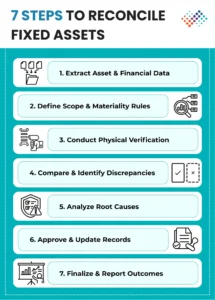
A structured fixed asset reconciliation starts with clean data, a defined scope, and physical verification, followed by identifying and resolving discrepancies. It then closes with updated records and an exception summary, making reconciliation a repeatable control.
1. Export the fixed asset register, GL balances, and depreciation support
Start with the system data, not the field count. Pull:
- The current fixed asset register.
- Relevant asset and accumulated depreciation accounts.
- Period activity.
- Depreciation schedule.
- Additions, transfer, and disposal logs.
Then segment the data by asset class, location, site, or business unit. That makes the work executable.
2. Define the reconciliation scope and materiality rules
Not every asset deserves the same cadence or level of review. Before fieldwork starts, define:
- Which asset classes are in scope?
- Which sites or departments are included?
- What counts as a material exception?
- Who must approve each correction type?
This step prevents the team from debating the rules after exceptions appear.
3. Run physical verification by location, custodian, or department
Now move to the field. The team verifies assets using the method that fits the environment: barcode, RFID, BLE, or guided mobile verification with photos and location proof.
The goal is not only to mark items “found.” The goal is to capture usable evidence that can support a correction later. AssetCues positions this part of the workflow around importing the register, assigning audit tasks to field teams, mobile scanning, discrepancy review, audit logs, and final ERP sync back to systems such as SAP, Oracle, or Dynamics.
4. Compare results and classify discrepancies
Once field results come in, compare them against the fixed asset register and the GL support. Then sort every mismatch into a clear category:
- Not found.
- Found but unrecorded.
- Wrong location.
- Wrong custodian.
- Duplicate record.
- Disposed but still active.
- Addition recorded in finance, but is missing in the register.
- Depreciation mismatch.
- Wrong class or useful life.
At this point, do not jump straight to correction. First, classify the issue correctly.
5. Investigate root causes with evidence
Each discrepancy needs a reason, not just a status. Ask:
- Was the asset transferred without documentation?
- Was the disposal completed physically but not financially?
- Was the invoice posted, but the asset was never created in the FAR?
- Was the asset tagged twice during a migration?
- Did someone change useful life without a finance review?
The answer should point to both the cause and the control failure.
6. Approve corrections and update the system of record
Next, route each exception to the right owner. Finance may approve GL or FAR corrections. IT may confirm device ownership. Site operations may confirm location changes. Internal audit may review whether the evidence and approval trail are strong enough.
Then update the register, post the journal if needed, and preserve the decision trail.
7. Publish the final tie-out and open-exception summary
A strong cycle ends with more than a cleaned register. It ends with:
- A signed or approved reconciliation statement.
- An open-exception log.
- Aging of unresolved items.
- A lessons-learned summary for the next cycle.
That final summary is what turns reconciliation from a clean-up task into a control program.
What Discrepancies Show Up Most Often?
The best reconciliation teams do not only count discrepancies. They build a repeatable response to each type.
Discrepancy Matrix: Issue, Evidence, Owner, and Action
Discrepancy type |
What it usually means |
Evidence to check |
Typical owner |
Usual action |
|---|---|---|---|---|
| Asset missing physically | Asset moved, retired, lost, or recorded incorrectly | Last scan, transfer records, disposal form, custodian confirmation | Operations / IT / Finance | Confirm location, retire asset, or escalate for investigation |
| Asset found but missing from the register | The asset was acquired or inherited without proper registration | Invoice, PO, serial number, site confirmation | Finance/procurement/site team | Create record, classify correctly, confirm capitalization treatment |
| Wrong location | The transfer happened informally or late | Transfer note, mobile scan, custodian confirmation | Operations / IT | Update location and owner fields, review transfer control |
| Disposed asset still on books | Physical retirement happened before the financial update | Disposal approval, scrap note, sale document, journal reference | Finance/operations | Remove from FAR, post-disposal or write-off entry |
| GL addition missing from FAR | Capitalization entry posted, but asset master not created | Invoice, capitalization approval, journal reference | Finance | Create a FAR record and link support |
| Depreciation mismatch | Useful life, start date, method, or class is wrong | Depreciation schedule, policy, and reviewer approval | Finance | Correct settings and recalculate if required |
| Duplicate asset record | Migration or tagging error created two records | Tag history, system migration logs, and physical verification | Finance / IT | Merge or retire duplicate and document the decision |
| Wrong class or useful life | The asset was classified incorrectly or repurposed | Asset specs, policy matrix, capitalization note | Finance | Reclassify asset, update useful life, adjust future depreciation |
¤ Common failure modes behind repeat exceptions
Even when the symptoms differ, the root causes usually fall into five buckets:
- Poor additions control.
- Weak transfer governance.
- Delayed disposal workflows.
- Unreliable master data.
- Disconnected systems.
If the same mismatch category keeps repeating, the team should stop treating it like a one-off exception and fix the policy behind it.
¤ Example: one discrepancy, three systems, one control failure
Imagine a laptop moves from one office to another:
- The physical asset exists.
- IT team reassigns it locally.
- The finance register still shows the old site and old custodian.
The asset is not “missing.” The control failed because the transfer did not flow across systems. Reconciliation should catch that before the next audit.
How Should Finance, Audit, IT, and Operations Share Ownership?
Fixed asset reconciliation fails when ownership is vague. It works when each team knows what it owns, what evidence it must provide, and what it must approve.
A practical ownership model
Team |
Core responsibility |
What success looks like |
|---|---|---|
| Finance/controllership | Owns FAR-to-GL tie-out, accounting policy, capitalization, depreciation, and final sign-off | Clean balances, explained variances, documented approvals |
| Internal audit | Reviews control design, evidence sufficiency, and recurring control failures | Fewer repeat findings, stronger audit trail |
| IT | Validates asset ownership, user assignment, device movement, and integration with ITAM/CMDB where relevant | Accurate user-device mapping and better transfer discipline |
| Operations/facilities/site teams | Confirms physical existence, location, condition, and custody | Faster field verification and fewer unresolved location gaps |
| Asset manager/program owner | Coordinates cadence, status reporting, exception aging, and policy enforcement | Predictable cycle times and lower repeat error rates |
What each team should not do
Finance should not chase every physical exception alone. Similarly, IT should not maintain a parallel truth without reconciliation to finance. Site teams should not move assets informally and assume someone else will update the register. Likewise, the internal audit should not become the operating owner of the process.
The minimum governance every company should document
At a minimum, document:
- Who approves new asset creation?
- Who approves transfers?
- Who approves disposals?
- Who can change a useful life or class?
- Who signs off on unresolved differences?
- How quickly must each exception type be closed?
That governance layer matters because software can enforce workflow, but software cannot invent accountability.
How Often Should Fixed Assets Be Reconciled?
Most organizations should separate financial cadence from physical verification cadence.
A practical rule
- Register-to-GL tie-out: Monthly for most companies.
- Physical verification: Based on risk, mobility, value, and audit requirements.
That balance works because finance usually needs cleaner monthly records, while operations may not need a full wall-to-wall count every month.
Suggested cadence by asset profile
Asset type |
Suggested GL tie-out cadence |
Suggested physical verification cadence |
Notes |
|---|---|---|---|
| High-value plant and machinery | Monthly | Quarterly or semiannual, based on criticality | Use site-based ownership and documented shutdown windows |
| Vehicles and mobile equipment | Monthly | Monthly or quarterly | Mobility increases transfer and loss risk |
| IT devices and laptops | Monthly | Quarterly or rolling cycle counts | Link IT ownership changes to finance updates |
| Medical / lab equipment | Monthly | Quarterly or per policy | Capture condition and calibration context where relevant |
| Furniture and low-value stationery items | Monthly or quarterly, depending on materiality | Annual or risk-based sampling | Use pragmatic controls, not a heavy process for immaterial items |
Country-Specific Guidance For Your Target Markets
¤ USA: depreciation support and close discipline
US finance teams often care about placed-in-service dates, class, depreciation method, and support for book and tax treatment. The IRS explains that business or income-producing property is recovered through depreciation rules in Publication 946, so fixed asset records need to stay consistent with the supporting schedules used for that recovery.
¤ India: physical verification expectations under CARO 2020
For applicable company audits, CARO 2020 requires reporting on whether the company maintains proper records with quantitative details and the situation of property, plant, and equipment, and whether management physically verifies PPE at reasonable intervals. The 2022 ICAI guidance note on CARO 2020 also reflects that CARO 2020 applies to audits from the financial year 2021–22 onward and aligns guidance with the latest Companies Act and Schedule III references.
¤ United Kingdom: record keeping for capital allowances and disposals
HMRC states that good record keeping helps businesses make correct claims and resolve questions faster, and it recommends keeping records of capital allowances claimed either for the specific asset or as part of a pool. That makes clean acquisition, disposal, and value records especially important for UK finance teams.
A balanced note on frequency
Monthly tie-outs are a strong default. However, a very small single-site business with limited asset movement may choose a lighter cadence. On the other hand, a multi-site enterprise with constant transfers usually needs tighter control than an annual count can provide.
What Does A Good Reconciliation Output Look Like?
A successful reconciliation cycle should produce more than “the sheet looks better now.”
Minimum outputs after each cycle
A strong close or audit file should contain:
- Final register extract.
- Relevant GL report.
- Depreciation schedule.
- Signed or approved reconciliation statement.
- An exception log with status and owner.
- Supporting documents for resolved variances.
- Record of what still remains open.
Sample reconciliation summary
Measure |
Amount/result |
Reviewer note |
|---|---|---|
| Gross cost per FAR | $300,602 | Tied after the addition of 3 late-created assets |
| Gross cost per GL | $300,602 | No remaining variance |
| Accumulated depreciation per FAR | $101,325 | Adjusted for one useful-life correction |
| Accumulated depreciation per GL | $101,325 | Tied after approved correction |
| Physical exceptions found | 37 assets | 31 closed, 6 open pending site confirmation |
| High-value open exceptions | 2 assets | Escalated to the plant controller |
| Duplicate records retired | 4 assets | Migration issue documented |
| Disposals completed post-review | 3 assets | Write-off entries posted |
The evidence pack that makes review easier
Reviewers and auditors respond well when the file tells a clear story:
- The mismatch.
- Supporting evidence.
- The decision.
- Who approved it?
- The corrected record.
If any of those five parts are missing, the team will usually revisit the same exception later.
When Do Spreadsheets Stop Being Enough?
Spreadsheets still work in simple environments. If the business has one site, low asset movement, limited IT complexity, and modest audit pressure, a well-controlled spreadsheet process may be acceptable.
However, spreadsheets usually break down when the company has:
- Multiple sites.
- Frequent transfers.
- Recurring field audits.
- Separate finance and IT systems.
- Or a growing backlog of unexplained exceptions.
Signs you have outgrown a manual process
- The same discrepancy types reappear every cycle,
- Field teams send evidence by email or messaging apps.
- Finance waits for site responses before closing.
- Reviewers cannot trace who approved what.
- Or the register becomes accurate only for a short time after the annual audit.
What modern software should improve
Modern asset verification and reconciliation software should make five things easier:
- Importing or syncing the asset register.
- Assigning and tracking field verification tasks.
- Capturing scan, photo, time, as well as location evidence.
- Routing exceptions to the right owner, thereby ensuring accountability.
- Syncing approved changes back to the source systems, so that records remain aligned.
AssetCues currently describes its workflow in exactly those terms: import the asset register, assign audit tasks, verify assets with a mobile app, review discrepancies, and sync final data back to SAP, Oracle, or Dynamics. It also highlights geo-tagged proof, mobile scanning, audit logs, and multi-tech support for barcodes, RFID, and IoT-enabled tracking.
Balanced buying advice
Even so, software is not a shortcut around policy. If the business has no transfer discipline, unclear ownership, or weak capitalization rules, software will surface those issues faster, but it will not solve them by itself.
That is why software evaluation should include:
- Workflow fit.
- Evidence capture.
- Reviewer controls.
- Integration depth.
- Permissions.
- Security and privacy review.
- Vendor’s ability to support both rollout and continuous use.
What KPIs Should Teams Track?
A company cannot improve reconciliation by measuring only whether the cycle ended.
Track these KPIs instead:
- Percentage of assets physically verified.
- GL-to-register variance by asset class.
- Exception rate.
- Average days to close an exception.
- Percentage of high-value exceptions still open after review.
- Recurring discrepancy categories.
- Location mismatch rate.
- Disposed-but-active asset count.
- Duplicate record count.
- Reconciliation completion time.
These measures show whether the register is getting healthier over time.
Common Mistakes That Keep Fixed Asset Reconciliation Messy
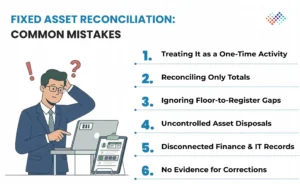
Fixed asset reconciliation often breaks down when teams treat it as a one-time exercise, which leads to data drift and hidden gaps. At the same time, weak disposal controls and disconnected finance and IT records create inconsistencies. Without proper evidence and process discipline, these issues keep repeating and make audits harder to defend.
1. Treating reconciliation as a one-time project
If updates happen only during audit season, the register drifts again as soon as people move, retire, or replace assets.
2. Reconciling only totals
A total balance can be tied while class-level, site-level, or custodian-level records remain wrong. That creates false confidence.
3. Ignoring floor-to-register findings
Teams sometimes focus only on “assets not found.” That misses the opposite problem: assets found physically but not recorded correctly.
4. Letting disposals happen outside the process
When site teams retire assets before finance receives the approval trail, ghost assets accumulate on the books.
5. Running separate truths in finance and IT
This is especially common for capitalized IT assets. Finance keeps the FAR. IT keeps the device record. Reconciliation fails when those records never meet.
6. Correcting records without preserving the evidence
An updated register with no explanation may look clean, but it is not defensible.
Key Takeaways
Fixed asset reconciliation works best when the business stops treating it like a single check and starts treating it like a connected control across the floor, the register, and the ledger.
If you remember only five ideas from this guide, remember these:
- Verification is not reconciliation. Instead, verification gives you field truth. Reconciliation, in turn, turns that truth into reliable records.
- A clean process compares three views. Specifically, physical assets, the FAR, and the GL all need to agree.
- Ownership matters as much as technology. Therefore, without clear approvals and responsibilities, exceptions keep returning.
- Monthly finance tie-outs and risk-based physical checks are a practical default. However, one annual cleanup rarely stays clean for long.
- The real goal is continuous control. Ultimately, the best programs make every future reconciliation cycle smaller, faster, and easier to defend.
Conclusion
Fixed asset reconciliation works best when it becomes part of everyday discipline rather than an occasional clean-up. When teams consistently connect field reality with financial records, small mismatches are caught early before they turn into audit issues or reporting gaps. Over time, this reduces dependency on last-minute fixes and brings more predictability to both financial close and operational tracking.
More importantly, a well-run reconciliation process strengthens decision-making. As a result, clean, trusted asset data helps teams plan disposals, control costs, and manage asset lifecycles with greater confidence. Over time, as the process matures, the focus naturally shifts from fixing errors to preventing them—thereby creating a system where accuracy is maintained continuously, not rebuilt every cycle.

Frequently Asked Questions
Q1. What should tie the fixed asset register and the general ledger?
Ans. At a minimum, gross cost, accumulated depreciation, and net book value should tie after timing and classification differences are explained. Stronger teams also reconcile by asset class, site, or custodian when risk warrants it.
Q2. How often should fixed assets be reconciled?
Ans. Most organizations should tie the FAR to the GL monthly and run physical verification at a risk-based cadence. High-value or highly mobile assets usually need more frequent physical checks than low-risk stationary assets.
Q3. What documents support fixed asset reconciliation?
Ans. Typical support includes invoices, capitalization approvals, depreciation schedules, transfer records, disposal approvals, scan logs, photos, timestamps, geolocation proof, and ERP posting references. The best evidence pack tells a clear before-and-after story.
Q4. What is a ghost asset?
Ans. A ghost asset is an item that remains in the records but no longer exists in the business or should no longer be active. Ghost assets distort both operational visibility and financial reporting.
Q5. Can software replace the whole process?
Ans. Software can automate data capture, exception routing, evidence collection, and system sync. However, software still needs clear policy, approvals, and accountability to produce reliable outcomes.
Q6. What is the best approach for multi-location companies?
Ans. The best approach is staged and owner-based: first, clean the source data; then, assign field work by site; next, capture evidence digitally; after that, route exceptions to the right team; and finally, sync approved corrections back into the source systems.
Q7. What should you do if the register is not trustworthy?
Ans. Treat the first cycle as a rehabilitation project. Clean key master-data fields, validate tags and classes, rebuild evidence discipline, and then move into a monthly control rhythm.