



What Is Asset Decommissioning?
Asset decommissioning is the formal process of removing an asset from active service in an organization. It goes beyond switching off equipment or moving it to storage. Teams confirm the decision to retire the asset and schedule its shutdown or removal. They handle safety and compliance requirements such as utilities disconnection, hazardous material handling, or data wiping. They document the asset’s condition and final status.
They route the asset to the next stage, such as sale, ITAD, recycling, demolition, or formal retirement. Without a structured process, assets enter a grey zone. They remain inactive but still appear operational in records. This creates ghost assets, ongoing depreciation for unused assets, and growing register inaccuracies.
TL;DR
Asset decommissioning is the structured process of withdrawing an asset from operational service, covering shutdown, physical removal, documentation, and handoff to disposal or retirement workflows. It is a critical stage of the fixed asset management process, marking the final lifecycle phase before teams move into fixed asset disposal, where they sell, scrap, return, donate, or write off an asset, and it requires both operational coordination and accounting follow-through.
Why Asset Decommissioning Matters
Decommissioning gaps are one of the most common sources of register inaccuracy in large enterprises. Assets that are informally removed from service powered down, moved to a storeroom, handed back to a vendor, or simply left in place without any formal process remain on the register as active assets. They continue to depreciate, occupy insurance schedules, and appear in physical verification counts as expected-but-absent items.
For IT assets, the stakes are higher: decommissioned servers and laptops that are not formally processed through a data sanitization and ITAD workflow create data breach exposure. For facilities teams, decommissioning machinery without proper utility disconnection and hazard documentation creates safety and compliance risk. A formal decommissioning policy closes these gaps.
How Asset Decommissioning Works
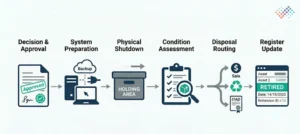
- Decision and authorisation: Teams raise a formal decommissioning request, and the appropriate authority operations, finance, or IT reviews and approves it based on the asset type.
- Preparation: Teams address dependencies by disconnecting utilities, migrating users, backing up and wiping data (for IT assets), and cancelling maintenance contracts.
- Physical shutdown and removal: Teams take the asset out of service and move it to a designated holding area or prepare it for vendor collection.
- Condition assessment: Teams document the asset’s final condition, including valuable components, residual functionality, and any hazardous materials requiring specialist handling.
- Routing to disposal: Teams direct the asset to the appropriate end-of-life path sale, ITAD, recycling, donation, or scrap—and obtain a data destruction certificate for IT assets.
- Register update: Teams update the asset status to decommissioned or retired and record the decommissioning date, reason, approver, and disposal reference.
Best Practices for Asset Decommissioning
- Treat decommissioning as a process, not an event. Teams must complete and log each step: decision, shutdown, documentation, and disposal before they close the asset record.
- For IT assets, teams must perform decommissioning and data sanitization together. A decommissioned device that teams have not sanitized remains a security risk until they wipe or physically destroy it.
- Link work orders to decommissioning tasks. When teams use work order management to track these activities, they create an audit trail and ensure they do not skip any step.
- Additionally, review decommissioning triggers in the asset tracking policy annually. Teams should define and consistently apply criteria such as age, condition, utilisation thresholds, and lease expiry.
How AssetCues Helps with Asset Decommissioning
AssetCues provides structured asset retirement and decommissioning workflows, enabling teams to route end-of-life assets through a defined approval and documentation process before updating the register. At disposal, teams record the asset’s disposal status, decommissioning date, and supporting references, ensuring full audit traceability.