



What is Asset Revaluation?
Asset revaluation is the remeasurement of a fixed asset to its fair value at a specific date, replacing historical cost as the basis for its carrying amount. Under IAS 16, a company can choose the revaluation model for an entire class of property, plant and equipment, while US GAAP doesn’t permit upward revaluation of these assets.
TL;DR
Asset revaluation carries assets at fair value at the revaluation date, less later depreciation and impairment. Increases usually go to a revaluation surplus in equity, and decreases usually go to profit or loss. The model brings the balance sheet closer to current values but commits the company to regular valuations and higher future depreciation.
How It Works
Once a company adopts the model for a class, it revalues every asset in that class. Valuations must happen often enough that carrying amounts stay close to fair value. IAS 16 notes that volatile items may need annual revaluation, while others may need it only every three to five years. IFRS 13 governs how companies measure fair value.
The accounting follows the direction of the change. An increase goes to other comprehensive income and builds a revaluation surplus in equity, unless it reverses an earlier decrease that went to profit or loss. A decrease goes to profit or loss, except to the extent that it uses up an existing surplus for the same asset.
At the revaluation date, accumulated depreciation is either restated in proportion to the gross amount or eliminated against it. The surplus can later move to retained earnings, either on derecognition or gradually as the company uses the asset, but never through profit or loss. Deferred tax under IAS 12 applies to the difference between the revalued amount and the tax base.
In India, Ind AS 16 follows the same model. CARO 2020 asks the auditor to report whether a revaluation relied on a registered valuer. Where the change is 10% or more of a class’s aggregate net carrying value, the auditor states the amount.
Why It Matters
Revaluation changes more than the balance sheet. The revalued amount becomes the new starting point for the depreciable base, so an upward revaluation raises every future depreciation charge and lowers reported profit.
The model also creates a lasting obligation. Valuations cost money, recur for as long as the company uses the model, and must cover the whole class. The register has to keep revalued figures alongside the historical cost figures, making fixed asset reconciliation important for keeping these records accurate and consistent.
Companies usually adopt the model for land and buildings, where market values drift furthest from cost. Choosing it for fast-depreciating equipment rarely justifies the effort.
Example
All figures are illustrative. A company bought a building for $5 million with a 50-year life and no residual value. After ten years, accumulated depreciation is $1 million and the carrying amount is $4 million.
An independent valuer assesses fair value at $4.8 million. The company eliminates the accumulated depreciation against cost, carries the building at $4.8 million, and records an $800,000 revaluation surplus in other comprehensive income, before deferred tax.
Over the remaining 40 years, annual depreciation rises from $100,000 to $120,000. The company can transfer the extra $20,000 each year from the revaluation surplus to retained earnings, without touching profit or loss.
Asset Revaluation vs Asset Impairment
A downward revaluation and an impairment both reduce carrying amount, but they come from different standards. Revaluation remeasures a whole class to fair value on a regular cycle under IAS 16. An asset impairment under IAS 36 applies to assets under either model when an indicator suggests the carrying amount exceeds the recoverable amount. For a revalued asset, IAS 36 treats an impairment loss as a revaluation decrease.
Best Practices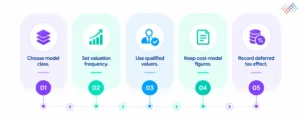
- Choose the model class by class, deliberately: Adopt revaluation where fair values move materially and reliably, typically land and buildings in the asset class list.
- Set valuation frequency by volatility: Revalue more often where market values move quickly, and document the basis for the cycle.
- Use qualified valuers and keep their reports: Auditors, and in India CARO reporting, will look for the valuation evidence.
- Keep cost-model figures alongside revalued amounts: Disclosure still requires them, and they’re hard to rebuild later.
- Record the deferred tax effect with every revaluation: A surplus without its tax effect overstates equity.