



What is Corrective Maintenance?
Corrective maintenance is work carried out to restore an asset to its required function after an operator, technician, or monitoring system identifies a fault. Work may begin immediately if the fault requires urgent attention, or be deferred to a planned maintenance window if the asset can continue operating safely and within acceptable limits.
TL;DR
Corrective maintenance fixes faults after they appear instead of preventing them. Some of it is urgent breakdown work; much of it can wait for a planned window because the fault hasn’t stopped the asset. How much corrective work a site does, and how much of that is emergency work, says a lot about its maintenance program.
Types
- Immediate corrective maintenance: Work begins as soon as someone recognizes the fault, usually because safety, the environment, or output is at stake.
- Deferred corrective maintenance: Work waits for a planned window under defined rules, because the asset still runs within acceptable limits.
- Run-to-failure maintenance: A deliberate choice to let low-criticality items fail and then replace them, typically with spares already on the shelf.
Why It Matters
Unplanned corrective work is the most expensive way to fix the same fault. Emergency jobs pull in overtime, expedited parts, and contractors, and the failure often damages neighboring components. Lost output usually costs more than the repair itself.
Patterns in corrective history expose deeper problems. The same asset failing the same way every few months points to a design, operating, or strategy issue that repeated repairs won’t solve. Comparing that history with asset availability shows which failures actually hurt output.
Corrective work isn’t automatically a sign of failure, though. For cheap, non-critical items with no warning signs, running to failure costs less than inspecting them. A site with almost no corrective work is probably over-maintaining.
Example
All figures are illustrative. A conveyor gearbox fails at 2 a.m. The emergency repair costs $3,200 in expedited parts and $1,600 in overtime, and the line loses six hours of output worth $2,500 an hour. The total cost reaches $19,800.
Now suppose a vibration route had found the same bearing defect two weeks earlier. The team defers the repair to the next changeover, buys parts at normal prices for $2,400, and uses $800 of standard labor. The line loses no output, and the total is $3,200.
Both jobs are corrective, because a fault existed in each case. The difference of $16,600 comes entirely from recognizing the fault early enough to plan the work.
Corrective vs Reactive and Breakdown Maintenance
The terms overlap but aren’t identical. Breakdown maintenance covers only repairs after an asset has stopped, and reactive maintenance is an informal label for working that way by default. Corrective maintenance is the broader category: it includes those repairs and also planned fixes of defects found while the asset still runs. Its natural counterpart is preventive maintenance, which acts before a fault exists.
Best Practices
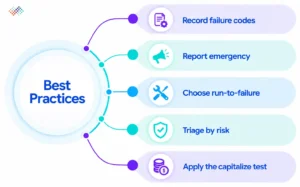
- Record a failure code on every corrective job: Consistent codes turn individual repairs into evidence about causes and strategy.
- Report emergency and planned corrective work separately: A rising emergency share is an early warning that detection or planning is slipping.
- Choose run-to-failure deliberately: Document which assets run to failure, and hold the spares that make the choice safe.
- Triage by risk, not by who reports the fault: Safety and criticality should decide the queue.
- Apply the capitalize-or-expense test to large repairs: Significant part replacements can belong on the balance sheet, while restoring repairs don’t.