



What is Preventive Maintenance?
Preventive maintenance is work carried out before failure to reduce the chance that an asset breaks down. It can be performed on a fixed schedule, such as at set times or usage intervals, or when condition data shows signs of degradation. In everyday use, the term commonly refers to planned servicing, inspection, and part replacement performed at predetermined intervals.
TL;DR
Preventive maintenance services, inspects, and replaces parts before faults appear, so fewer failures reach production. Most programs run on calendar or usage intervals set from manufacturer guidance, regulations, and failure history. It works well against wear-driven failures, but over-servicing wastes money and can introduce new defects.
Types
- Predetermined maintenance: Tasks run at fixed calendar or usage intervals, regardless of the asset’s current condition.
- Condition-based maintenance: Tasks run when monitored parameters show degradation, as described in condition-based maintenance.
- Predictive maintenance: Tasks run ahead of a forecast failure date derived from condition trends, as described in predictive maintenance.
Why It Matters
Wear-driven failures are the most avoidable kind. Regular lubrication, filter changes, and scheduled replacements stop many breakdowns before they cost output, overtime, and collateral damage. For lifts, pressure vessels, fire systems, and vehicles, regulations or insurers often require documented inspections at set intervals.
Warranty terms add another reason. Manufacturers commonly make coverage conditional on following their service schedule, so missing records can void a claim. Fixed asset management connects maintenance history and asset condition with the broader asset lifecycle record.
The failure mode of preventive maintenance is doing too much. Excessive intervals burn labor and parts, and every intrusive task carries some risk of reassembly errors or contamination. Programs that never remove tasks slowly grow more expensive without growing more reliable.
Example
All figures are illustrative. A company runs 25 delivery vans that each cover 60,000 km a year. An oil and filter service every 15,000 km costs $180, so the program costs $18,000 a year.
Before the program, the fleet averaged three engine failures a year. Each cost $9,500 to repair and five days of van rental at $400 a day, for a total of $34,500 a year. The schedule pays for itself if it prevents even two of those failures.
Preventive vs Corrective Maintenance
The two strategies differ in timing. Preventive maintenance acts before a fault exists, while corrective maintenance restores an asset after a fault appears. Neither is better in the abstract: high-criticality assets usually justify prevention, while cheap, non-critical items are often cheaper to run until they fail.
Best Practices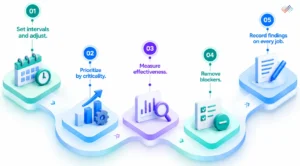
- Set intervals from failure behavior, then adjust with history: Start from manufacturer guidance and regulation, and change intervals when findings show parts wearing faster or slower.
- Prioritize by criticality: Concentrate preventive effort where asset criticality scores are highest.
- Measure effectiveness, not just compliance: Track failures between services alongside the share of tasks completed on time.
- Remove tasks that don’t prevent failures: Review task lists periodically and retire work that finds nothing and prevents nothing.
- Record findings on every job: Notes on wear and defects turn routine servicing into data for better intervals.