



Introduction
Physical Verification Policy – Definition & Importance: A physical verification policy is an internal document that defines how and when an organization will verify the existence and condition of its fixed assets. In simple terms, it lays out a structured procedure for periodic physical asset counts to ensure the assets listed in your books actually exist on the ground. This policy is crucial for maintaining accurate asset records, meeting companies act asset verification requirements, and ensuring ongoing regulatory compliance asset verification.
For example, India’s Companies Act and audits require verifying fixed assets periodically. Similarly, U.S. SOX frameworks demand strong internal controls over asset records. Therefore, regular verification helps eliminate ghost assets that inflate values and distort depreciation, reinforcing the importance of standard fixed asset verification practices.
In short, a well-designed physical verification policy ensures audit-ready accuracy and alignment with laws, from the Companies Act asset verification norms to global standards on regulatory compliance in asset verification.
In this article, you’ll learn:
- Why a formal physical verification policy is critical for audit readiness, governance, and financial accuracy.
- What key elements every asset verification policy must include to satisfy auditors and regulators.
- How India, US, UK, and GCC regulatory requirements impact fixed asset verification practices.
- How technology and automation help execute verification policies consistently and compliantly.
- How AssetCues enables enterprises to build, implement, and sustain audit-ready verification policies.
Why an Asset Verification Policy Is Critical

An asset verification policy is critical for both governance and compliance. Here are key reasons CFOs, Controllers, and Auditors consider it indispensable:
-
Ensuring Accurate Financial Reporting:
Regular physical verification confirms fixed assets on the balance sheet are real. Moreover, it ensures your asset register avoids non-existent ghost assets. Therefore, removing ghost assets prevents overstated values, incorrect depreciation, and compliance issues. Consequently, standards like IAS 16 and ASC 360 require existing assets.
-
Regulatory Compliance & Audit Requirements:
Many regulations require or presume periodic asset verification for compliance. For example, India’s Companies Act mandates verification at reasonable intervals and reconciliation of material discrepancies. Similarly, SOX 404 expects strong internal controls, where physical verification acts as a key safeguard. Therefore, a verification policy proactively ensures regulatory adherence and audit readiness.
-
Preventing Losses, Fraud, and Audit Issues:
A formal policy establishes controls to detect missing or stolen assets early. Moreover, scheduled checks deter misappropriation and quickly flag significant variances. Consequently, auditors increasingly expect documented verification evidence across regions. Therefore, policies ensure audit-ready, verifiable records for regulators and stakeholders.
-
Operational Efficiency & Accountability:
When verification processes are clear, departments maintain stronger asset discipline and accountability. Moreover, structured verification avoids audit scrambling and ensures accurate records. Consequently, audits run smoother with fewer queries and reduced surprise write-offs. In summary, the policy supports governance, protects asset value, and demonstrates compliance.
Key Elements of a Physical Verification Policy
An effective physical verification policy document typically covers several key components. It should be clear, enterprise-grade (formal wording), and practical to implement. Below is a summary of essential elements your policy should include:
Policy Component | Description & Purpose |
Purpose & Scope | The policy defines why it exists and clearly outlines its purpose. Moreover, it specifies scope, detailing which fixed assets require physical verification. Additionally, it aligns verification objectives with broader asset management and compliance goals. Therefore, clarity in purpose and scope ensures consistent, audit-ready execution. |
Frequency of Verification | The policy specifies how often assets are verified across the organization. Moreover, best practice recommends annual verification or rolling cycles every one to three years. Therefore, high-value or mobile assets may require more frequent spot-checks. Finally, the policy defines schedules and clarifies reasonable intervals for compliance. |
Roles and Responsibilities | The policy outlines responsibility for planning and executing asset verification. Typically, a cross-functional team includes Finance, custodians, Facilities, and Internal Audit. Moreover, it assigns clear ownership and permits external experts under guidelines. |
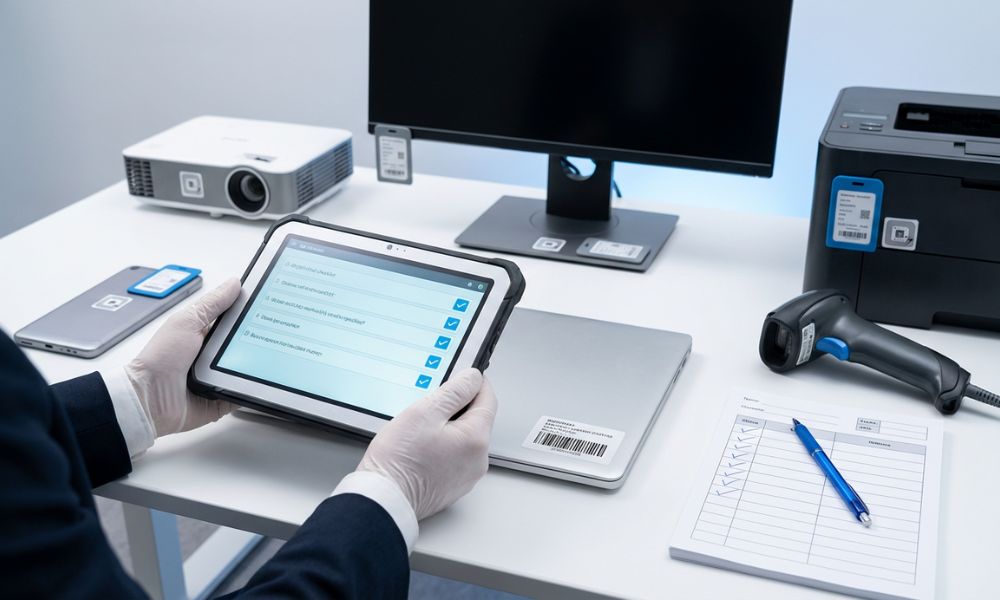
Verification Methodology | Describes how physical verification is conducted across assets and locations. Moreover, it defines methods such as barcode or RFID scanning and wall-to-wall versus floor-to-register checks. Additionally, it outlines procedures for capturing condition and location using mobile apps. Finally, it addresses special cases, allowing indirect evidence for immovable or continuous-use assets. |
Documentation & Reporting | Specifies preparing a Physical Verification Report after each exercise. Moreover, it requires listing verified assets, discrepancies, and signed approvals from teams. Additionally, it defines required audit evidence like logs, photos, and count sheets. Therefore, maintaining a secure audit trail ensures traceability and compliance. |
Discrepancy Reconciliation | The policy defines how discrepancies between physical counts and registers are handled. Moreover, it requires reconciliation statements explaining missing or unrecorded assets clearly. Therefore, material discrepancies must be escalated and adjusted with proper approvals. Finally, every variance must be resolved through updates or authorized write-offs. |
Compliance Reference | Good policies reference the regulatory frameworks they adhere to. For instance: “This policy aligns with the Companies Act 2013 requirements and Clause 3(i) of CARO 2020 for physical verification of assets; it also supports compliance with Section 404 of the Sarbanes-Oxley Act (US) and ISO 55001 asset management standards.” Including this shows that the policy is built with compliance in mind, and guides employees on why these procedures matter. |
Policy Review & Updates | Finally, state how often the policy itself will be reviewed (e.g. annually or biennially) and updated for changes in regulations or business needs. Assign responsibility for periodic review (e.g. Head of Finance or Compliance Committee). This ensures the policy stays current with evolving requirements – for example, if a new law mandates a yearly asset verification, the policy must be revised accordingly. |
Tip: Present the policy in a clear, approved format (often as part of the company’s Finance Manual). Some companies attach a Fixed Asset Verification Checklist or SOP as an appendix to the policy, which provides step-by-step instructions. The policy document can refer to such detailed procedures so that high-level rules and detailed workflows are linked. For a practical example of structuring these elements, see our fixed asset verification process guide which outlines planning, physical inspection, reconciliation, and reporting stages in detail.
Global and Regional Compliance Requirements (India, US, UK, GCC)
Regulatory requirements for asset verification vary by region, but the common theme is that regulators and auditors expect companies to have control over their physical assets. Below we highlight key compliance points in India, the US, the UK, and GCC regions:
-
India:
In India, the Companies Act 2013 makes asset verification effectively mandatory. Moreover, CARO requires auditors to report verification programs and handling of material discrepancies. Therefore, guidance recommends annual verification or at least once every three years. Consequently, formal policies ensure compliance with Ind AS and depreciation rules. Additionally, if companies are ISO 55001 certified or follow Indian GAAP, those frameworks reinforce maintaining accurate asset records.
Bottom line: Indian firms should explicitly mention in their policy that they will conduct physical verification at intervals that satisfy the Act and CARO – typically a full count or cycle count annually. Not doing so can result in auditors qualifying their report or notes in the accounts, which is a serious compliance red flag.
-
United States:
The U.S. lacks a single law mandating annual asset verification. However, SOX Section 404 and US GAAP implicitly require controls ensuring recorded assets exist. Therefore, most public companies adopt periodic verification policies auditors expect. Moreover, such policies act as preventive controls against asset loss under PCAOB standards.
To stay compliant, U.S. companies should align verification policies with COSO principles. Moreover, documenting count frequency and reconciliation procedures supports SOX control requirements. However, lacking verification routines can lead to control deficiencies and audit issues. In short, a robust policy ensures physical inventory accountability and accurate financial records.
-
United Kingdom:
The UK regulatory environment emphasizes true and fair financial reporting and governance. Although laws don’t mandate frequency, Companies Act 2006 implies accurate asset records. Moreover, UK GAAP, IFRS, and governance codes expect safeguarding significant assets. Therefore, physical verification policies support audits, compliance, and sector-specific requirements.
In practice, UK companies follow global best practices with annual or biennial asset verification. Moreover, this approach supports sound financial management and stakeholder expectations. Therefore, a documented policy helps demonstrate director accountability and proper asset records. In summary, UK regulations strongly favor having a physical verification policy.
-
GCC (Gulf Cooperation Council) Region:
In GCC countries, IFRS adoption and new regulations elevate fixed asset management. For example, UAE corporate tax increases scrutiny over depreciation and asset registers. Although annual verification isn’t mandated, auditors increasingly expect physical asset verification. Therefore, strong internal controls prevent penalties, audit adjustments, and compliance risks.
Many large companies in these regions now implement asset tagging and verification programs. For example, UAE advisors note that without tags, proving asset existence under new tax regimes becomes difficult. Therefore, GCC organizations should align verification policies with IFRS, ISO, and local governance codes. Ultimately, a formal policy signals proactive compliance and audit readiness in the post-tax era.
Global Best Practice Note: Across regions, regulatory compliance asset verification is no longer optional. Whether by law or audit expectations, organizations must demonstrate asset control and accuracy. Moreover, aligning with ISO 55001 strengthens compliance by ensuring reliable asset information. Therefore, a formal verification policy becomes a cornerstone of effective asset management.
Tailor your physical verification policy to meet the strictest applicable requirement among your jurisdictions. It’s better to exceed minimum compliance (e.g., do annual counts even if only triennial is required) than to fall short. This will keep you on the right side of regulators in India, the SEC/PCAOB in the US, auditors in the UK, and emerging compliance regimes in the GCC.
How to Align Policy with Regulatory Frameworks (SOX, ISO 55000, Companies Act)
Aligning your policy with regulations and standards means translating high-level requirements into actionable policy statements. Here’s how you can ensure your physical verification policy maps to key frameworks:
-
Sarbanes-Oxley (SOX) & Internal Controls:
For SOX-covered companies, position asset verification as a core internal control activity. Moreover, reconciling records to physical counts and investigating variances supports financial reporting accuracy. Therefore, aligning with COSO principles like segregation of duties and documentation strengthens control testing. Ultimately, a documented verification policy provides clear SOX audit evidence.
-
ISO 55000/55001 (Asset Management Standard):
ISO 55001 requires a systematic asset management framework and reliable lifecycle information. Therefore, position physical verification as part of the broader asset management policy, using risk-based verification for critical assets. Moreover, verification outputs like reports and discrepancy logs support documented information and continual improvement. Consequently, the policy aligns with ISO’s Plan-Do-Check-Act cycle, strengthening compliance and audit readiness.
-
Companies Act & Local Laws:
Aligning policies with national laws requires embedding statutory requirements directly. For example, Indian policies should reference Companies Act, Schedule III, and CARO. Moreover, policies must mandate annual verification, full coverage, and reporting material discrepancies. Therefore, explicit legal references reassure auditors and demonstrate intentional regulatory compliance.
-
Financial Reporting Standards (IFRS/GAAP):
While accounting standards don’t mandate policies, they require accurate asset outcomes. Therefore, verification helps identify lost or disposed assets for derecognition under IFRS/GAAP. Moreover, investigations and write-offs ensure a complete, accurate asset register. Consequently, verification reports support auditor evidence requirements and compliance.
-
Internal Policies and Audit Integration:
Align the physical verification policy with Internal Audit plans and related asset policies. Moreover, cross-reference capitalization and disposal policies to ensure consistency and control. Therefore, the policy should allow Internal Audit oversight through observation or testing. Consequently, this alignment strengthens governance and audit assurance.
In summary, tailor the language of your physical verification policy to mirror the key points of each relevant framework. If done well, anyone reading the policy (be it an ISO auditor, external financial auditor, or compliance officer) can trace requirements to specific sections of your policy. This not only ensures compliance but also makes external audits smoother, since you can demonstrate, on paper and in practice, that you are meeting regulatory requirements proactively.
Role of Technology in Policy Execution
Modern technology is a game-changer in executing physical verification policies efficiently and accurately. Here’s how leveraging the right tools can enhance compliance and save time:

Technology plays a critical role in executing physical verification policies by enabling faster audits, real-time reconciliation, and secure, audit-ready evidence through asset tagging, mobile verification, ERP integration, and analytics-driven oversight.
-
Asset Tagging Systems:
Implementing asset tags like barcodes or RFID forms the foundation of tech-enabled verification. Moreover, the policy can mandate tagging all new assets and using scanners instead of paper checks. Consequently, auditors quickly confirm details via mobile apps, reducing errors significantly. Therefore, technology ensures complete coverage, instantly flagging missing or unrecorded assets.
-
Mobile Verification Apps:
Mobile software like AssetCues enables auditors to verify assets on the go. Moreover, standardized workflows capture photos, condition, and GPS location as verification proof. Consequently, counts finish faster while generating rich, audit-ready evidence. Therefore, enforced in-app steps improve compliance with verification procedures.
-
Real-Time Data and ERP Integration:
One major advantage of technology is instant reconciliation during asset verification. Moreover, integrated systems log discrepancies in real time for immediate review. Consequently, verified data can sync directly with ERP systems, eliminating delays and errors. Therefore, the policy should promote integration to maintain an always up-to-date asset register.
-
Dashboard and Exception Management:
Technology-enabled dashboards provide real-time oversight during asset verification. Moreover, managers can track progress, monitor discrepancies, and enforce timelines automatically. Consequently, advanced features like AI validation and mandatory approvals improve consistency. Therefore, standardized workflows ensure policy compliance and accurate, controlled verification outcomes.
-
Audit Trail and Security:
A key concern in verification is ensuring trustworthy results without data manipulation. Moreover, digital tools create tamper-proof audit trails with timestamps, locations, and user IDs. Consequently, geo-tagged photos and system logs provide strong audit evidence and support investigations. Therefore, role-based access and trail reviews strengthen security and compliance.
-
Analytics and Continuous Improvement:
Over time, the data gathered via tech tools can be analyzed for insights. For example, if certain locations consistently have discrepancies, that may indicate control issues there. Or if certain types of assets often go missing, perhaps additional security is needed for those. By using software that tracks verification history, you can generate reports for management and the board, demonstrating trends and improvements. This ties back to the policy’s review clause – technology makes it easier to evaluate how well the policy is working (e.g., “we achieved 99.5% asset match this year, up from 98% last year after implementing RFID at our warehouses”).
Incorporating technology into a physical verification policy need not be complex. Instead, the policy can state that asset management systems and scanning tools support verification. Consequently, digital records strengthen compliance and simplify audit evidence submission.
How AssetCues Helps Enterprises Build Audit-Ready Policies
Crafting and implementing a physical verification policy can be challenging – and this is where AssetCues provides valuable support. AssetCues is not only a software platform but also a team of fixed asset management experts who understand regulatory compliance deeply. Here’s how AssetCues can help enterprises establish and execute an audit-ready verification policy:
-
-
Expert Policy Frameworks & Templates:
AssetCues offers fixed asset verification policy templates built on proven best practices. Moreover, these templates align with Companies Act asset verification, SOX, and ISO 55001 requirements. Therefore, CFOs can customize quickly without missing critical sections. Consequently, organizations gain audit-ready, compliant policies without starting from scratch.
-
Audit & Compliance-Ready Records by Design:
AssetCues automatically enforces policy compliance throughout asset verification. Moreover, the platform generates audit-ready reports, logs, and clear asset statuses aligned with auditor expectations. Consequently, policy rules embed directly into workflows, ensuring mandatory evidence like photo capture. Therefore, compliance becomes built-in, delivering transparency, accountability, and audit confidence.
-
Policy-Driven Lifecycle Control:
AssetCues extends beyond one-time verification by embedding control across the asset lifecycle. Moreover, it delivers audit-ready accuracy, policy-driven workflows, and real-time visibility from acquisition to disposal. Consequently, organizations configure verification frequency, responsibilities, and approvals aligned with policy mandates. Therefore, AssetCues ensures daily operations fully match policy requirements without execution gaps.
-
Technology Enablement and Automation:
As discussed earlier, technology is key, and AssetCues leads this transformation. Moreover, mobile scanning and AI powered asset management features make verification faster while improving accuracy. Consequently, built-in analytics and ERP integration ensure audit-ready, synchronized records. Therefore, AssetCues enables full policy compliance with real-time visibility and control.
-
Professional Services – Verification & Tagging:
In addition to software, AssetCues provides professional Asset Verification and Tagging Services. Moreover, expert teams deliver durable tagging, accurate counts, and audit-ready reports. Consequently, organizations achieve enterprise-wide consistency while retaining full oversight. Therefore, these services help kick-start policy implementation with clean, compliant asset records.
-
Continuous Support and Improvement:
AssetCues isn’t a one-time solution; we continuously help refine asset policies. Moreover, platform updates and our knowledge base keep teams aligned with evolving regulations. Additionally, ongoing staff training ensures best practices during every verification cycle. Essentially, we act as an extension of your finance and compliance team when it comes to asset management. By using AssetCues, you create a sustainable cycle: policy -> implementation -> feedback -> improvement. Moreover, our solution is built by audit and compliance professionals. Notably, many blog authors are Chartered Accountants, reinforcing credibility and trust. Therefore, the platform aligns closely with external auditors and regulators.
-

Key Takeaways
- Overall, a physical verification policy ensures assets recorded in books actually exist, supporting accurate financial reporting and audit readiness.
- Moreover, regulations and audit frameworks across India, the US, UK, and GCC increasingly expect documented verification controls, making a formal policy essential for compliance.
- Finally, technology-enabled execution streamlines verification, reduces discrepancies, and delivers continuous audit-ready accuracy across the asset lifecycle.
Conclusion
In short, AssetCues helps demystify and operationalize the physical verification policy. We give you the tools, templates, and expert help to ensure that your policy is not just a document on paper, but a living practice that delivers audit-ready results. The outcome for your enterprise is tangible: smoother audits, no compliance headaches, and confidence that your fixed asset investment is accurately accounted for and safeguarded.
A physical verification policy brings structure, accountability, and consistency to how organizations confirm asset existence and condition. When aligned with regional regulations and supported by technology, it strengthens internal controls, simplifies audits, and ensures asset data remains reliable over time. Enterprises that formalize and digitize this process are better equipped to meet regulatory expectations while maintaining long-term governance and operational clarity.
FAQs
Q1: Is physical verification of fixed assets mandatory for all companies?
Ans: Requirements vary by jurisdiction, yet physical verification is widely expected. For example, India mandates verification, while SOX-driven audits expect strong controls. Similarly, GCC regions highly recommend verification to support audits and tax compliance. Therefore, best practice treats verification as mandatory to avoid compliance failures.
Q2: How frequently should we conduct physical asset verification?
Ans: The ideal frequency varies by asset risk, but annual verification remains best practice. Moreover, large organizations may use rotating cycle counts ensuring all assets are verified periodically. Therefore, critical and high-value assets require annual checks, while low-risk items allow longer cycles. Ultimately, consistent scheduling and documentation demonstrate a systematic, audit-ready verification approach.
Q3: What should we do if discrepancies are found during physical verification?
Ans: When discrepancies arise, policies must clearly define investigation and root-cause identification steps. Moreover, teams should document discrepancies thoroughly, creating a reliable audit trail. If discrepancies prove material, then escalate issues to senior finance leadership. Finally, approved record adjustments and preventative actions ensure accuracy and future compliance.
In essence, find out what happened, fix the records, and fix the process. And keep evidence – for example, if you removed 10 missing assets from the books, retain the approval and journal entry copies with the verification file. This shows auditors that discrepancies weren’t ignored but properly resolved.
Q4: Who should be responsible for carrying out the physical verification? Can we outsource it?
Ans: Primary responsibility typically rests with the Finance or Fixed Assets team, working closely with operating departments. Moreover, a cross-functional approach involving Finance, asset-owning departments, and Internal Audit improves accuracy and oversight. However, organizations may outsource verification to specialists like AssetCues, especially for large or distributed asset bases. In summary, clear internal ownership combined with supervised external expertise strengthens compliance and efficiency.
Q5: How can technology streamline the physical verification process?
Ans: Technology dramatically improves efficiency and accuracy in physical asset verification. For example, barcode and RFID scanning speeds identification while reducing errors and creating instant logs. Moreover, mobile verification apps enable real-time updates, photos, GPS evidence, and faster consolidation. Consequently, centralized dashboards, real-time reconciliation, and secure audit trails strengthen regulatory compliance asset verification and audit confidence.
In practice, technology-driven verification reduces weeks-long physical audits to days. Moreover, automated systems improve accuracy by eliminating false discrepancies from data errors. Therefore, platforms like AssetCues reduce manual effort, speed audits, and strengthen compliance. Consequently, geo-tagged photos and digital checklists provide verifiable proof for auditors.