


Introduction
A tag that reads perfectly on the supplier’s demo table can go silent once it sits on a steel cabinet, a cleaned trolley, or a hot motor housing. If you are about to specify RFID tags and readers for real assets, this guide shows how to choose them for the job and prove them on your own assets. You can then buy with evidence rather than catalogue claims.
RFID tagging means attaching radio-frequency identification tags to assets so readers can identify them without line of sight, which is the foundation of rfid tracking. Good tagging matches the tag, its mounting, and the reader to the tracking job and the asset’s surface, then proves that combination on real assets before anyone orders in volume.
This guide to RFID asset tagging is written for the engineering, procurement and deployment teams who turn an RFID decision into a hardware specification. It also helps finance and audit reviewers see how a physical tag becomes trustworthy evidence on the asset record.
In this guide, you will learn:
- What RFID tagging setup fits different tracking jobs, including asset counts, passage detection, proximity monitoring, and position tracking.
- How passive, active, and battery-assisted tags differ, and how surfaces, environmental conditions, mounting, and exposure affect tag selection.
- How to evaluate readers, antennas, regional requirements, and tag-reader combinations through structured testing on actual assets and operating conditions.
- How to qualify RFID hardware using acceptance criteria, dated evidence logs, supplier documentation, pilot results, and controlled retagging practices.
Which RFID technology is best for asset tracking? Start with the tracking job
No single RFID technology is best for asset tracking. The right choice depends on the job the tag must do: help people count assets, record assets passing a point, show that an asset is nearby, or estimate its position. Each job needs a different combination of tag, reader and infrastructure, so define the job before comparing products.
Many enterprise asset programmes start with counting and passage detection, because those jobs cover audits, storeroom checks and movement through controlled doors. Passive UHF tags, often sold under the RAIN RFID name, suit both: they carry no battery, they are small and inexpensive per unit, and a reader can identify many of them in one pass.
Proximity and position are different jobs. Proximity can use a handheld finder mode or active tags, while position needs installed location infrastructure, usually with battery-powered tags, and costs more to run.
Match the RFID setup to the tracking job
Tracking job | Question it answers | Typical tag and reader pattern | What it cannot tell you |
|---|---|---|---|
| Count | Which tagged assets are in this room or area at the time of the sweep? | Passive UHF tags; handheld reader or reader sled on a mobile device | Where each asset sits within the area |
| Passage detection | Did this asset pass this door, dock or cage, and when? | Passive UHF tags; fixed reader and antennas at the choke point | Where the asset went after the read |
| Proximity | Is the asset near this reader or locator? | Active (battery) tags or handheld finder modes; readers within range | A precise position |
| Position | Where exactly is the asset inside the covered area? | Active tags, or passive tags read by fixed antenna arrays, with installed locators and calibration | Anything outside the instrumented area |
It also shows a common trap in tag selection: a tag and handheld bought for counting will not become a position system without installed infrastructure, however good the tag is. Handheld and fixed-reader RFID give event-based visibility, while continuous position needs suitable installed infrastructure, which is what separates basic reads from RFID location tracking.
Passive, active or battery-assisted tags?

Power source is the second decision, and it follows from the job. A passive tag draws its power from the reader’s signal, while an active tag carries a battery and can transmit on its own. Battery-assisted (semi-passive) tags sit between the two: the battery supports the tag’s electronics, but the reader still starts the conversation.
Where each tag power type fits
Tag type | Best fit | Watch out for |
|---|---|---|
| Passive | Bulk audits, IT sweeps, storerooms, portals | Range depends on surface, mounting, reader and environment |
| Active | High-value mobile equipment, large yards, assets needing alerts | Larger tags, battery replacement, installed locators |
| Battery-assisted | Sensor-enabled or specialist cases | Battery lifecycle and higher unit cost |
Which RFID tags suit metal, liquids, high temperatures and cleaning?
The best RFID tags for asset tracking are the ones that survive the asset’s surface and environment and still read at the distance your workflow needs. Metal reflects radio energy and liquids absorb it; as the NIST RFID environment considerations explain, materials and deployment conditions change RFID performance. A standard label can therefore read well on a plastic case and fail on the same model’s aluminium version.
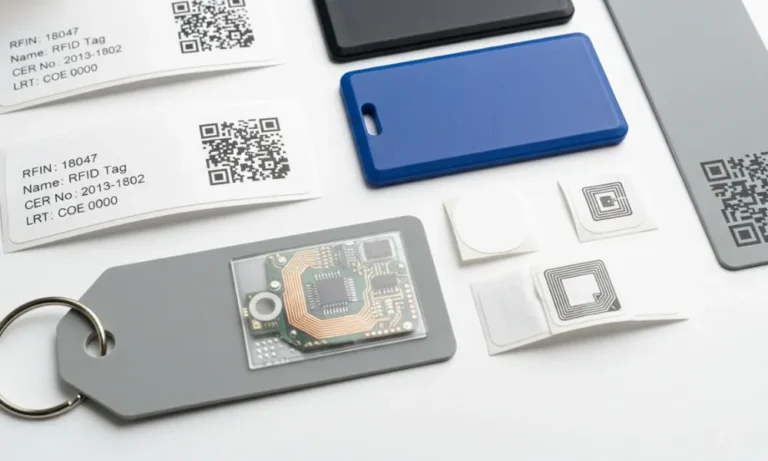
Form factor follows from that. Standard labels and inlays suit plastic, wood and painted surfaces. On-metal labels and hard tags include a spacer or design that lets them work against metal. Cable-tie and embedded tags suit small or irregular items, and tamper-evident labels show removal, which matters for theft-prone or high-value assets.
Starting candidates to test, by asset class:
Asset class | Surface and exposure risks | Tag form factors to shortlist | What to test before rollout |
|---|---|---|---|
| Laptops and IT peripherals | Metal or plastic casings, curved edges, heat vents, daily handling | Low-profile label; on-metal label where casings are metal | Read at normal audit distance; adhesion after handling; no blocked vents |
| Servers and network devices | Dense metal racks, cable clutter | On-metal label or small hard tag | Reads by rack position, aisle direction and tag orientation |
| Plant machinery | Metal, vibration, oil, dust, heat | Rugged on-metal hard tag | Mounting method, read distance, cleaning and maintenance access |
| Mobile medical and lab equipment | Cleaning chemicals, curved plastic and metal, frequent moves | Cleanable label or rugged tag | Survival through the real cleaning cycle; placement clear of operating controls |
| Outdoor containers and returnable items | UV, rain, impact, stacking | Rugged UHF hard tag | Weather exposure, portal reads, stray reads near the gate |
| Liquid-filled containers and equipment | Liquid absorbs UHF energy; reads change when full or empty | Stand-off or liquid-tolerant tags placed away from the liquid side | Reads with the item full and empty, from the normal approach side |
| Tools and toolboxes | Impact, abrasion, small or irregular surfaces, frequent handling | Rugged hard tag, cable-tie tag or embedded tag | Attachment strength, reads when stacked, stray reads near the tool cage |
| Furniture and office assets | Low value, rarely moved | Standard label, or barcode instead of RFID | Whether RFID improves the audit enough to justify the tag |
RFID tags for equipment tracking often face heat, oil, impact, and repeated cleaning, which is why the plant and mobile-equipment rows lean towards rugged hard tags. The IT rows are different: dense racks and metal casings make RFID IT asset tracking a test of on-metal labels and placement.
The furniture row makes a fair point too: for low-value, rarely moved assets, a barcode or QR label may give the audit what it needs at lower cost.
High-temperature, chemical and cleaning exposure
High-temperature RFID tracking tags are built for assets near ovens, engines, sterilisation or paint lines, but makers rate them for specific temperature ranges and exposure times. Read the rated range and duration on a current data sheet, then run your own exposure test with the real cleaning agents, heat cycles and handling. A tag that survives one wash but peels after repeated washes has not passed.
Label materials, adhesives and tamper evidence
Label durability is a materials decision as much as an RFID one. Polyester labels suit indoor assets, while anodised aluminium and polycarbonate face plates stand up better to abrasion, chemicals and outdoor exposure. For RFID, a metal face plate must be part of a tag engineered to work with it; a standard inlay behind metal will not read.
The adhesive must match the surface energy and texture, and a protective laminate helps printed IDs stay readable. Tamper-evident constructions leave a visible pattern or break apart when removed, which tells an auditor that a tag has been interfered with.
What reader and antenna setup does RFID tagging need?
RFID tagging needs a reader setup that matches where each read should happen and who is responsible for it. Handheld readers and mobile sleds suit audits and searches by people walking an area. Fixed readers, portals and cabinet readers capture assets crossing a boundary or sitting in controlled storage. Printers and encoders produce and check labels before they reach the asset.
Reader options and what each one demands:
Reader option | Best for | What it demands from you |
|---|---|---|
| Handheld reader or mobile sled | Audits, IT sweeps, room searches, exception checks | Trained users, a scanning routine, charged devices |
| Fixed reader with antennas | Doors, docks, cages, choke points | Read-zone design, mounting, power, network, stray-read tuning |
| Shelf or cabinet reader | Controlled storage of files, tools or kits | Higher installation effort and careful tuning |
| Printer and encoder | Producing and verifying labels in volume | Label stock control and a rule for rejected tags |
Antenna shape where a fixed reader can see. Placed well, they create a read zone that covers the doorway and little else; placed badly, they miss assets or pick up tags in the next room. Read zones, direction, tag mounting, power and connectivity all need validating in a site pilot rather than trusting a drawing.
Region-specific operation
UHF RFID frequencies and permitted power levels differ by region. GS1’s overview of UHF frequency allocations for RAIN RFID shows, for example, that North America uses a different UHF band from most of Europe. Treat that overview as a planning reference only: confirm the approvals for each reader and each country with the supplier and the local regulator before standardising hardware across sites.
How do you qualify RFID tags and readers before buying in volume?
Qualify RFID hardware by testing each shortlisted tag and reader combination on the actual assets, in the actual environment, with the actual workflow, and by recording every result in a dated qualification log. Supplier data sheets tell you what a product should do; only your own tests show what it does on your assets.
Test on the actual asset
Bench tests flatter tags. Attach each candidate to real assets using the final placement rule, then read it with the production reader model at the distance and direction your users will work. Include the difficult cases on purpose: the metal version of a laptop, the server at the top of a full rack, the trolley after cleaning.
Placement tests for each tag candidate:
Test | What to check | Pass condition |
|---|---|---|
| Surface | Does the tag read on the real material? | Reads reliably mounted on the asset, not only in hand |
| Orientation and distance | Does it read from the user’s normal position? | Reads at the workflow distance and direction |
| Stacking | Does it read when assets sit together as stored? | Target assets read in normal storage |
| Exposure | Does heat, cold, moisture, UV, or cleaning affect it? | Still reads after realistic exposure |
| Adhesion and mounting | Does it stay attached? | Survives handling, cleaning and maintenance |
| Stray reads | Does the reader pick up nearby assets? | Read zone can be tuned or extra reads filtered |
| Fallback | Can people identify the asset without RFID? | Human-readable ID and barcode or QR stay visible |
What sets read range on your assets?
Read range on your assets depends on the whole setup, not the tag alone. The tag’s antenna size and design matter, and so do the reader’s power setting and antenna, the regional power limit, the surface underneath, the tag’s orientation, and how closely assets are stacked.
Datasheet ranges are measured in ideal conditions. Find your working range by moving the reader away from a mounted tag along the user’s normal approach and recording where reads start to drop, then repeat it on the difficult surfaces.
Record read conditions and failures
A qualification log turns testing into evidence. Each entry links one supplier claim to the setup you tested, the outcome you observed, and the decision you made. Claims you have not tested stay marked “unverified”, so nobody later mistakes a data-sheet promise for a site result.
Field | What to record |
|---|---|
| Supplier claim | The exact statement from the data sheet, with the data sheet’s date or version |
| Test date | The date of the test, so later supplier changes can be compared |
| Tested setup | Tag model with inlay and adhesive version, reader model and firmware, asset, mounting, placement, reader power and antenna |
| Conditions | Environment, exposure applied, distance, orientation, stacking |
| Outcome | Reads attempted, reads successful, stray reads, failures and their cause |
| Decision | Accepted, rejected, retest or unverified, with who decided and when |
| Review date | When the entry must be re-checked, for example after a supplier changes the inlay |
Worked example:
A supplier’s data sheet says an on-metal label “reads on metal surfaces”. The team logs that claim, mounts the label on the aluminium lid of a test-equipment case and reads it with the production handheld at the audit distance. It reads every time on a single case, but misses the middle cases in a stack of five.
The decision is “retest” with a revised placement on the case side. The second test passes, and the log now records the accepted placement, the reader setting, and the stacking result, so the next site does not repeat the first mistake.
Run the qualification as a short, ordered process:
- Group assets by surface and environment, including the difficult classes, and pick a representative sample from each.
- Shortlist at least two tag options per class, one of them a conservative choice for difficult surfaces.
- Run the placement tests and log successes, misses, and stray reads separately for each option.
- Apply the exposure the asset will really face, such as cleaning, heat, vibration, or weather, and read again.
- Accept a tag only on reliability, then document the approved placement with photos for the tagging routine.
What evidence should you ask RFID suppliers for?
Ask RFID suppliers for evidence you can check, not only for prices. A complete response lets procurement compare offers on the same basis and gives engineering something to test against.
- A current, dated data sheet for each tag and reader, including rated temperature range, surface suitability, and mounting instructions.
- The air-interface standard supported. RAIN RFID tags and readers implement ISO/IEC 18000-63, also known as GS1 UHF Gen2, which is what allows products from different makers to work together.
- Compatibility of readers or sleds with your mobile devices and asset software, and of printers and encoders with the label stock.
- Encoding support, so you can write your own identifier scheme to the tag and lock it if your policy requires.
- Regional approval for each reader in each country where it will operate.
- Warranty and durability terms, including what happens when adhesive or inlay fails early.
- Site samples in enough quantity to run the placement tests before any volume order.
RFID asset tracking cost follows from these choices rather than from the tag’s unit price alone. Rugged, on-metal and active tags cost more than standard labels, and fixed readers bring installation, power and tuning work that handhelds do not. A cheap tag that fails early can cost more in retagging and audit exceptions than the better tag would have.
Best practices for RFID tagging
The practices below keep a tagging programme reliable after the pilot, when volumes grow and suppliers change.

- Set acceptance criteria before testing starts: So results are judged against agreed targets rather than whatever the first tag achieves.
- Keep a reference sample of each approved tag: With its data sheet, so later deliveries can be compared against what was qualified.
- Re-qualify after any supplier change: To inlay, adhesive, label stock or reader firmware, even if the part number stays the same.
- Separate commissioning rights from tagging work: So the person attaching tags is not also approving record changes.
- Keep retagging kits on site: With approved spare tags, so a damaged tag is replaced through the controlled workflow on the same visit.
Key Takeaways
- No RFID technology is best for every asset; choose by tracking job: count, passage, proximity or position.
- Passive UHF tags suit audits and doorways; position needs installed location infrastructure, usually with battery-powered tags.
- Metal, liquids, heat, and cleaning decide which tags work, so test candidates on the actual asset before buying in volume.
- A dated qualification log separates tested results from untested supplier claims.
- A tag read proves the identifier, not the attachment or ownership; commissioning and controlled replacement make the link trustworthy.
Conclusion: Tag for the job, prove it on the asset
Successful RFID tagging is less about finding the best tag and more about proving the right one. Define the tracking job, shortlist tags for each surface and environment, choose readers for where each read should happen, and qualify every combination on real assets with a dated log. Then link each tag to its asset record under control, so every read can be trusted as evidence in RFID fixed asset tracking.
AssetCues supports this process by connecting RFID-tagged assets with their asset records and tagging workflows, helping teams move from hardware qualification to controlled asset tracking.

Frequently asked questions about RFID tagging
Q1. What RFID tags work on metal assets?
Ans: On-metal RFID tags work on metal assets because their design or spacer layer lets them operate against a metal surface. Standard labels usually read poorly when mounted directly on metal. Flag-mounted tags that stand off the surface, or tags set into a recess, are options where a flat label will not fit. Test each on-metal option on the real asset, since curvature, coatings and nearby metal still change results.
Q2. Can RFID tags be used outdoors?
Ans: RFID tags can be used outdoors when they are rugged tags built for UV, moisture, temperature swings, abrasion and impact. Check the rated exposure on the data sheet, then run a weathering and handling test on the real asset before buying in volume.
Q3. How long do RFID asset tags last?
Ans: RFID asset tag life depends on the tag’s construction, the adhesive and the environment, so no single figure applies. Passive tags have no battery to run down, so they usually fail through physical damage or adhesive loss; active tags also depend on battery life. Ask suppliers for rated life under your conditions, and record real failures by asset class during rollout.


