



What is an Asset Class?
An asset class groups fixed assets of similar nature and use, such as buildings, vehicles, or IT equipment, under one set of accounting rules. In fixed asset accounting, the term has nothing to do with investment asset classes like equities or bonds.
TL;DR
An asset class is the accounting grouping that decides an asset’s default depreciation method, useful life, general ledger accounts, and place in the financial statements. IAS 16 requires several key choices and disclosures at the class level, including choosing between the cost and revaluation models. Put an asset in the wrong class, and every one of those defaults goes wrong with it.
How Asset Classes Are Used
IAS 16 describes a class as a grouping of assets of a similar nature and use in an entity’s operations. Its examples include land and buildings, machinery, ships, aircraft, motor vehicles, furniture and fixtures, and office equipment. Companies define their own classes within that principle, usually in the capitalization and depreciation policy.
Much of the accounting then runs at class level. The measurement model applies to an entire class, and the fixed asset note discloses measurement bases, depreciation method, useful lives, and a reconciliation of movements for each class. In most ERP systems, the class also determines which general ledger accounts receive cost, accumulated depreciation, and depreciation expense.
Tax rules group assets differently. In India, Schedule II of the Companies Act, 2013 sets useful lives by type of asset, while income tax pools assets into blocks by depreciation rate. In the US, MACRS assigns recovery periods through its own asset classes. Book classes rarely map one-to-one onto any of these.
Components
- Class name and code: A stable identifier used in the fixed asset register, reports, and system configuration.
- Accounts: The general ledger accounts for cost, accumulated depreciation, and depreciation expense.
- Depreciation defaults: The standard method, useful life, and residual value assumption for new assets.
- Capitalization threshold: The minimum cost at which the company capitalizes an item in this class instead of expensing it.
- Measurement model: Cost or revaluation, applied to every asset in the class.
- Tax mapping: The tax block or recovery class each book class feeds.
Why It Matters
Classification errors spread quietly. The class feeds defaults into the asset master data record at creation. A wrong class means a wrong life, wrong accounts, and a wrong disclosure line, often for years before anyone notices.
Class design also shapes what finance can do later. Because revaluation applies to a whole class, a company can’t revalue one attractive building and leave the rest at cost. Companies using the group depreciation method normally draw pool boundaries by class as well, so broad classes produce blunt averages.
The number of classes is a trade-off. Too few classes force dissimilar assets onto the same life and method. Too many classes create inconsistent coding, and reporting fragments into lines nobody reads.
Example
All figures are illustrative. A company completes $900,000 of improvements to a leased office with ten years left on the lease. The team codes the spend to the Buildings class, which carries a 40-year life, instead of Leasehold Improvements.
The Buildings class charges $22,500 a year. Leasehold Improvements would have charged $90,000 a year over the remaining lease term, so depreciation runs $67,500 a year too low. When the lease ends, the company still carries $675,000 for improvements it’s leaving behind and has to write the balance off in a single year.
Asset Class vs Asset Category
The terms often share a screen but serve different users. The asset class is the accounting grouping that drives policy defaults and disclosure. Categories and sub-categories sit beneath it for operational tracking, such as laptops, monitors, and docks within an IT equipment class.
Best Practices
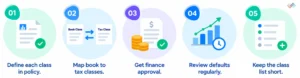
- Define every class in written policy: Record the accounts, depreciation defaults, threshold, and measurement model for each class.
- Map book classes to tax classes: A maintained mapping keeps tax depreciation and deferred tax calculations traceable.
- Put class changes behind finance approval: Reclassifying an asset changes its depreciation and disclosure, so it shouldn’t be a free edit.
- Review class defaults with useful lives: Test each class’s default estimated useful life against actual retirement patterns at year-end.
- Keep the class list short enough to use: Add a class only when the assets genuinely need different accounting