



Introduction
Every fixed asset generates a predictable set of journal entries across its life and an unpredictable set when something is missed. Fixed asset accounting entries record the lifecycle events of long-term tangible assets: capitalization at cost, periodic depreciation, improvements, transfers, and disposal with gain or loss.
Every fixed asset entry in accounting pairs a balance-sheet movement with its supporting evidence, keeping the register, the ledger and the audit file aligned. The asset capitalization entry sets the tone for everything downstream; get the initial cost basis wrong, and every depreciation entry that follows inherits the error.
This guide carries both: fifteen worked entries from capitalization to disposal, each with the evidence that should sit behind it, plus the corrections nobody puts in textbooks.
In this guide, you will learn:
- What journal entries are required throughout the fixed asset lifecycle, from capitalization and depreciation to transfers, disposals, and corrections.
- How to record common fixed asset transactions accurately, including CWIP transfers, improvements, repairs, inter-company transfers, and disposals.
- Why supporting evidence, maker-checker approvals, and asset-level documentation are essential for accurate accounting and audit readiness.
- How to apply a consistent process for selecting, preparing, approving, and posting fixed asset journal entries throughout the asset lifecycle.
Entry index
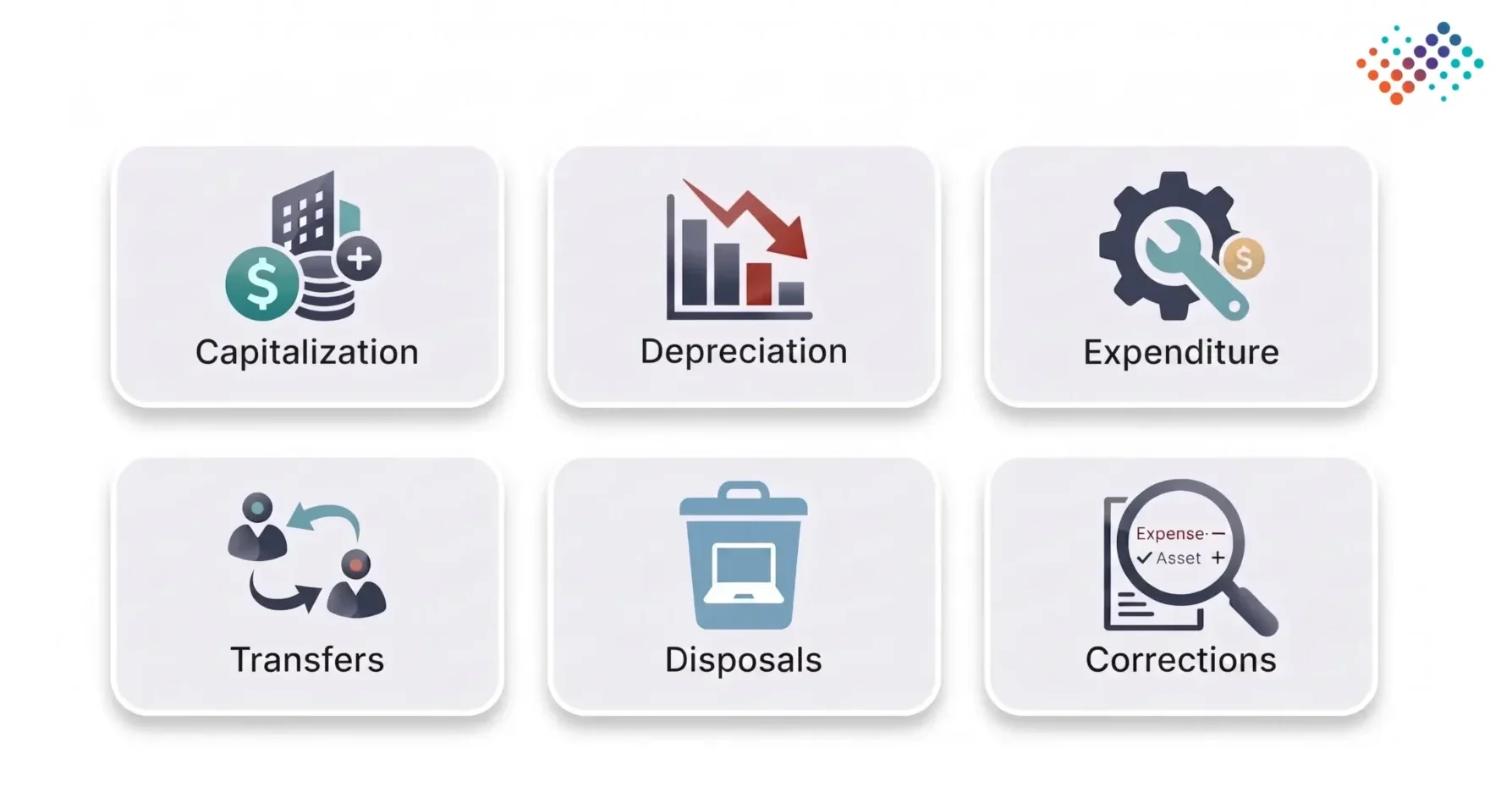
- A. Capitalization: Direct purchase · purchase with retention · CWIP transfer · post-capitalization adjustment
- B. Depreciation: Periodic · catch-up for late capitalization
- C. Subsequent expenditure: Improvement · repair (the contrast pair)
- D. Transfers: Inter-site · inter-company
- E. Disposals: Sale at gain (worked) · sale at loss · scrap/write-off
- F. Corrections & verification: Wrongly capitalized expense · asset found in verification
A. Capitalization entries
1. Direct purchase of a fixed asset
The foundational entry cost includes the purchase price plus directly attributable costs to bring the asset to working condition:
Debit |
Credit |
| Fixed asset (class) | Accounts payable / Bank |
Tax treatment splits by market. In India, GST claimed as input credit is excluded from the capitalized cost; only irrecoverable GST enters it. In the US, non-recoverable sales tax is capitalized as part of cost.
Evidence: Invoice, GRN, installation certificate.
2. Purchase with retention money withheld
Common in Indian construction and machinery contracts: part of the price is withheld until the defect-liability period ends. The full cost is capitalized now; the retention sits as its own liability:
Debit |
Credit |
| Fixed asset (class) | Accounts payable + Retention money payable |
Evidence: Contract retention clause, RA bill, retention release terms.
3. Transfer from CWIP at readiness
When a constructed asset or a separable part becomes ready for use, its accumulated cost exits CWIP, including Mass Additions Oracle workflows, where construction costs are capitalised to fixed assets.
Debit |
Credit |
| Fixed asset (class) | Capital work in progress |
Evidence: Ready-for-use certificate, final cost sheet.
4. Post-capitalization cost adjustment
A late invoice for an eligible cost arrives after the asset is capitalized. This follows the same principles as asset capitalization in SAP for subsequent acquisition costs. Add it to the asset’s cost and depreciate the revised amount prospectively.
Debit |
Credit |
| Fixed asset (class) | Accounts payable |
Evidence: Late invoice, eligibility note, approval.
B. Depreciation entries
5. Periodic depreciation
Debit |
Credit |
| Depreciation expense | Accumulated depreciation |
Run per your schedule, by component where significant India’s Schedule II makes the component approach mandatory for significant parts, covered in our standards guide. Method selection and worked schedules live in our depreciation content.
Evidence: Depreciation run report, policy reference.
6. Catch-up depreciation on late capitalization
The entry textbooks skip. An asset ran from February but was capitalized in June; depreciation is owed from February, because the ready-for-use date governs, not the posting date:
Debit |
Credit |
| Depreciation expense (current period; prior-period adjustment if material) | Accumulated depreciation |
Frequent catch-up entries are a symptom, not a habit to accept: the placed-in-service event is being captured late. The date doctrine is covered in placed in service vs ready for use.
Evidence: RFU certificate, catch-up computation, materiality assessment.
C. Subsequent expenditure: the contrast pair
7. Improvement that meets recognition criteria
Debit |
Credit |
| Fixed asset (class) | Accounts payable / Bank |
8. Repair or maintenance
Debit |
Credit |
| Repairs & maintenance expense | Accounts payable / Bank |
Same invoice format, opposite balance-sheet effect. An improvement extends life, capacity or performance; a repair restores what was there. The decision framework with ten worked classification calls is in capitalize vs expense.
Evidence: Capitalize-vs-expense test documented at coding, work order, approval.
D. Transfer entries
9. Inter-site transfer (same legal entity)
Usually no P&L entry at all: update location, custodian and cost centre in the register, with a reclass entry only if the asset class changes. The control is register accuracy, not the GL.
Evidence: Transfer note, receiving site acknowledgement.
10. Inter-company transfer
A transfer between group entities is a disposal for the seller and an acquisition for the buyer, at the agreed transfer value:
Debit (transferor) |
Credit (transferor) |
| Receivable from group company + Accumulated depreciation | Fixed asset cost + gain (or debit loss) |
Transfer pricing rules and GST or sales tax apply, and the result is eliminated on consolidation. Treat the paperwork with disposal-grade seriousness.
Evidence: Transfer agreement, TP/board approval, tax invoice.
E. Disposal entries
One computation drives all three variants: compare net proceeds with net book value.
11. Sale at a gain worked example
A machine costing ₹20,00,000 with accumulated depreciation of ₹15,50,000 is sold for ₹6,00,000 gross, with ₹20,000 of selling costs:
Computation |
Amount (₹) |
| Net book value (20,00,000 − 15,50,000) | 4,50,000 |
| Net proceeds (6,00,000 − 20,000) | 5,80,000 |
| Gain on disposal | 1,30,000 |
| Debit | Credit |
| Bank 5,80,000 + Accumulated depreciation 15,50,000 | Fixed asset cost 20,00,000 + Gain on disposal 1,30,000 |
12. Sale at a loss
Same structure; the balancing figure flips sides:
Debit |
Credit |
| Bank + Accumulated depreciation + Loss on disposal | Fixed asset cost |
13. Scrap or write-off (no proceeds)
Debit |
Credit |
| Accumulated depreciation + Loss on write-off | Fixed asset cost |
India note for all disposals: assess GST on the disposal consideration separately; it does not change the gain-loss computation above.
Evidence: Sale invoice or scrap certificate, disposal approval per the authority matrix, delivery or destruction proof.
F. Corrections and verification entries
14. Expense wrongly capitalized
Debit |
Credit |
| Repairs / relevant expense (+ reverse depreciation taken) | Fixed asset (class) |
Document the reason code. One correction is housekeeping; a pattern of them is a coding-control failure that auditors will write up.
15. Asset found in physical verification
Verification finds a working asset that was never recorded as a write-on:
Debit |
Credit |
| Fixed asset (class) | Other income / retained earnings, per materiality and framework |
The entry is the small part. The investigation into why the asset was unrecorded usually matters more, and that chain is covered in the (GRN) goods received note-to-fixed-asset.
Evidence: Verification report, valuation basis, root-cause note.
The evidence rule: what turns entries into audit answers
Every entry above carried an evidence line, and that is the real message. An entry without its document is an explanation; an entry with it is an answer.
Three practices make the difference at scale:
- Attach evidence at posting, against the voucher; never reconstruct at audit.
- Route capitalization, disposal and correction entries through maker-checker approval.
- Keep the asset reference on every entry, so the register, ledger and evidence tie per asset.
This is where the process usually strains: evidence scattered across email and drives, approvals in inboxes, and the capitalization pack rebuilt manually every close.
AssetCues holds evidence, approvals and comments against each capitalization case, enforces maker-checker, and produces an audit-ready pack linked to the final ERP asset reference; your ERP stays the book of record.
How to record fixed asset journal entries: 5 steps
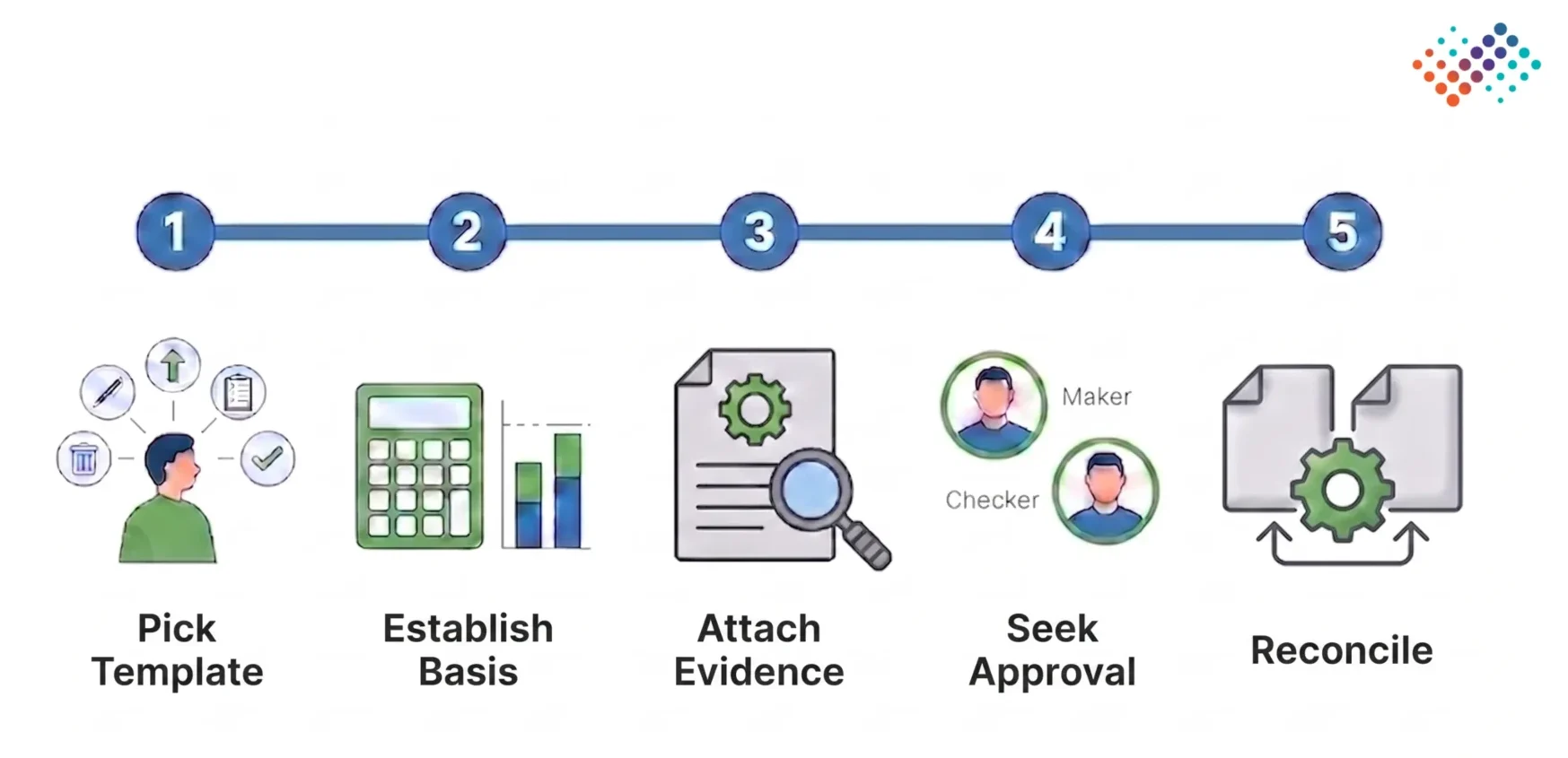
- Identify the lifecycle event capitalization, depreciation, improvement, transfer, disposal or correction and pick the matching template.
- Establish the amount basis: cost build-up, schedule output, or the proceeds-versus-NBV computation.
- Attach the evidence listed for that entry before posting, against the voucher.
- Route through the approval the entry class requires maker-checker for capitalization, disposals and corrections.
- Post with the asset reference, confirm the register and ledger move together, and reconcile them through the fixed asset roll forward.
Key takeaways
- Fifteen entries cover practically everything: four capitalization variants, two depreciation entries, the improvement/repair pair, two transfers, three disposals, and two corrections.
- The entry is the easy half. The evidence attached to it invoice, certificate, approval is what survives an audit.
- Disposal accounting is one computation: proceeds versus net book value; the sign decides gain or loss.
- Catch-up depreciation exists because depreciation runs from the ready-for-use date, not the posting date.
- US and India presentations differ mainly in tax mechanics: GST input credit, retention money, and Schedule II lives.
Conclusion
Accurate fixed asset accounting entries ensure every stage of an asset’s lifecycle is supported by the correct journal entries, approvals, and documentation. Whether recording asset capitalization, depreciation, transfers, or disposals, every fixed asset accounting entry should be backed by complete supporting evidence to strengthen financial reporting and audit readiness.
Asset capitalization software supports this process by automating capitalization workflows, approvals, and supporting documentation while integrating with your ERP to improve accuracy, compliance, and audit readiness.
FAQs on fixed asset journal entries
Q1. What is an asset capitalization entry?
Ans: An asset capitalization entry records a fixed asset on the balance sheet at cost: debit the fixed asset class and credit accounts payable, bank, or capital work in progress for constructed assets. Cost includes the purchase price plus directly attributable costs to bring the asset to working condition.
Q2. How do you record the disposal of a fixed asset?
Ans: Remove both the asset’s cost and its accumulated depreciation, record any proceeds, and recognise the balance as a gain or loss. Gain or loss equals net proceeds minus net book value, where net book value is cost less accumulated depreciation.
Q3. What is the entry when CWIP becomes a fixed asset?
Ans: Debit the relevant fixed asset class and credit capital work in progress for the accumulated cost of the ready asset, with depreciation starting from the ready-for-use date.