


Introduction
Most “GAAP vs IFRS” guides compare the whole frameworks and give fixed assets three paragraphs. This one inverts that by focusing on the fixed asset accounting standard followed in each major regime, the accounting standard for fixed asset recognition and measurement, and the fixed asset accounting best practices that make every treatment auditable.
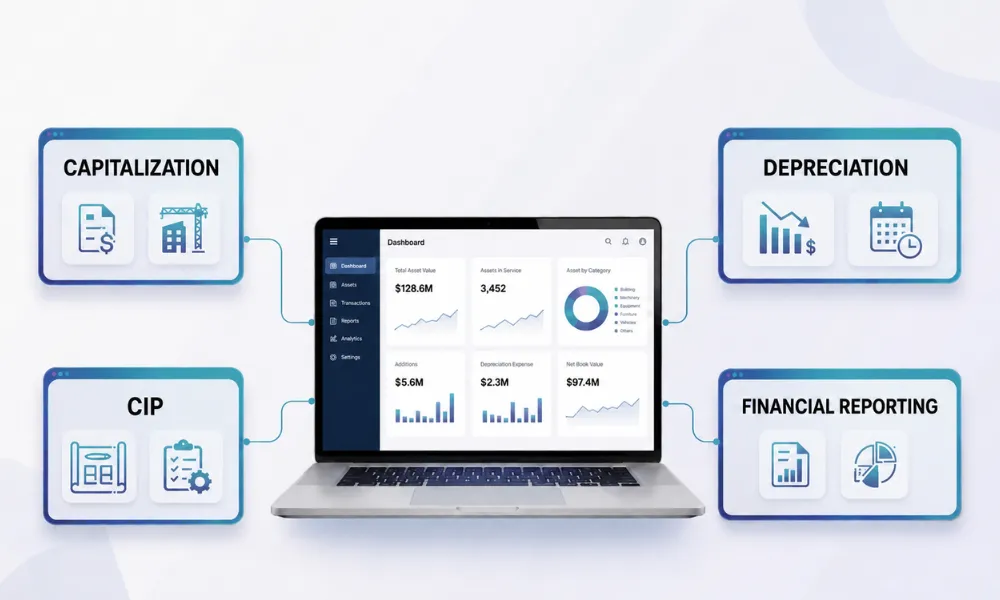
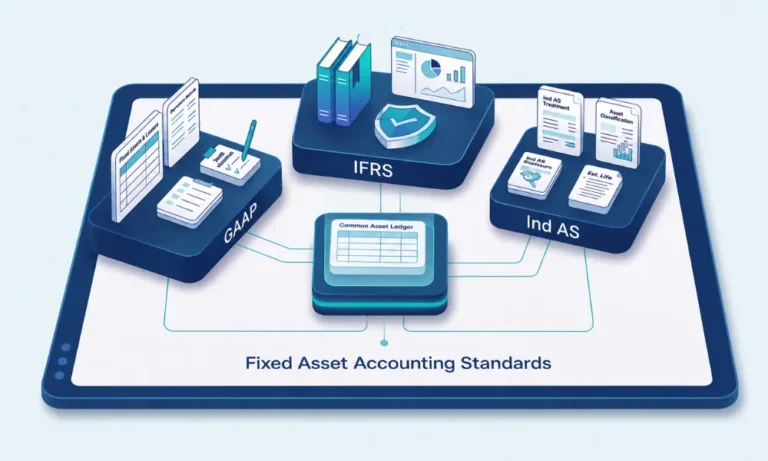
Fixed asset accounting standards are the rules governing recognition, measurement, depreciation, impairment and disclosure of property, plant and equipment: ASC 360 under US GAAP, IAS 16 under IFRS, Ind AS 16 and AS 10 in India, and GASB standards for US governments, with each jurisdiction pairing its book standard with separate tax-depreciation rules.
In this guide
- Which fixed asset accounting standards apply across major jurisdictions, and how US GAAP, IFRS, Ind AS, AS 10, and GASB differ in recognition, depreciation, impairment, and reporting.
- How key accounting treatments such as revaluation, componentization, borrowing costs, impairment, and tax-book differences vary across accounting frameworks.
- Why strong capitalization policies, reconciliations, physical verification, and documented controls are essential for audit-ready fixed asset accounting.
- How to apply fixed asset accounting standards consistently across multiple countries while maintaining compliance, operational controls, and reliable financial reporting.
Which standards govern fixed asset accounting?
It depends on where you report. US public and private companies apply ASC 360 under US GAAP; over 140 jurisdictions apply IAS 16 under IFRS; India applies Ind AS 16 for larger entities and AS 10 for the rest; US state and local governments apply GASB standards.
Each book standard then pairs with a separate tax regime, and the pairing, not the book standard alone, is what your systems must actually handle, including asset capitalization in SAP for organizations running SAP landscapes.
The big three compared: ASC 360 vs IAS 16 vs Ind AS 16
Feature |
ASC 360 (US GAAP) |
IAS 16 (IFRS) |
Ind AS 16 (India) |
| Initial measurement | Cost, including directly attributable costs | Cost, same principle | Cost, converged with IAS 16 |
| Subsequent measurement | Cost model ONLY, no upward revaluation | Choice per class: cost model OR revaluation model | Same choice as IFRS; revaluation via OCI |
| Componentization | Permitted, not required | REQUIRED for significant parts with different lives | Required, reinforced by Schedule II |
| Impairment | Two-step: undiscounted cash-flow trigger, then fair-value measurement; NO reversals | One-step recoverable amount (higher of fair value less costs and value in use); reversals permitted | Follows the IFRS model (Ind AS 36) |
| Borrowing costs | Capitalized for qualifying assets (ASC 835-20, avoidable interest) | Capitalized, mandatory (IAS 23) | Capitalized, mandatory (Ind AS 23) |
| Depreciation start | When placed in service | When available for use | When available for use |
Three of these rows do most of the damage in practice.
Revaluation is the most misstated: several guides present it as how IFRS values fixed assets. It is a choice, made per class, and most IFRS filers still elect the cost model; the difference is the option’s existence, not its universal use.
Impairment runs on different engines entirely. A US GAAP asset can pass the undiscounted test while the identical asset fails IFRS’s discounted recoverable-amount test- same facts, different write-down. And once taken, the US GAAP loss is permanent; IFRS reverses when conditions recover.
Componentization decides depreciation accuracy for complex assets. Under IFRS and Ind AS, significant parts with different lives must depreciate separately; US GAAP permits but does not compel it, so identical plants can carry structurally different charges across a group’s US and IFRS books.
Government fixed asset accounting: GASB (and GRAP)
US state and local governments follow GASB, not FASB. GASB 34 brought capital assets including infrastructure onto government-wide statements, measured at historical cost and depreciated over useful life.
Two features are distinctive. Infrastructure may use the modified approach with no depreciation, provided the government maintains the assets at a documented condition level and reports on it. And capitalization thresholds are policy decisions, with GFOA guidance commonly anchoring them at $5,000 or higher.
Lease and subscription assets have their own recent standards (GASB 87 and 96), pulling right-of-use assets into the capital-asset universe. South Africa’s public sector runs a parallel structure under GRAP alongside IFRS for the private sector.
India specifics: Schedule II and CARO
India layers two compliance mechanisms over the accounting standard that other markets leave to judgement.
Schedule II of the Companies Act prescribes indicative useful lives for factory buildings: 30 years; other RCC buildings: 60 years; general plant and machinery: 15 years; computers: 3 years (servers: 6 years); furniture: 10 years; office equipment: 5 years, with departures permitted but disclosed and justified.
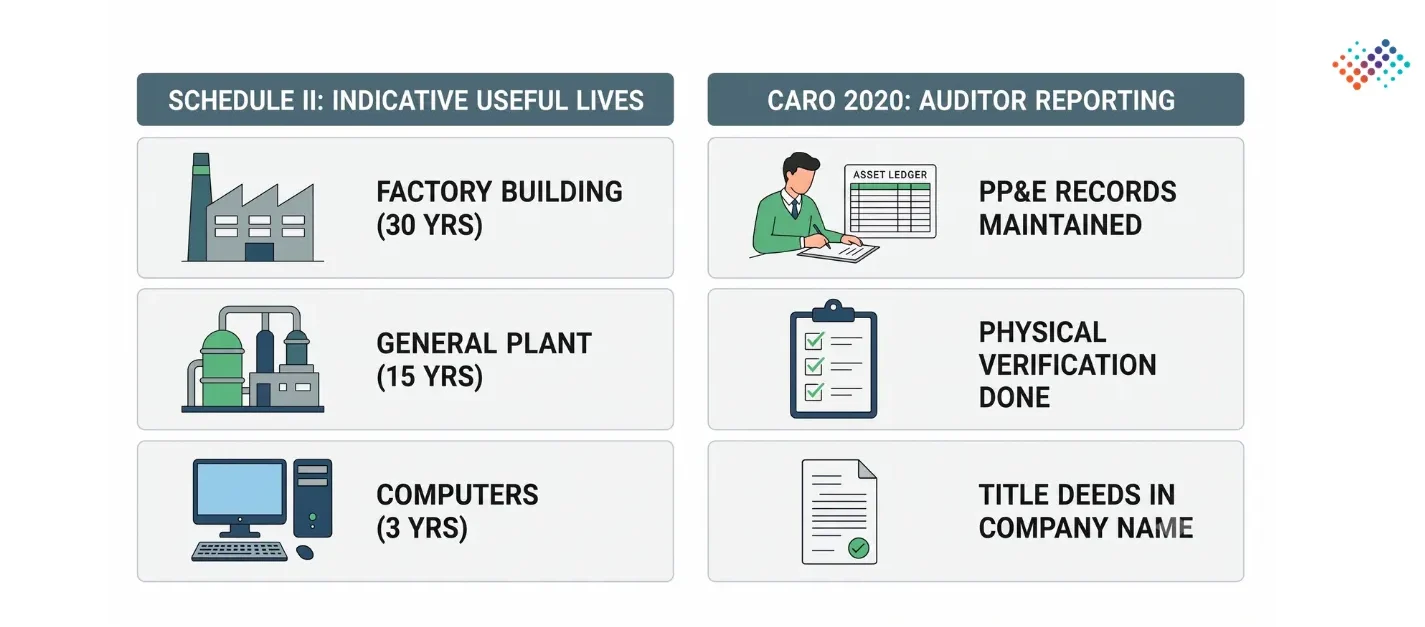
CARO 2020 then makes fixed asset controls a reportable matter: the auditor must state whether proper PP&E records are maintained, whether physical verification happens at reasonable intervals with discrepancies addressed, and whether title deeds of immovable property are held in the company’s name.
That verification clause is why Indian audit season and physical verification cadences are inseparable; the control is not optional when the auditor must report on it.
The eight-market matrix: standards and tax, side by side
One row per market. The right-hand column is the one multi-nationals trip on every book standard pairs with a tax regime that ignores it:
Market |
Book standard |
Tax interaction: the watch-out |
| USA | ASC 360 (US GAAP); GASB for governments | MACRS depreciation and the IRS placed-in-service date run on tax rules, fully separate from book |
| India | Ind AS 16 (larger entities); AS 10 (others); Schedule II lives; CARO controls | Income-tax WDV block-of-assets system bears no resemblance to book depreciation |
| UK | IAS 16 (listed); FRS 102 s.17 (UK GAAP) | No tax depreciation at all; capital allowances (AIA, full expensing, WDAs) instead; FRS 102 s.25 makes borrowing-cost capitalisation a choice |
| Australia | AASB 116 word-for-word IAS 16 | ATO instant asset write-off is a tax concession, not a book threshold; conflating them misstates both |
| Canada | IFRS (public); ASPE 3061 (private) | Capital Cost Allowance runs declining-balance tax classes regardless of book method |
| South Africa | IFRS; GRAP (public sector) | SARS wear-and-tear allowances (s.11(e) and related) are the tax track, separate from book |
| Philippines | PFRS fully converged with IFRS | BIR depreciation rules govern the tax return; PFRS governs the books |
| Global / IFRS | IAS 16 + IAS 23 + IAS 36 | The consolidated view reconciles subsidiaries above reconcile their local books into it |
Label every treatment with its jurisdiction, and run book and tax as parallel calculations from one asset record. The UK’s borrowing-cost choice has its own treatment in assets under construction.
Best practices: the 8 controls auditors expect
Whatever the regime, the audit tests the same architecture, supported by accurate fixed asset accounting entries. Written as a workpaper control, then the evidence that proves it operates.
- A written, approved capitalization policy: Applied in practice, evidenced by sampled codings that trace to its rules.
- The threshold enforced at invoice coding: Evidenced by boundary items coded correctly, with approvals for any override.
- Ready-for-use date discipline: Evidenced by readiness certificates behind each capitalization, and few catch-up entries.
- Component review at capitalization: Evidenced by a decision record per major asset (required under IFRS and Ind AS).
- Monthly register-to-GL reconciliation via the fixed asset roll forward: Evidenced by tied schedules and a variance log with root causes.
- Physical verification on a defined cadence: Evidenced by reports, two-way reconciliation, and actioned discrepancies.
- Disposal approval per an authority matrix: Evidenced by approvals preceding execution and proceeds traced to bank.
- Exception queues owned, aged and escalated: Evidenced by queue extracts with owners and closure history, not just lists.
Common challenges and their fixes
- Parallel books at scale: Book, tax and group views drifting apart. Fix: one asset record driving all calculations, never three spreadsheets.
- Policy drift across sites: Identical assets formed and classified differently by plant. Fix: formation and threshold rules enforced by system at coding, not by memo.
- Late capitalization: Assets running while depreciation waits for paperwork. Fix: readiness captured at source, with the ready-not-capitalized queue visible and owned.
- Evidence scattering: Approvals and certificates across inboxes and drives. Fix: evidence held against the capitalization case, assembled once, produced on demand.
Why getting it right pays
Clean standards compliance is usually sold as risk avoidance, but the returns are direct: audits that close weeks faster on evidence instead of explanation, depreciation that states the P&L correctly, tax positions that survive scrutiny, and capital decisions made on an asset base that is actually real.
Where AssetCues fits: The policy engine applies thresholds, classes and component logic consistently at source, and exceptions live in owned queues the system-side answer to challenges two through four while your ERP remains the book of record. If multi-site consistency is the recurring finding.
How GAAP, IFRS and Ind AS differ on fixed assets: the 5-point walk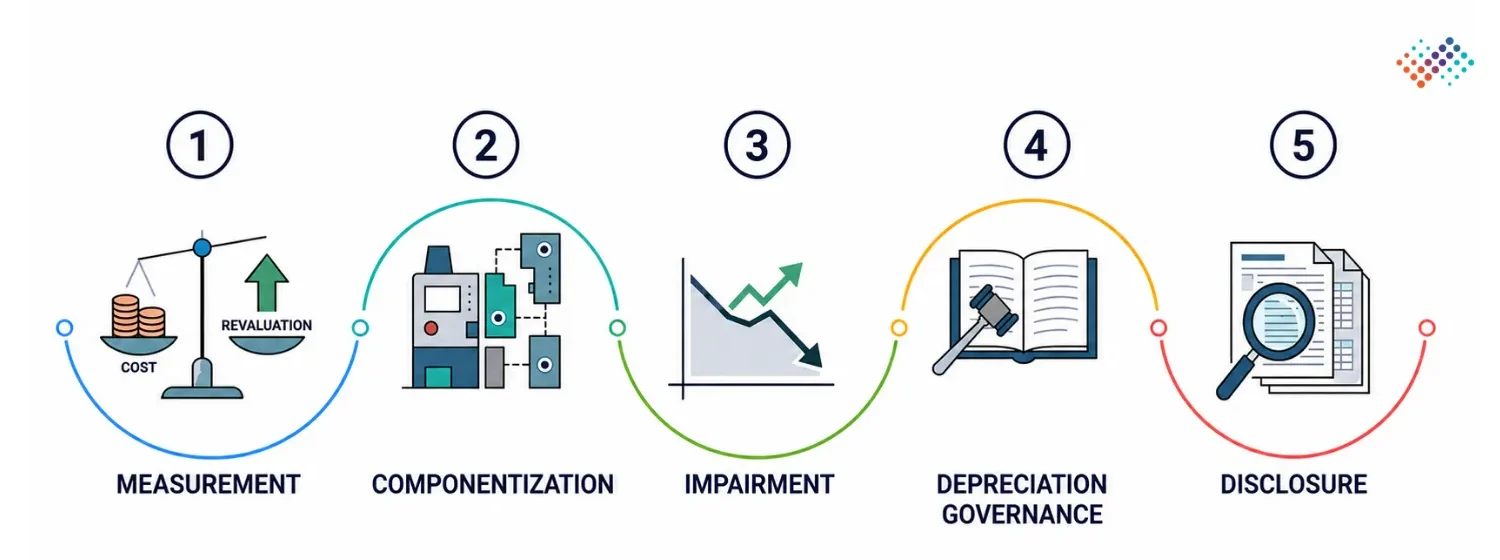
- Measurement after recognition: US GAAP holds cost; IFRS and Ind AS offer the per-class revaluation choice.
- Componentization: Required for significant parts under IFRS and Ind AS; permitted under US GAAP.
- Impairment: Undiscounted trigger and permanent losses under US GAAP; recoverable amount with reversals under IFRS and Ind AS.
- Depreciation governance: Judgement-led lives under US GAAP and IFRS; Schedule II’s prescribed lives and CARO’s reportable controls in India.
- Disclosure: Converged reconciliations, plus India’s ageing schedules and the UK’s policy-choice notes as local layers.
Key takeaways
- The principles converge on cost at recognition, depreciation over useful life, but the divergences are consequential: revaluation, impairment mechanics and componentization all split US GAAP from IFRS.
- Revaluation of fixed assets is a per-class choice under IFRS and Ind AS, and prohibited under US GAAP, the single most-misstated difference online.
- Impairment runs on different engines: an undiscounted-cash-flow trigger with no reversals under US GAAP; recoverable amount with reversals under IFRS.
- Book and tax are separate systems in every market: MACRS, capital allowances, CCA, wear-and-tear and conflating them is the classic multinational error.
- Whatever the regime, auditors test the same eight controls; the standard sets the rules, the controls prove you followed them.
Conclusion
Applying the right fixed asset accounting standard ensures compliance, but long-term success depends on following the correct accounting standard for fixed assets with consistent controls. Adopting fixed asset accounting best practices helps organizations improve accuracy, strengthen audit readiness, and maintain reliable financial reporting.

FAQs on fixed asset accounting standards
Q1. What is the difference between GAAP and IFRS for fixed assets?
Ans: The three consequential differences: IFRS allows a per-class revaluation model while US GAAP permits only cost; IFRS requires component depreciation for significant parts while US GAAP merely permits it; and impairment uses an undiscounted trigger with no reversals under US GAAP versus a recoverable-amount test with reversals under IFRS.
Q2. Is revaluation of fixed assets allowed under US GAAP?
Ans: No. US GAAP requires that fixed assets are carried at cost less depreciation and impairment, and cannot be written up. IFRS and Ind AS permit an optional revaluation model applied class by class, with increases going to other comprehensive income.
Q3. Which standard applies to fixed assets in India?
Ans: Larger and listed Indian companies apply Ind AS 16, converged with IAS 16, while other companies apply AS 10. Both operate alongside Schedule II of the Companies Act, which prescribes indicative useful lives, and CARO 2020, which makes fixed asset records, verification and title deeds reportable audit matters.