


Introduction
Fixed assets are often the largest number on the balance sheet and the ones built from the most hand-offs: procurement buys, projects build, sites hold, finance accounts. Understanding the fixed asset accounting process is essential to ensuring those hand-offs result in accurate financial reporting.
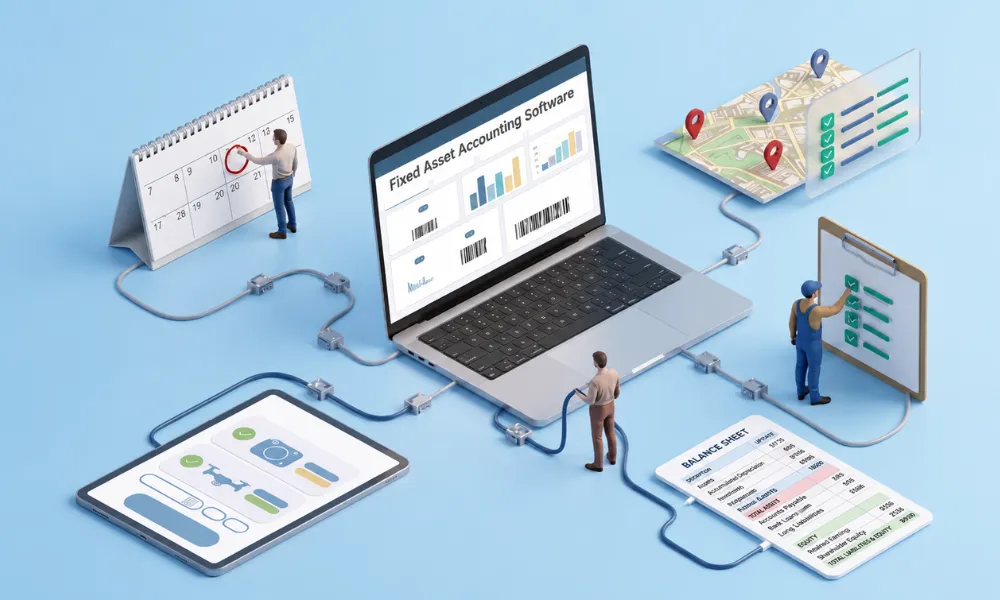
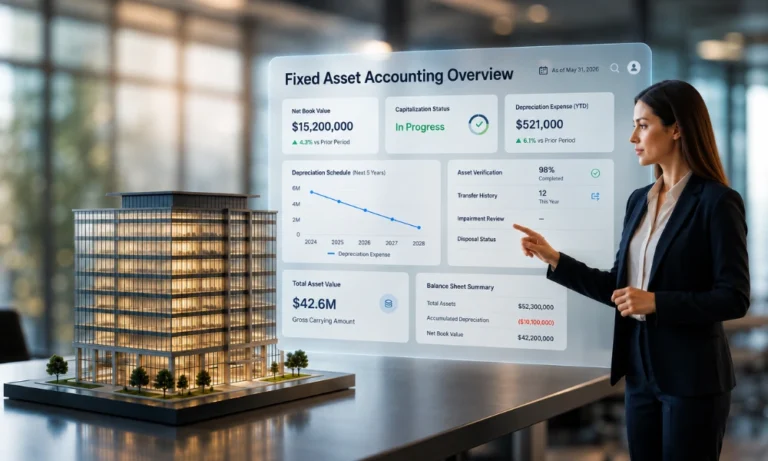
Fixed asset accounting is the process of recording, depreciating, tracking and reporting a company’s long-term tangible assets property, plant and equipment from acquisition to disposal. This guide is the accounting map for that journey: what counts as a fixed asset, the treatment at every lifecycle stage, the core entries and ratios, the standards by market, and the two places the process reliably breaks.
It covers capitalization, depreciation, transfers, verification, impairment and derecognition, under standards such as ASC 360, IAS 16 and Ind AS 16. For teams managing the capitalization step specifically, asset capitalization software controls the workflow between physical receipt, project readiness, and final asset creation in ERP.
In this guide, you will learn:
- What fixed asset accounting is, which assets qualify for capitalization, and how accounting requirements apply throughout the asset lifecycle.
- How to account for fixed assets from acquisition and capitalization through depreciation, transfers, impairment, disposal, and financial reporting.
- Why accurate asset records, physical verification, and strong process controls are essential for compliance, financial accuracy, and audit readiness.
- How to implement a consistent fixed asset accounting process, including core journal entries, key performance metrics, and period-end controls.
What is fixed asset accounting?
Fixed asset accounting ensures organizations correctly value, accurately depreciate, and reliably account for their long-term tangible assets.
It spans four jobs: recording assets at the right cost, allocating that cost over useful life through depreciation, tracking each asset’s location and condition against the books, and reporting the balances and movements that standards require.
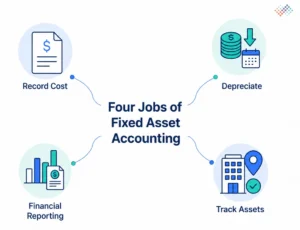
It sits at a junction. Procurement and projects create the assets, operations use and move them, and finance answers for them, which is why fixed asset accounting is as much a coordination process as a bookkeeping one.
What is a fixed asset? Criteria, types and examples
A fixed asset is a tangible item that a business owns and uses to generate income, with a useful life of more than one year. Three tests decide the classification:
- Held for use in production, supply, rental or administration, not for resale. Stock held for sale is inventory, however large.
- Expected to be used for more than one accounting period.
- Cost at or above the company’s capitalization threshold; smaller items are expensed for practicality.
Is land a fixed asset? Yes, land is the classic fixed asset. It is the one class that is not depreciated, because its useful life is indefinite; buildings on it are depreciated separately.
Typical classes: land, buildings, plant and machinery, vehicles, furniture and fixtures, office and IT equipment, and leasehold improvements. What dominates depends on the industry:
Industry |
Fixed assets that dominate the register |
| Manufacturing | Production lines, utilities plant, moulds and tooling, factory buildings, material-handling equipment |
| Pharma | Clean rooms, reactors, HVAC and validation-critical utilities, lab instruments |
| BFSI | Branch fit-outs, IT infrastructure, ATMs, servers and network equipment |
| Logistics | Warehouses, racking, forklifts, fleet vehicles, sortation and scanning systems |
| Technology/services | Data-centre hardware, laptops and devices, office fit-outs |
Intangible assets: Software, patents, licences follow their own standards and their own capitalization criteria, and sit outside this guide’s scope.
The fixed asset lifecycle: accounting at every stage
Every fixed asset moves through the same stages, and each stage has one accounting job and one control.
Stage 1–2: Acquire, or construct through CWIP
Purchased assets are capitalized at cost, purchase price plus directly attributable costs to bring the asset to working condition. The criteria, thresholds and policy machinery live in our asset capitalization guide.
Self-constructed assets accumulate in capital work in progress until ready for use with its own ageing discipline and transfer trigger.
Stage 3: Place in service
The asset enters the register, and depreciation starts, when it is available for use, not when the project closes. This date is the most consequential single field in the register.
Stage 4: Depreciate
Depreciation allocates cost over useful life straight-line, most commonly, by significant component where required. Method selection and worked schedules are covered in our dedicated depreciation content, and component rules in IAS 16, Ind AS 16 & AS 10.
Stage 5: Maintain and improve
Repairs and maintenance are expensed. Improvements that extend life, capacity or performance are capitalized. The judgement between the two is where P&L quietly gains or loses accuracy every month.
Stage 6: Transfer and verify
Assets move between sites, cost centres and custodians; the register must move with them. Periodic physical verification register-to-floor and floor-to-register is the control that keeps the books honest, and fixed asset audits test it.
Stage 7: Revalue or impair
When damage, obsolescence, or market shifts indicate possible impairment, companies test the carrying amount and write it down if they cannot recover it. Under IFRS and Ind AS, companies may also choose to revalue assets upward, provided they apply the policy consistently across the entire asset class.
Stage 8: Dispose
When a company sells, scraps, or writes off an asset, it removes both the asset’s cost and accumulated depreciation, and the difference between the proceeds and the carrying amount becomes the gain or loss. Moreover, disposal often reveals undocumented assets during the final audit of every earlier stage.
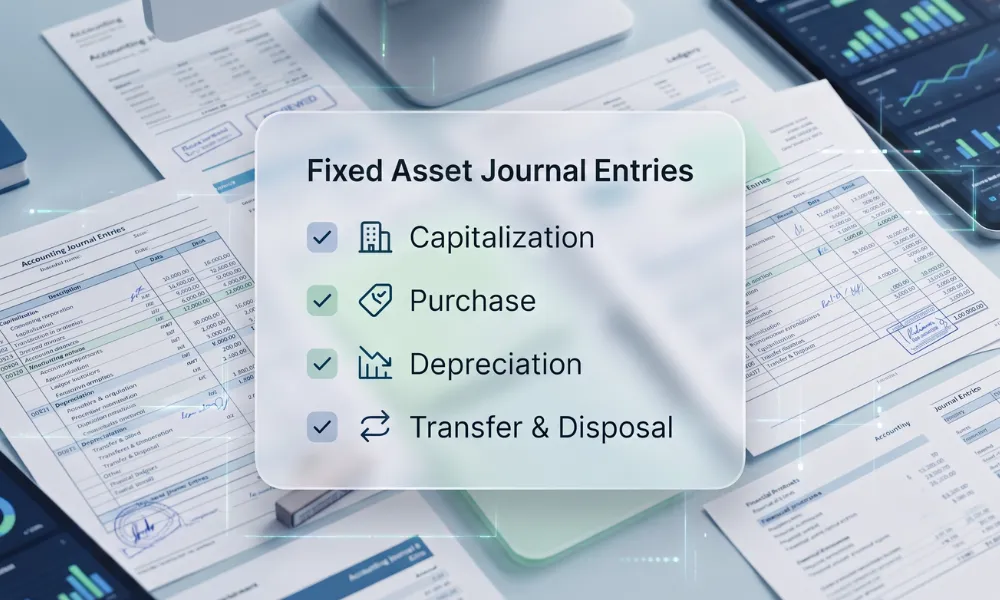
Core journal entries: the three that matter most
Three entries carry most fixed asset volume. For a deeper look at how each fixed asset entry in accounting works across capitalization, depreciation, transfers, and disposal with gain or loss, that covers the full set of lifecycle entries that keep the register, ledger, and audit file aligned. Patterns shown; account names follow your chart of accounts:
Event |
Debit |
Credit |
| Capitalization (purchase) | Fixed asset (class) | Accounts payable / Bank |
| Periodic depreciation | Depreciation expense | Accumulated depreciation |
| Disposal (sale) | Bank (proceeds) + Accumulated depreciation | Fixed asset (cost); balance = gain or loss to P&L |
Fixed asset ratios and formulas
Two formulas answer most analytical questions about the fixed asset base:
Net fixed assets = Gross fixed asset cost − Accumulated depreciation.
Fixed asset turnover = Net sales ÷ Average net fixed assets.
Turnover measures how much revenue each unit of fixed asset investment generates. Capital-light businesses run high ratios; manufacturers run low ones; compare within an industry, never across.
A falling turnover ratio has two honest explanations and one dishonest one: heavy recent investment not yet productive, declining sales or an asset base inflated by ghost assets and un-transferred CWIP. The ratio cannot tell you which; verification can.
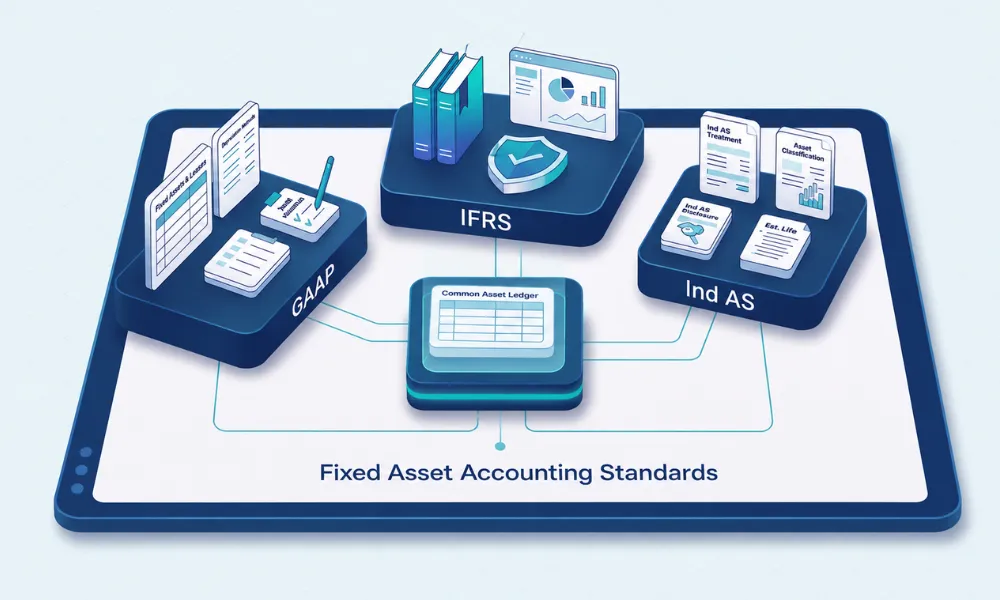
Standards snapshot by market
The core principles are similar, but recognition, disclosure, and tax treatment differ across jurisdictions.
Market |
Book standard |
Watch-out (book vs tax) |
| USA | US GAAP ASC 360 (PP&E); ASC 835-20 (capitalized interest) | MACRS tax depreciation and the placed-in-service date run on IRS rules, separate from book |
| India | Ind AS 16 (listed/large); AS 10 (others); Schedule II lives; Schedule III presentation | Income-tax WDV block-of-assets system bears no resemblance to book depreciation |
| UK | IAS 16 (listed); FRS 102 s.17 (UK GAAP) | No tax depreciation; capital allowances instead |
| Australia | AASB 116 word-for-word IAS 16 | ATO instant asset write-off is a tax concept, not a book threshold |
| Canada | IFRS (public); ASPE 3061 (private) | Capital Cost Allowance declining-balance tax classes |
| South Africa | IFRS; GRAP for public sector | SARS wear-and-tear allowances, separate from book |
| Philippines | PFRS fully converged with IFRS | BIR depreciation rules for tax |
The full eight-regime comparison measurement, revaluation, componentization, impairment and the controls auditors expect are in fixed asset accounting standards around the world.
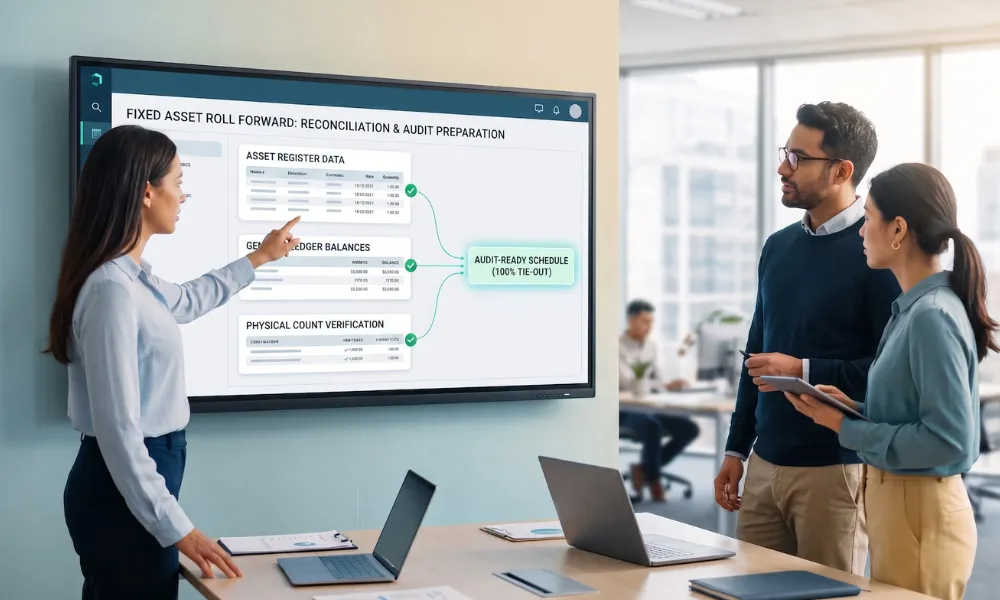
The register and the roll forward
Two artefacts hold the whole discipline together. The fixed asset register is the asset-by-asset record of cost, dates, location, custodian, depreciation to date and the source every other report reconciles to.
The fixed asset roll forward summarizes period movements, including opening balances, additions, disposals, transfers, depreciation, and closing balances, reconciled to the general ledger. It provides a clear audit trail of changes in fixed assets and supports accurate financial reporting and audit readiness.
Where fixed asset accounting breaks: the physical-financial divide
Two failure points account for most fixed asset findings, and neither is a bookkeeping error.
The first is upstream: Assets are physically received, moved and even used before any controlled asset record exists. No pre-asset ID at receipt, serials keyed manually and wrongly, custody untracked between delivery and capitalization.
The second is the chain break: Physical receipt, GRN posting, invoice processing and asset creation happen across different teams and systems. Quantities and serials disagree across documents, and the reconciliation lands on finance at close.
The consequences compound quietly: Ghost assets and unrecorded ones, depreciation starting late, register-to-floor mismatches at verification, and audit samples that take days to evidence.
The receipt-to-capitalization chain goods received note discipline, matching, the pre-asset record and the exception queues that keep it moving gets its full treatment in our GRN to fixed asset guide.
This is where AssetCues closes the gap: A controlled pre-asset record from the moment of receipt, serials and custody captured at source, the receipt-GRN-invoice-asset chain kept linked, and exceptions owned in queues while your ERP remains the book of record.
A single-site business with a few hundred assets can run this discipline on a well-kept register, a good verification cadence and clear ownership. As sites, hand-offs, and asset counts multiply, evaluating the best fixed asset accounting solution becomes increasingly important because the spreadsheet stops being reviewable.
Fixed asset accounting in ERP
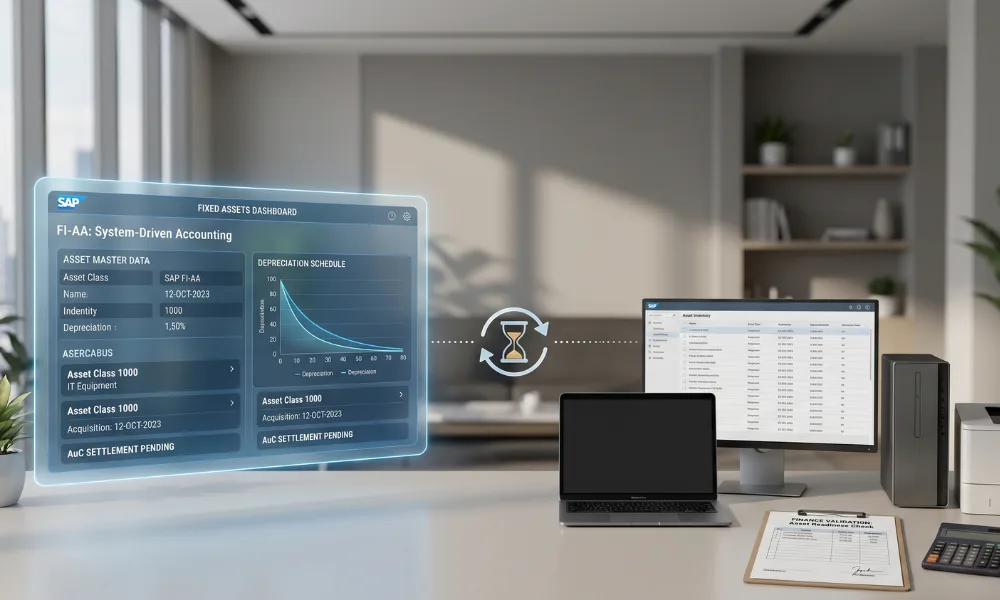
Enterprise ERPs carry the fixed asset sub-ledger well: asset masters, depreciation engines, posting integration and reporting.
What they carry thinly is the operational workflow before the asset exists: receipt control, readiness capture, evidence, and exception ownership. That split of work is worth understanding before any system decision.
The capability-versus-gap analysis, system by system: SAP fixed asset accounting (FI-AA) and Oracle Fixed Assets, and dedicated fixed asset accounting software differ in supporting asset accounting, operational controls, and end-to-end asset management processes.
How to do fixed asset accounting: 8 steps
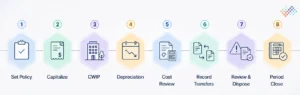
- Set and document the capitalization policy, including capitalization thresholds, asset classes, useful lives, componentization rules, and depreciation methods.
- Capitalize each asset at cost, including directly attributable costs, from a controlled record of what was actually received.
- Route constructed assets through CWIP with project lineage, and transfer each part at readiness.
- Start depreciation from the available-for-use date, by component where significant.
- Test every maintenance cost against the capitalize-vs-expense criteria at coding, not at close.
- Record transfers as they happen, and verify physically on a fixed cadence, reconciling both directions.
- Review for impairment indicators at each reporting date, and derecognise disposals with documented approval.
- Close each period with the roll forward tied to the general ledger and the exception queues reviewed by the owner.
Key takeaways
- A fixed asset is a tangible item that an organization holds for use in its business, expects to use for more than one accounting period, and capitalizes because its cost exceeds the company’s capitalization threshold.
- From there, fixed asset accounting follows the asset’s lifecycle: capitalize, depreciate, maintain, transfer, verify, and dispose. Each stage has its own entry and its own control.
- In practice, three entries carry most of the volume: capitalization, periodic depreciation, and disposal with gain or loss.
- Although the standards differ by market, they vary more in disclosure requirements and tax interaction than in principle; therefore, always identify the applicable jurisdiction for every treatment.
- However, the process typically breaks in two places: ready assets remain stuck before entering the register, and physical assets gradually drift away from the financial record.
Conclusion
Strong fixed asset accounting ensures every asset is recorded, depreciated, verified, and reported accurately throughout its lifecycle. A consistent fixed asset accounting process, supported by clear capitalization policies and regular physical verification, improves financial reporting and audit readiness.
Understanding what qualifies as a fixed asset in accounting and applying disciplined fixed asset management accounting practices helps organizations maintain accurate records, strengthen controls, and make better long-term capital decisions.
FAQs on fixed asset accounting
Q1. What is a fixed asset register in accounting?
Ans. A fixed asset register is the asset-by-asset record of cost, dates, location, custodian and depreciation that supports the balance-sheet figure.
Q2. What is fixed asset management accounting?
Ans. Fixed asset management accounting combines the financial records with the physical management of assets, tracking, verification and lifecycle decisions.
Q3. What is a fixed assets journal entry?
Ans. A fixed assets journal entry is an accounting record used to recognize the purchase, depreciation, transfer, or disposal of a fixed asset. It ensures asset transactions are accurately recorded in the general ledger and financial statements.