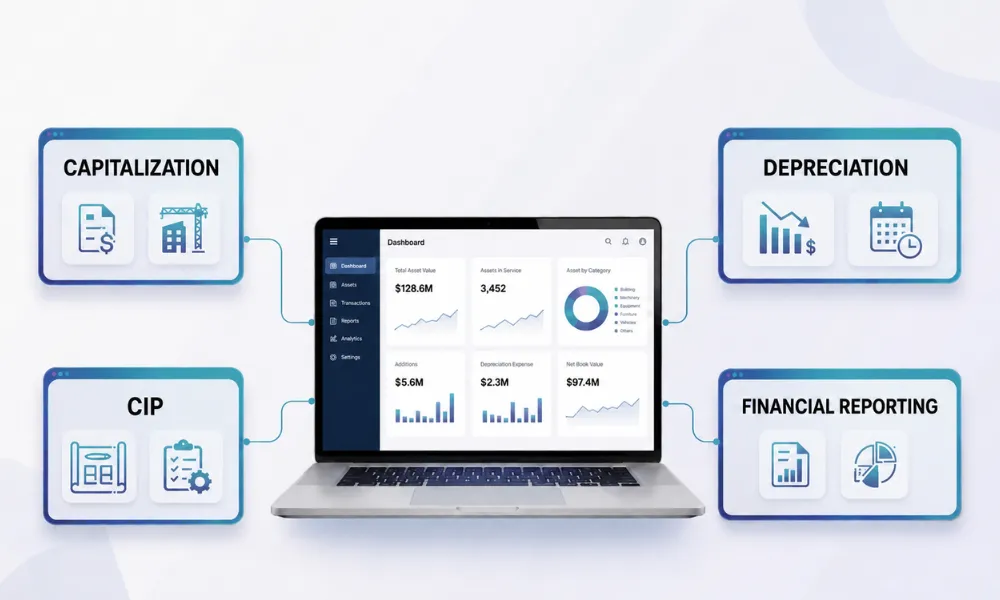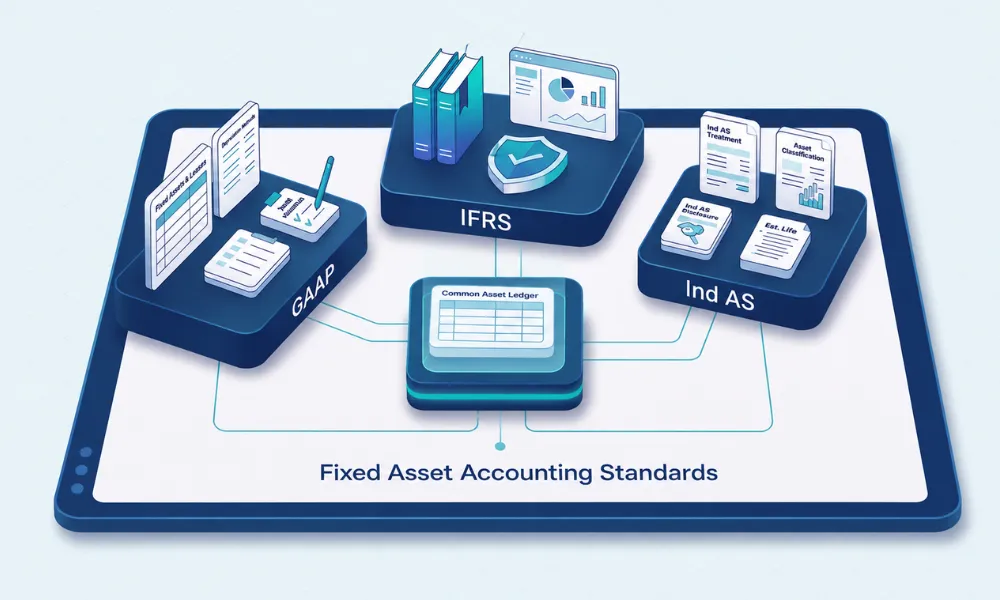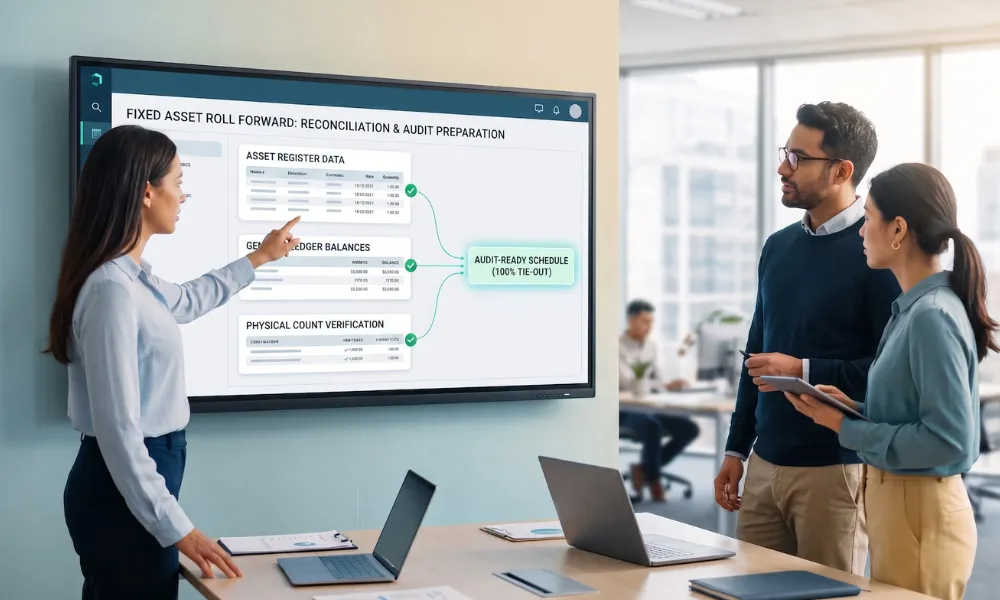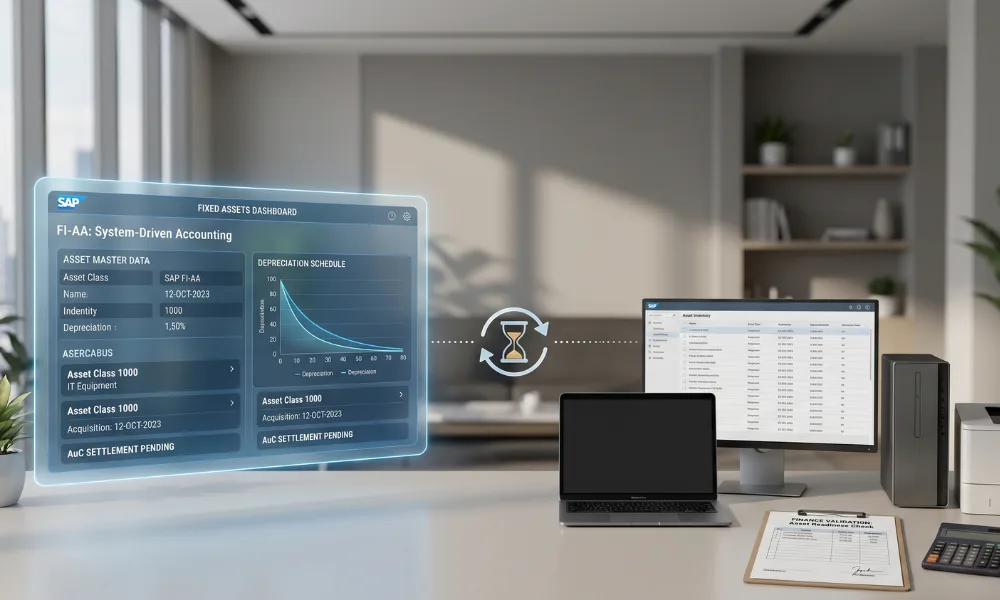



Introduction
Every guide to grn accounting ends at the same place: the three-way match clears, the invoice gets paid, inventory updates. Done. For fixed assets, that ending is the middle. The machine on the dock still has to become a record in the asset register, and the stretch between the GRN and that record is where enterprises lose assets, serials, evidence and depreciation time.
This guide follows the journey from the goods received note to asset capitalization and explains how orn in accounts payable fits into the receipt-to-payment process.
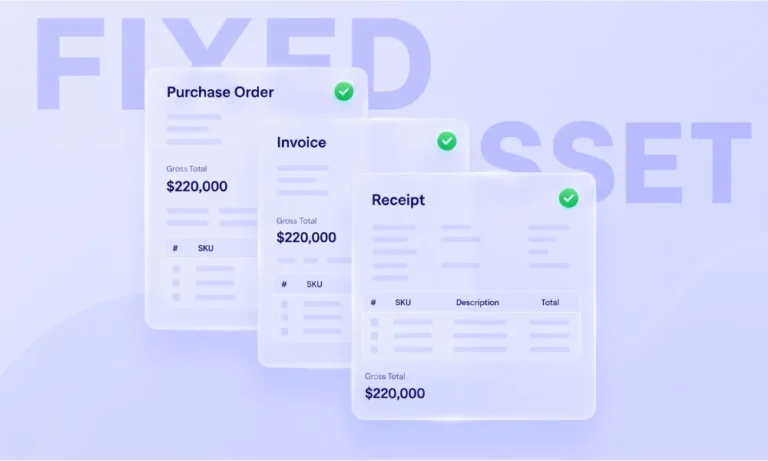
A goods received note (GRN) is the buyer’s internal record confirming what physically arrived against a purchase order: items, quantities, condition and date. In fixed asset accounting, it is the first link in the receipt-to-capitalization chain: PO → dispatch → receipt and GRN → invoice match → asset clearing → the final asset record.
In this guide
- What a Goods Received Note (GRN) is, how it supports fixed asset accounting, and why the receipt-to-capitalization process differs from inventory receiving.
- How to manage the GRN-to-asset process, including three-way matching, asset clearing, pre-asset records, and receipt controls.
- Why asset losses, delayed capitalization, reconciliation issues, and audit findings occur between receipt and asset creation and how to prevent them.
- How to establish an effective receipt-to-capitalization workflow using ownership, exception queues, reconciliations, and standardized control processes.
GRN in brief
GRN stands for goods received note, also goods receipt note. The receiving team raises it when goods arrive, recording what came, in what quantity and condition, against which PO. It is the buyer’s own evidence, distinct from the supplier’s delivery note.
In accounts payable, it anchors the three-way match: purchase order, GRN and invoice must agree before payment is released. That much, every procurement guide covers well, so this guide won’t relitigate it. Our subject is what happens next when the goods are fixed assets.
GRN or receiving report? Two vocabularies, one chain
The same chain runs under two vocabularies, and this guide serves both:
Concept |
India / Asia companies running on SAP |
US companies running on Oracle |
| The receipt document | GRN (goods received note) | Receiving report/goods receipt |
| The matching control | Three-way matching (PO–GRN–invoice) | Three-way match (PO–receiver–invoice) |
| The suspense account | GR/IR clearing; asset clearing | Receipt accrual; asset clearing |
| The interim asset state | CWIP / pre-capitalization | CIP / pre-capitalization |
Where fixed assets differ from inventory receiving
Inventory receiving asks one question: Did the right quantity of the right item arrive in acceptable condition? Fixed-asset receiving asks that plus three more: which exact units are these, who has them, and where are they until they become assets?
Here is the gap: Assets are physically received before they are capitalized, and in that interim there is usually no controlled record to identify, tag, serialise or track them.
The symptoms repeat everywhere. No unique pre-asset ID at receipt; serials, IMEIs and MAC addresses keyed manually and wrongly; equipment moving between teams with no custody trail.
The stakes are specific. This is the most vulnerable stage of the asset journey: loss, theft, duplication and serial-mismatch risk all peak here and every divergence between the physical object and its eventual record is reconciliation work someone does later.
The control is a pre-asset record created at the moment of receipt: unique ID, serials scanned rather than typed, photos, custody and location long before the ERP asset master exists, following fixed asset accounting best practices.
The chain, link by link
Describing the chain in words, since this is what the diagram will show: purchase order → supplier dispatch → physical receipt and GRN → invoice and three-way match → asset clearing → asset creation. Each arrow is a handoff between teams, and each handoff is where the chain historically breaks.
Before arrival: the dispatch blind spot
Most chains start broken because suppliers dispatch without a structured pre-arrival signal: no ASN, no packing list, no serial file. Receiving discovers shipments at the gate; partials and delays surface only after expected dates slip.
The fragmentation problem
Then the chain’s central failure: receipt, GRN posting, invoice processing and asset creation happen across different teams and different systems.
So goods arrive, but the GRN isn’t posted. The invoice lands but can’t match. Quantity, serial and model details disagree across receipt, GRN, invoice and the final asset record.
Broken matching delays cost recognition, slows capitalization, and pushes reconciliation into close week, and for IT and serialized equipment, one wrong manual entry breaks traceability all the way to the register.
The accounting skeleton underneath is short: the GRN posts cost into a clearing account, the invoice clears against the vendor, and asset capitalization entries relieve clearing into the asset.
Three-way matching when the goods are assets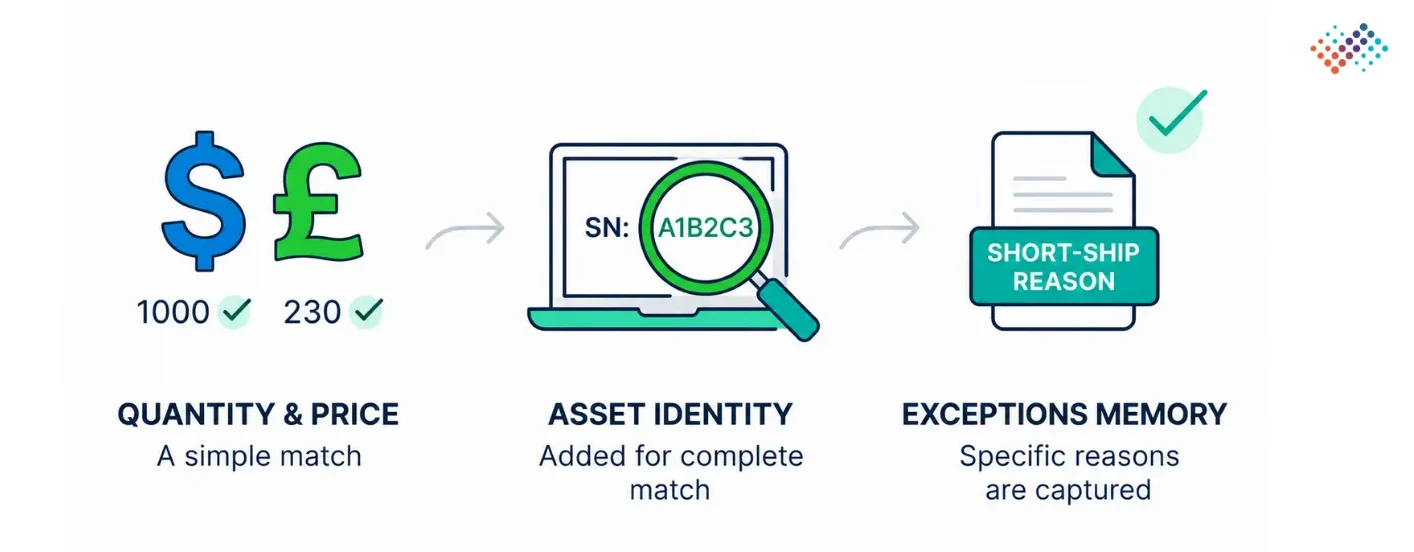
The standard match tests quantity and price across PO, GRN and invoice. For serialized assets, that test is necessary and insufficient; twenty laptops at the right price can still be the wrong twenty laptops.
Asset-grade matching adds identity: the serials received must be the serials invoiced and the serials that reach the asset record. A quantity match with a serial mismatch is a mismatch, and treating it as clean is how registers fill with equipment that doesn’t exist.
Match exceptions also need memory. An exception closed with a reason code supplier short-shipped, PO line bundled ten units into one turns a recurring annoyance into a fixable pattern; one closed as ‘resolved’ teaches nothing.
The asset clearing account: assets waiting to exist
The asset clearing account acts as a suspense account between the invoice and the asset. It temporarily holds the cost after receipt or invoice posting. The balance clears when the final asset record is created.
Viewed as a control, it is the chain’s most reliable health metric. Every clearing balance represents an asset waiting to exist. It has been paid for and is probably on site. It may already be in use. However, it is absent from the asset register and is not depreciating.
A healthy process reconciles the clearing account every month. It also reviews the age of every outstanding balance. Any balance remaining after two close cycles becomes a finding. It must have a named owner instead of being carried forward. In SAP fixed asset accounting, the same issue appears as aged GR/IR items. In Oracle, it appears as lines waiting in the mass additions queue.
The six named queues and who owns them
Everything above converges on one design: the chain’s exceptions become named queues with owners, SLAs and escalation. Unnamed exceptions are invisible; named ones get worked.
Queue |
What it holds |
Natural owner |
| ASN overdue | Expected deliveries past date with no arrival or dispatch signal | Procurement |
| Received-not-GRN | Goods at site, GRN unposted | Receiving / Stores |
| Invoice-not-linked | Invoices that cannot match to a GRN | Accounts Payable |
| Clearing residuals | Aged balances in the asset clearing account | FA Accountant |
| Tagged-not-capitalized | Tagged, in custody, no asset record | FA Accounting Manager |
| Ready-not-capitalized | In use or certified ready, capitalization unposted | FA Accounting Manager + Controller |
The last queue’s trigger for what ‘ready’ means and why its date matters is the placed-in-service doctrine. A queue without an owner column is a report; the checklist below ships with all six queues and the owner, SLA and escalation fields to fill.
Closing the chain with a control layer
Notice that nothing above requires new accounting; the entries were always simple. What the chain lacks is an owner: a system of record for the physical journey that Oracle assets and the ERP’s financial journey can reconcile against.
That is precisely what AssetCues is: a pre-asset record from the moment of receipt, serials and custody captured at source, the PO-GRN-invoice-asset linkage kept connected, and all six queues running with owners, SLAs and escalation while your ERP remains the book of record. If your clearing account and your register disagree about how many assets you own.
How to control the GRN-to-asset process: 7 steps
- Capture dispatch details, expected dates and serial files before arrival, so receiving plans instead of reacting.
- Create a pre-asset record at physical receipt: unique ID, scanned serials, photos, custody and location.
- Post the GRN against that record within SLA, keeping the received-not-GRN queue at zero ageing.
- Run the three-way match on quantity, price and serial identity, with exceptions owned and reason-coded.
- Reconcile the asset clearing account monthly, ageing and assigning every residual.
- Create the asset with formation decisions made from receipt knowledge, carrying tag, serials and evidence onto the record.
- Review all six queues on a monthly cadence as part of the fixed asset accounting cycle, escalating breaches and fixing the recurring causes upstream.
Key takeaways
- For consumables, the GRN’s job ends with payment. For fixed assets, it begins a chain ending in a tagged, evidenced, capitalized asset.
- Fixed asset receiving requires controls that inventory receiving does not. These include scanned serials, a pre-asset identity, and a custody trail.
- Three-way matching for fixed assets adds another question. It verifies quantity, price, and the serial identity of the received asset.
- The asset clearing account is the chain’s most reliable health metric. Every uncleared balance represents an asset waiting to exist.
- The chain fails between teams, not within them. The solution is clearly owned queues, not greater individual diligence.
Conclusion
Strong GRN accounting extends beyond matching purchase orders, invoices, and receipts; it ensures every received asset is accurately tracked through to capitalization. A well-controlled goods received note process, combined with effective handling of GRN in accounts payable, improves financial accuracy, strengthens audit readiness, and creates a reliable receipt-to-capitalization workflow that reduces delays, reconciliation issues, and asset risks.
FAQs on GRN and the receipt-to-asset chain
Q1. What is the difference between a GRN and a delivery note?
Ans: A delivery note comes from the supplier. It lists what the supplier claims to have shipped. A GRN is created by the buyer’s receiving team after inspecting what actually arrived. The delivery note is the supplier’s assertion. The GRN is the buyer’s evidence. Only the GRN belongs in the three-way match.
Q2 What is three-way matching?
Ans: Three-way matching compares the purchase order, the goods received note and the supplier invoice, releasing payment only when all three agree on items, quantities and price. For serialized fixed assets, a robust match adds a fourth check: the serial identity of what arrived must tie to what was invoiced and what reaches the asset register.
Q3. What happens after the GRN for a fixed asset purchase?
Ans: After the GRN, the company matches and processes the invoice, posts the cost to the asset clearing account, and then creates the asset by classifying it, assigning an asset tag, recording its ready-for-use date, and adding it to the asset register while clearing the balance. This post-match stage, not the GRN itself, is where most fixed asset control failures occur.