


Introduction
A fixed asset roll forward is the schedule that reconciles fixed asset balances across a period: opening balance + additions − disposals ± transfers − depreciation = closing balance, run for cost and accumulated depreciation by asset class. It is the first schedule auditors request, and the anchor of the fixed asset accounting cycle.
Every number on that schedule is a claim. The roll forward’s job is to make each claim traceable within the broader fixed asset accounting process, and its power is that it cannot hide a broken process: whatever went wrong during the year surfaces as a variance.
In this guide
- How the roll forward formula reconciles cost and accumulated depreciation separately, letting net book value emerge as the resulting difference between them
- Why auditors request this schedule first, since it converts one static balance into five separately testable movements for sampling
- What the three-way tie-out between register, ledger, and physical verification reveals, and how a worked $150,000 variance traces to its root cause
- When to distinguish the fixed asset accounting cycle from the asset lifecycle, and how recurring variance patterns point to specific process owners
What is a fixed asset roll forward?
The roll forward, also called the fixed asset continuity schedule or movement schedule explains how each asset class moved from its opening balance to its closing balance.
It runs the same formula twice. For cost: opening + additions − disposals ± transfers = closing. For accumulated depreciation: opening + depreciation charge − depreciation on disposals = closing.
Net book value falls out of the difference: cost minus accumulated depreciation, at each end of the period.
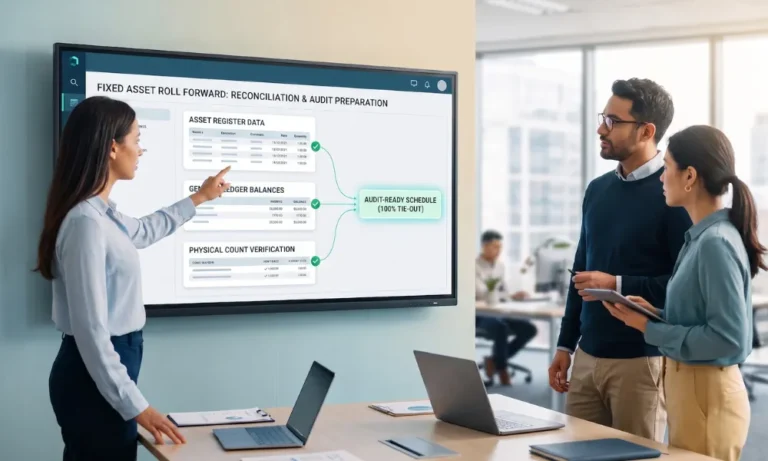
Its inputs come from the fixed asset register, the asset-by-asset record, and Oracle Fixed Assets, and its output must equal the general ledger. That three-way agreement is the whole game.
Why auditors ask for it first
Because it decomposes one untestable number into five testable movements. A closing balance can only be accepted; a movement can be sampled.
Each column maps to a different audit procedure: additions vouch to invoices and capitalization support, disposals to approvals and proceeds, depreciation to policy recomputation, transfers to both sides of the entry.
Which is why the schedule’s quality is really evidence quality. A roll forward whose additions column can produce its invoices and ready-for-use certificates on request closes the audit weeks faster than one that triggers archaeology.
Building the schedule, column by column
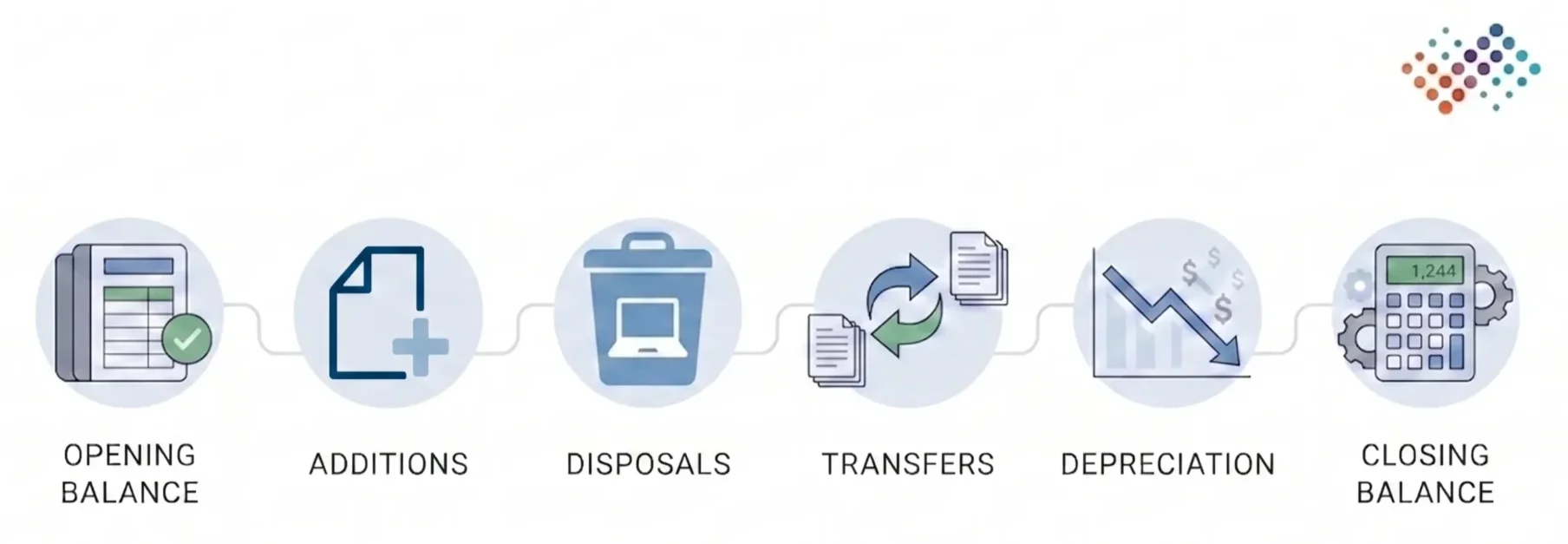
- Opening balances: Prior-year closing, agreed to last year’s audited schedule. Any difference means a prior-period adjustment that must be documented, not absorbed.
- Additions: Capitalizations during the period, at cost, from the register. Constructed assets arrive here as CWIP transfers at their ready date.
- Disposals: Cost of assets sold, scrapped or written off, with their accumulated depreciation removed in the parallel schedule.
- Transfers: Inter-class and inter-site moves. Across all classes, this column must net to exactly zero; a non-zero total means half a transfer.
- Depreciation: The period charge per the schedule run, tying to the P&L expense.
- Closing: Computed, never typed. If closing is an input cell, the schedule is a decoration.
The tie-out: register, ledger, physical
A roll forward that only agrees with itself proves nothing. Three reconciliations give it teeth:
Schedule to general ledger: Closing cost and accumulated depreciation per the schedule against the GL control accounts, by class, with every difference explained or flagged, including reconciliation of the GRN in accounts payable process where capital purchases are involved
Schedule to register: The schedule’s totals must equal the sum of asset-level records, or the schedule is describing a register that doesn’t exist.
Register to physical: The reconciliation that catches ghost assets and unrecorded ones, done through periodic physical verification and tested by fixed asset audits.
A worked variance: the $150,000 that wasn’t there
Our template ships with this example planted in it. Manufacturing’s vehicles class: opening cost $1,450,000, additions $240,000, no disposals recorded, schedule closing $1,690,000. The GL says $1,540,000.
The tie-out flags a $150,000 difference: GL lower than schedule. That pattern has one usual meaning: a disposal reached the ledger but never reached the register.
The trail: the GL asset account shows a November credit of $150,000 against a truck sale; proceeds were banked; the register still carries the truck at full cost with depreciation running.
The fix is two-part. The correction: Record the disposal in the register, remove its accumulated depreciation, and recompute the gain or loss. The control: disposals become one linked event approval, register update and GL entry together so the pattern cannot recur.
That is the roll forward doing its real job. The variance was never a spreadsheet problem; it was a disposal-workflow problem that the schedule refused to hide.
The fixed asset accounting cycle: cadence, not lifecycle
Two similar phrases mean different things, and conflating them muddles both.
The fixed asset accounting cycle is the recurring close rhythm: Record the period’s movements through fixed asset accounting entries, run depreciation, roll the schedule forward, tie out, review exceptions, and report.
The asset lifecycle is each asset’s one-way journey from acquisition to disposal. The accounting at every lifecycle stage is mapped in our fixed asset accounting guide.
This section focuses on the cycle in the first sense. The cadence:
Frequency |
Core tasks |
Output |
| Monthly | Post movements; run depreciation; roll the schedule; tie to GL; review exception queues | Tied roll forward or flagged variances |
| Quarterly | Review lives and rates on additions; impairment indicators; rotating physical checks | Review memo; verification exceptions actioned |
| Annually | Full schedule for the financial statements; complete verification per policy (CARO cadence applies in India); useful-life review | Audit-ready schedule with evidence pack |
Common roll-forward breaks root cause and owner
Variances repeat in patterns. Naming the pattern names the cause, and the cause names the owner:
Pattern |
Usual root cause |
Owner of the fix |
| GL lower than schedule | Disposal in the ledger, not in the register | FA Accounting Manager |
| Schedule lower than GL | Costs posted to asset accounts with no asset record | Financial Controller |
| Depreciation off the asset base | Late capitalizations from wrong dates; ghost assets still depreciating | FA Accountant |
| Transfers not netting to zero | One-sided transfer postings | GL Accountant |
| Opening ≠ prior closing | GL-only prior-period adjustments never pushed to the register | Financial Controller |
Automating the tie-out
At a few hundred assets, this template and discipline are enough. At enterprise scale, multiple sites, entities and systems, fixed asset accounting software helps automate the manual tie-out that otherwise consumes close days and still leaks.
What automation changes is not the formula but the exceptions: variances land in owned queues with ageing and escalation, asset capitalization in SAP cases carry their evidence to the schedule, and the audit pack assembles from records instead of memory.
That is the layer AssetCues adds: exception queues with owners and SLAs, evidence held against each capitalization case, and register-to-ERP consistency while your ERP stays the book of record. If the quarterly tie-out is a two-day hunt, request a demo.
How to prepare a fixed asset roll forward: 6 steps
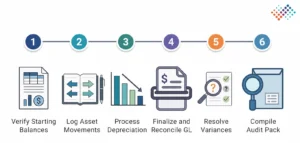
- Agree opening balances to the prior period’s closing schedule, documenting any adjustment rather than absorbing it.
- Populate additions, disposals and transfers from the register, with each movement’s evidence attached at source.
- Run and post depreciation, then complete the accumulated-depreciation schedule in parallel with cost.
- Compute closing balances by formula and tie them to the general ledger control accounts by class.
- Investigate every unexplained difference to a root cause and an owner, not just to a journal entry that makes it go away.
- File the schedule with its evidence pack as the period’s audit-ready record, and log the recurring variances as control actions.
Key takeaways
- The roll forward is one formula applied twice: once to cost, once to accumulated depreciation, with net book value falling out of the difference.
- Auditors ask for it first because it converts a static balance into a testable movement story; every column samples differently.
- A tied roll forward means the register, ledger, and schedule agree; an untied one is a process finding, wearing a numeric disguise.
- The fixed asset accounting cycle is the close rhythm around the schedule monthly, quarterly, and annually, and is not the same thing as the asset lifecycle.
- Most breaks trace to three causes: untracked disposals or transfers, late capitalizations, and ghost assets.
Conclusion
Fixed asset lifecycle accounting tracks each asset from acquisition through disposal, and it stays distinct from the accounting cycle even though the two work together closely. Every stage in that journey capitalization, depreciation, transfer, and eventual write-off feeds data into the roll forward, so weak lifecycle tracking shows up as roll-forward variances later.
Ghost assets and late capitalizations, two of the most common breaks named in this guide, both trace back to lifecycle discipline rather than to the schedule itself. Strengthening lifecycle accounting at the source, therefore, prevents the very variances that the roll forward exists to catch.
FAQs on the roll forward and the accounting cycle
Q1. What is a fixed asset roll forward in accounting?
Ans: A fixed asset roll forward is a schedule reconciling fixed asset balances across a period: opening balance plus additions, minus disposals, plus or minus transfers, equals closing balance run for both cost and accumulated depreciation. It ties the asset register to the general ledger and is the primary schedule auditors request.
Q2. How often should a roll forward be prepared?
Ans: Best practice is monthly, so variances surface while the causing transactions are still fresh and traceable. At minimum, quarterly for management reporting and annually for the audit, but an annual-only roll forward turns twelve months of breaks into one archaeology project.
Q3. What is the difference between a roll forward and a fixed asset register?
Ans: The register is the asset-by-asset record of cost, dates, location, and depreciation per asset, while the roll forward is the class-level movement summary built from it. The register answers questions about individual assets; the roll forward proves the period’s balances reconcile.
Q4. What do auditors check in a fixed asset roll forward?
Ans: Auditors verify the schedule ties to the general ledger and the register, then sample each movement column: additions to invoices and capitalization support, disposals to approvals and proceeds, depreciation by recomputation, and transfers to both sides of the entry. Unexplained variances and missing evidence drive further testing.