Asset Capitalization Co-pilot

Asset Capitalization Co-pilot: From Purchase Documents to ERP Assets

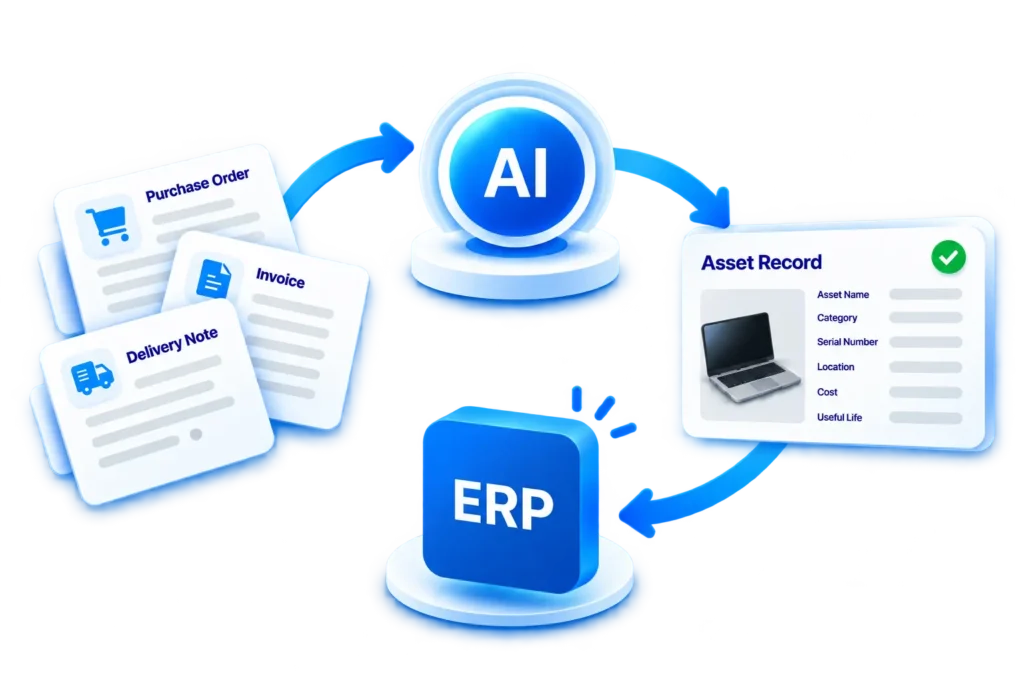
Meet the AI co-pilot that does the heavy lifting of asset capitalization. AssetCues extracts document data, understands asset context, maps your catalogue and builds enriched asset records — then moves eligible records into your ERP with minimal manual intervention and your capitalization rules in control.
Intelligent document processing. Automated asset preparation. AI asset capitalization guided by your business rules.
Asset Capitalization Co-pilot Hero Section
The Problem

Your documents already hold the answers. Your team is still retyping them.

What is the asset? How many units should be created? Which catalogue entry fits? What belongs together? Every capitalization cycle asks the same questions — and most finance teams still answer them line by line.
Asset-Capitalization The Problem
Line-by-line record assembly

Line-by-line record assembly

Finance re-reads POs, GRNs and invoices to rebuild the same context for every asset, one record at a time.

Spend waiting in CWIP

Spend waiting in CWIP

The longer each record takes to prepare, the longer spend sits in CWIP and the further the register drifts from what was actually bought.

Inconsistent classification

Inconsistent classification

Suppliers describe similar assets differently, so similar assets land under different names and classes — and the register inherits the inconsistency.

Repetitive ERP entry

Repetitive ERP entry

Creating assets one at a time in the ERP turns a single multi-unit purchase line into an afternoon of data entry — in SAP, for example, line after line through AS01.

The Solution

Meet the Asset Capitalization Co-pilot.

It maps catalogues, structures units, enriches asset identities, and prepares eligible assets for ERP creation using your configured rules.
The Asset Capitalization Co-pilot is the AI inside the AssetCues platform that turns purchase documents into ERP-ready asset records. It reads POs, GRNs and invoices, maps your asset catalogue, structures and enriches each record, and carries eligible assets into your ERP — automated asset capitalization with your rules in control.
Capitalization Copilot The Solution
How it works

Five steps from purchase line to capitalized asset.

1

Extract

Information is extracted from purchase orders, goods receipt notes and invoices and interpreted against your capitalization rules — automated asset creation from purchase orders and invoices starts with reading for meaning, not just text.

How it works Extract
2

Classify

Varied supplier descriptions are mapped to standardized catalogue names and classes. AI fixed asset classification builds consistency into the register from the very first record.

How it works Classify
3

Structure

Configured rules group related items, split quantities or components into individual units, and assign the appropriate audit method — automated asset classification and structuring, the way your policy defines it. A purchase line covering several laptops becomes individual, trackable unit records; for IT estates, the same flow doubles as automated IT asset onboarding.

How it works Structure
4

Enrich

Available details are read from invoices and asset photos — including nameplate details such as make, model and serial number. Automated asset data capture turns into automated asset master data creation, with far less manual entry.

How it works Enrich
5

Create

Prepared records progress through the required checks and approvals; eligible assets are then created in the connected ERP. AssetCues integrates with multiple ERPs, so mass, document-driven asset creation replaces one-at-a-time manual entry whichever system you run — for SAP users, a practical way to automate asset creation in SAP without keying records through AS01.

How it works Create
Key AI Capabilities

The intelligence behind faster asset capitalization.

AI-powered identity, condition, and tag integrity checks.
AI that reads for meaning

AI that reads for meaning

Extracts and interprets document data and transaction context against your capitalization rules to identify the assets behind the line items.

AI that speaks your asset catalogue

AI that speaks your asset catalogue

Maps varied supplier descriptions to standardized asset names and classifications, even when documents describe similar assets differently.

AI that structures the record

AI that structures the record

Applies configured rules to group related items, split quantities or components, and assign the appropriate audit method.

AI that fills in the identity

AI that fills in the identity

Reads invoices and asset photos to enrich make, model, serial number and tag information — a more complete identity with less manual entry.

Automation that carries work into your ERP

Automation that carries work into your ERP

Progresses prepared records through the required checks and approvals, then creates eligible assets through the enabled ERP integration.

Comparison

Asset capitalization, before and after the co-pilot.

Workflow stage Manual process With the Asset Capitalization Co-pilot
Reading documents
Each PO, GRN and invoice is read and retyped by hand
AI extracts and interprets document data against your rules
Classification
Clerk-by-clerk judgment; inconsistent names and classes
Catalogue-mapped, standardized names and classifications
Multi-unit purchases
One record keyed at a time
Configured rules split quantities into individual unit records
Identity details
Entered later — often left blank
Make, model and serial enriched from documents and photos
ERP creation
Manual entry per asset (e.g. AS01 in SAP)
Eligible assets created through the enabled integration after approvals
Business Outcomes

Make manual asset preparation the exception.

Get assets ready sooner

Get assets ready sooner

Repeatable preparation is automated, so finance focuses on the records that need clarification or judgment. Asset capitalization automation clears the routine queue.

Start with stronger data

Start with stronger data

Standardized names and richer identity details give tagging, audits and reporting a better foundation. Records created well are records you rarely have to fix.

Scale a consistent way of working

Scale a consistent way of working

The same configured catalogue and creation rules apply across the records in your workflow — one consistent way to automate fixed asset capitalization, however many documents arrive.

Built into your asset workflow, not beside it.

ERP asset creation uses the integration enabled for your implementation — AssetCues integrates with multiple ERPs, SAP and Oracle among them. The co-pilot works with the asset catalogue, business rules and approval workflow configured for your organization, on a platform certified to ISO 27001 for information security.
Ecosystem

Four co-pilots. One connected asset lifecycle.

Each co-pilot strengthens the evidence the next one works with — a record built well is tagged with confidence, audited with history and maintained with proof.
YOU ARE HERE

Asset Capitalization Co-pilot

Turns purchase documents into enriched ERP-ready asset records.

Asset Tagging Co-pilot

Validates the physical match with visual AI as tagging happens.

Learn more

Asset Audit Co-pilot

Compares asset photos over time to flag identity, condition and tag concerns.

Learn more

Asset Register Co-pilot

Keeps exceptions in focus with ongoing AI monitoring after creation.

Learn more
FAQs

Questions about Asset Capitalization Co-pilot

What makes this more than document extraction?
The co-pilot goes from extraction to interpretation, catalogue mapping, grouping, splitting and enrichment. The automation continues through the configured workflow for ERP asset creation — so the output is not extracted text, but a prepared, standardized asset record ready for capitalization.
Routine preparation is automated. Teams handle missing or uncertain information and the approvals required by the capitalization workflow. Your controls stay in place: AI prepares the record, and eligible assets are created only after the configured checks and approvals are met.
Yes. The co-pilot works with the asset catalogue and business rules configured for your implementation — your naming standards, grouping and splitting rules, and audit methods. ERP creation uses the enabled integration, so the result reflects your policy, not a generic template.
Asset creation uses the ERP integration enabled for your implementation. AssetCues integrates with multiple ERPs — SAP and Oracle among them. Prepared records pass the required checks and approvals before eligible assets are created, so your ERP remains the system of record throughout.
AssetCues is ISO 27001 certified for information security. The co-pilot works on the purchase documents and asset data within your implementation, applying your configured catalogue and rules. Access, approvals and workflows follow the controls set up for your organization.

Let AI build your next asset record.

See the journey from purchase information to ERP asset creation — against your own documents and rules — in a tailored demo.
Start Your Free Trial
Discover the Power of Automation.