Asset Register Co-pilot

Asset Register Co-pilot: Turn Your Register into an AI-Powered Control Center.

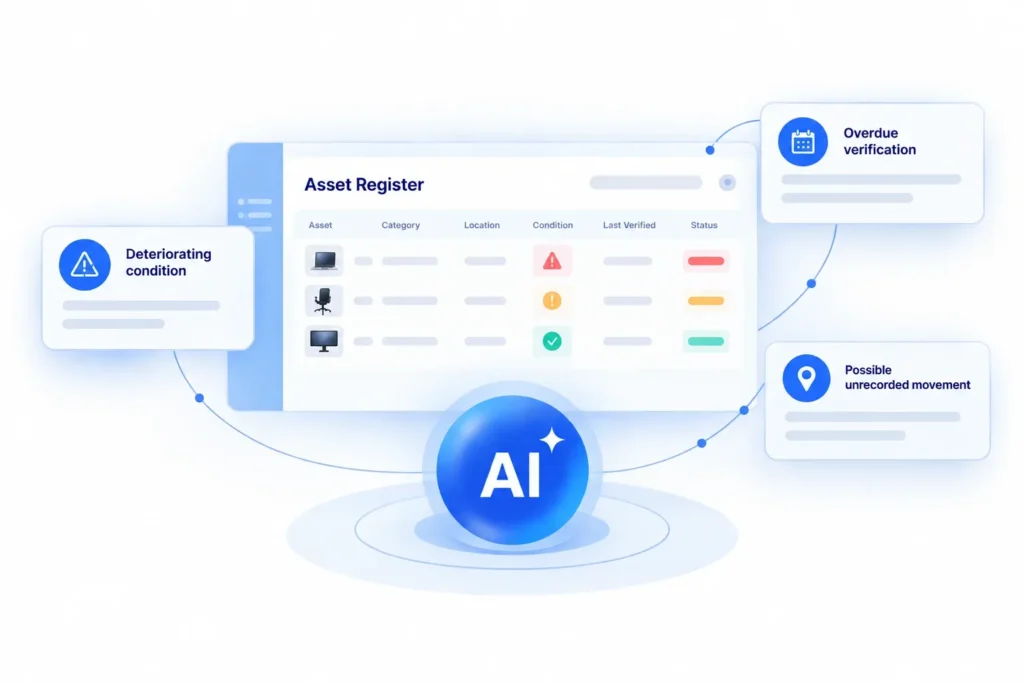
Meet the co-pilot that keeps asset exceptions in focus after creation. AssetCues combines AI-powered analysis with configured monitoring rules to surface deteriorating condition, overdue verification and possible unrecorded movements as fresh asset evidence arrives — fixed asset register automation that works between audits, not just during them.
Ongoing oversight. Earlier visibility of the records that need attention.
Asset Register Co-pilot

The Problem

Your assets keep changing. Your register finds out last.

Equipment moves. Condition changes. Verification becomes overdue. Most teams discover all of it at the next physical verification or year-end fixed asset register reconciliation — after the gap between the floor and the books has had months to grow.
The Problem
Changes outrun the register

Changes outrun the register

Movements, condition changes and disposals happen between audits — invisible until someone looks.

Data quality decays quietly

Data quality decays quietly

Descriptions and identity details drift as new information arrives and never reaches the record.

Reconciliation becomes archaeology

Reconciliation becomes archaeology

Year-end reconciliation digs through months of accumulated drift, one unexplained difference at a time.

Verification gaps go unnoticed

Verification gaps go unnoticed

Assets overdue for a physical check surface only when the auditor asks.

The Solution

Meet the Asset Register Co-pilot.

The Asset Register Co-pilot uses AI and monitoring rules to flag deteriorating condition, overdue verification, and possible unrecorded movements.It routes exceptions for review and carries confirmed corrections through the workflow to the connected ERP.

The Asset Register Co-pilot is the AI inside the AssetCues platform that keeps exceptions in focus after creation. It combines AI-powered analysis with configured monitoring rules to surface deteriorating condition, overdue verification and possible unrecorded movements as evidence arrives, and carries confirmed corrections through workflow to the connected ERP.

Asset Register Co-pilot process

How it works

Four steps from fresh evidence to a current register.

1

Evidence arrives

Scans, audit results and connected records supply new information about the assets on your books — continuously, not once a year.

How it works Evidence arrives
2

AI and rules analyze

The co-pilot analyzes available asset information and applies your monitoring rules as evidence is received or checks run.

How it works AI and rules analyze
        loading=
3

Exceptions surface

Condition concerns, overdue verification and possible unrecorded movements appear with their evidence attached — the AI detection layer that feeds the exception workflow your register program already runs, rather than a second queue beside it.

How it works Exceptions surface
4

Confirm and sync

Your team reviews, establishes what happened and progresses corrections through the configured workflow. Approved changes synchronize through the enabled ERP integration — automated asset register updates that begin with proof and finish with approval.

How it works Confirm and sync

Key AI Capabilities

Meet your co-pilot for a more current register.

AI-powered identity, condition, and tag integrity checks.
Keep asset information consistent

Keep asset information consistent

Carries the document and catalogue intelligence used during capitalization into ongoing record enrichment — automated asset data cleansing in the flow of work, so AI asset master data quality is maintained continuously rather than restored in cleanup projects.

Bring condition changes into focus

Bring condition changes into focus

Surfaces visible deterioration and condition exceptions from fresh asset evidence, prompting assessment for inspection, maintenance, retirement or accounting review.

Find the assets overdue for verification

Find the assets overdue for verification

Uses configured audit intervals and verification history to identify records needing a fresh physical check — coverage gaps surface automatically, not when the auditor asks.

Spot possible movements hiding in scan data

Spot possible movements hiding in scan data

Compares scan locations with the recorded location and transfer history, flagging differences that may indicate an asset moved without a register update.

Comparison

Register upkeep, before and after the co-pilot.

Dimension Periodic cleanup approach With the Asset Register Co-pilot
Exception discovery
At the next audit or reconciliation
As evidence arrives
Register quality
Restored in one-off cleanup projects
Maintained continuously — FAR cleansing in the flow of work
Movements
Found when something goes missing
Possible transfers flagged from scan data
Verification coverage
Tracked manually, if at all
Overdue assets surfaced automatically
ERP alignment
Re-established at reconciliation
Approved changes synced through the enabled integration

Business Outcomes

Make register upkeep an ongoing workflow.

Find the records that need action

Find the records that need action

Exception signals come into focus as scans, audits and connected records supply new evidence.

Turn findings into confirmed changes

Turn findings into confirmed changes

Evidence is reviewed, what happened is established, and corrections progress through the configured workflow. FAR cleansing becomes continuous instead of annual.

Carry approved updates forward

Carry approved updates forward

Approved changes synchronize through the enabled ERP integration, keeping the register reconciled with your ERP as corrections are confirmed.

Give finance an earlier view of asset concerns.

Condition and other asset exceptions arrive connected to the evidence finance needs to consider useful-life, impairment or retirement reviews. An automated fixed asset register is not just current — it is informative, supporting better decisions about the assets carried on the books. Carrying amounts and accounting adjustments remain with finance, under the applicable accounting policies and required approvals.

Ecosystem

Four co-pilots. One connected asset lifecycle.

Each co-pilot strengthens the evidence the next one works with — a record built well is tagged with confidence, audited with history and maintained with proof.

Asset Capitalization Co-pilot

Turns purchase documents into enriched ERP-ready asset records.

Learn more

Asset Tagging Co-pilot

Validates the physical match with visual AI as tagging happens.

Learn more

Asset Audit Co-pilot

Compares asset photos over time to flag identity, condition and tag concerns.

Learn more
YOU ARE HERE

Asset Register Co-pilot

Keeps exceptions in focus with ongoing AI monitoring after creation.

FAQs

Questions about Asset Register Co-pilot

How does it work with the other co-pilots?
The Asset Capitalization Co-pilot establishes the record, tagging validates the initial physical match, and audits compare evidence over time. The Asset Register Co-pilot brings that evolving information into ongoing exception monitoring and upkeep — each co-pilot strengthens the evidence the next one works with.
It analyzes available asset information and applies monitoring rules as evidence is received or checks run. Fresh scans, audits and connected data reveal physical changes; timely follow-up turns findings into confirmed updates — automated asset register updates that still pass through your approvals.
No — and deliberately so. It surfaces evidence for finance to assess useful life, impairment, retirement or valuation needs. Carrying amounts and any accounting adjustments follow the applicable accounting policies and required approvals.
Exceptions are surfaced and resolved as evidence arrives, instead of accumulating until the next reconciliation. For teams working to automate fixed asset reconciliation, the biggest gain is upstream: fewer unexplained differences reach the exercise, and those that do arrive with scan, photo and workflow evidence attached.
An ongoing control that reduces the need for cleanup. Continuous enrichment and exception monitoring keep descriptions, identities and locations aligned as information arrives, so register cleanup becomes a diminishing exercise — drift is caught early rather than corrected late.

Give your register an AI co-pilot of its own.

See how AssetCues brings intelligence to ongoing asset oversight and turns new evidence into action — in a tailored demo.
Start Your Free Trial
Discover the Power of Automation.