


Introduction
What is asset verification, and how does it work? Asset verification is the process of confirming that assets actually exist and that the records describing their location, custodian, condition, and status are accurate.
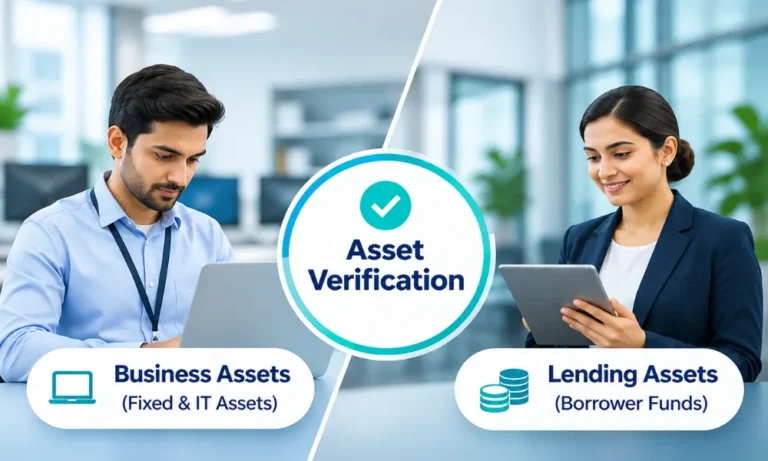
The term has two meanings. In business, teams carry out fixed asset verification and IT asset checks to match physical items against the asset register. In lending, banks and financial institutions verify a borrower’s funds before approving credit. This guide explains both in plain terms, then focuses on the business meaning: the types, the six-stage process, who owns it, and how often it should be done.
In this guide, you will learn:
- What asset verification means in business and lending, and how fixed-asset, IT-asset, and lender verification differ.
- How to run a six-stage verification cycle, from defining the register baseline and scope to field checks, approved corrections, and record updates.
- Why verification matters for register accuracy, audit evidence, and decision-making and how management, operations, IT, and internal audit share responsibility.
- How to set risk-based verification schedules and choose methods that produce reliable evidence while keeping human review in the process.
Asset Verification: A Definition
Asset verification is the evidence-backed confirmation that an asset exists and that the record describing it is correct. In a business context, that means physically or digitally checking the assets on the fixed asset register or IT inventory; in a lending context, it means a lender confirming that a borrower’s declared funds and holdings are real.
A working asset verification definition for finance teams: a periodic, documented check that every asset on the books can be found, identified and matched to its recorded location, custodian, condition and status. In audit textbooks, verification of asset means confirming the existence, ownership and condition of each recorded asset which is why auditors treat it as core evidence over the balance sheet. In Australia and parts of Asia, the same field activity is often called “asset sighting”.
The Two Meanings of “Asset Verification”
If you have searched for asset verification and found pages about mortgages next to pages about barcode scanning, you have met both meanings at once. They share a name and almost nothing else.
Dimension | Business asset verification | Lender (financial) asset verification |
|---|---|---|
| Who runs it | The organization that owns the assets: finance, operations, internal audit | A lender, underwriter or government programme |
| What is verified | Fixed assets, plant, IT equipment existence, location, custodian, condition | A borrower’s or applicant’s bank balances, deposits and holdings |
| Typical trigger | Year-end close, statutory audit, ERP migration, register clean-up | A loan or mortgage application, or a benefits eligibility check |
| Evidence produced | Scans, photographs, geo-tags, discrepancy logs, verification reports | Bank statements or electronic account confirmation |
| Who relies on it | Management, statutory auditors, insurers, lenders secured on the assets | The lender’s underwriting and compliance teams |
The lender meaning, briefly: In US mortgage underwriting, lenders must verify the funds a borrower needs to close, either from documents such as bank statements or through electronic verification reports. US state Medicaid programs run a similar check through asset verification systems that query applicants’ account balances electronically. If that is the verification you need, those two sources are the right starting points.
Everything from here on covers the business meaning the one that decides whether your balance sheet is backed by assets that exist.
Why Organizations Verify Assets
The purpose of asset verification is to close the gap between what the books say and what is actually on the floor. Left unverified, registers drift and the drift is measurable. When the Office of the New York State Comptroller audited one school district’s fixed assets, 64 of the 206 assets reviewed could not be located.
A 2026 internal audit for Prince William County, Virginia showed the gap running both ways: its latest physical inventory identified 201 new assets and 20 others noted as disposed, traded in, or damaged.
Those two findings are the two classic failure modes:

- Ghost assets: Items on the register that no longer exist. They inflate asset values, carry phantom depreciation and overstate insurance cover.
- Unrecorded assets: Real equipment missing from the register, invisible to controls, maintenance planning and insurance.
- Audit exposure: Existence and completeness gaps are precisely what statutory auditors test for, and unresolved discrepancies invite qualified findings.
- Weak downstream decisions: Depreciation, insurance, asset-backed lending and disposal planning are only as reliable as the last verification.
Regulation reinforces the point. In India, CARO 2020 expects management to physically verify property, plant and equipment at “reasonable intervals” and to deal with material discrepancies in the books; Ind AS 16 and the Companies Act 2013 set the record-keeping backdrop. Across the GCC, group audits under IFRS routinely ask for verification evidence behind IAS 16 balances In the United States, verification evidence supports management’s internal-control responsibilities under SOX.
In South Africa, public-sector entities face some of the most explicit requirements anywhere: municipal asset registers must satisfy GRAP standards and Auditor-General scrutiny, and verification deliverables often specify location, condition and useful-life indicators per asset.
Asset Verification vs Reconciliation vs Audit vs Tagging
Four related activities are routinely mixed up. One line each:
Activity | Core question | Comes before or after verification? |
|---|---|---|
| Asset tagging | How do we give each asset a unique, scannable identity? | Before: tags make verification faster and more accurate |
| Asset verification | Does each recorded asset exist, and does its record match reality? | The field activity itself |
| Asset reconciliation | How do we resolve the differences verification found? | After: field results are matched to the register and books |
| Asset audit | Can an independent reviewer rely on the records and controls? | After: verification evidence is what the auditor tests |
| Valuation | Is the asset carried at an appropriate amount? | Separate: a measurement question, not an existence question |
Verification produces the facts; asset reconciliation turns those facts into corrected records. If you are asking what is verification of assets versus an audit: verification is management’s own control, while an audit is the independent evaluation of it.
Types of Asset Verification
1. Physical verification of business assets
The classic form: trained teams walk floors, plants, branches and warehouses to sight each asset, scan its tag and record location, custodian and condition with photographs and geo-tags as evidence. In India, fixed assets verification of this kind is what CARO reporting assumes. Multi-location programmes add wave planning and central quality control. Explore our complete breakdown of the physical asset verification process for a step-by-step approach to verification.
2. IT asset verification
Laptops, servers and network gear move faster than any other asset class, and their records live in three places at once discovery tools, the CMDB and the fixed asset register. IT asset verification confirms the physical assets and reconciles those three views, including employee-held devices verified remotely.
3. Financial (lender) asset verification
The other meaning of the term, covered above: a lender or programme administrator confirming an applicant’s funds. It is a documents-and-data exercise run by the lender, not a field exercise run by the asset owner and it is out of scope for the rest of this guide.
How Does the Asset Verification Process Work? Six Stages
Formal asset verification procedures vary by organization, but a defensible cycle runs through the same six stages:

- Import the baseline: Pull the asset register, recent additions, disposals and custodian mappings into one working dataset, and mark exception sets such as leased or third-party assets.
- Plan the scope: Fix sites, asset classes, value thresholds, the method mix and evidence rules in writing before fieldwork starts.
- Verify in the field: Sight each asset, scan its tag, and capture location, custodian, condition and photographic evidence.
- Categorise discrepancies: Sort every mismatch into controlled categories not found, wrong location, unrecorded addition, duplicate, retired-but-active.
- Approve corrections: Route each proposed register change or write-off to a named approver; nothing changes without sign-off.
- Sync the records: Post approved corrections back to the register or ERP, and issue the verification report with its evidence trail.
Verification Methods Compared
Method | How it works | Relative speed | Best fit |
|---|---|---|---|
| Manual sighting | Assets physically sighted and recorded without tags | Slowest | Small asset groups, untaggable assets, one-time checks |
| Barcode / QR scanning | Each tag scanned line-of-sight with a mobile device | Fast | Most asset inventories; the default for recurring cycles |
| RFID scanning | Bulk radio reads capture many tags without line of sight | Fastest | High-volume, frequently moved assets where audit speed matters |
| Self-verification | Custodians confirm assigned assets remotely with photo evidence | Parallel | Employee-held laptops, phones and distributed field equipment |
Most programmes combine methods by asset class and risk rather than forcing one method onto everything.
Who Should Own Asset Verification?
Management owns it; auditors evaluate it. Within management, the split that works in practice: finance owns the policy, thresholds and reporting outcomes; operations, facilities and site custodians provide access and execute or support fieldwork; IT asset management oversees the IT inventory, while internal audit reviews the process and challenges unresolved exceptions.
The common failure is nobody owning it: verification gets treated as an audit-season favour rather than a standing control with a named owner and calendar.

How Often Should Assets Be Verified?
There is no single statutory frequency. India’s CARO 2020 asks for “reasonable intervals”; most regimes leave cadence to policy. In practice, risk sets the rhythm: high-value mobile assets such as IT and tools deserve quarterly or continuous spot checks, plant and machinery an annual or rolling cycle, and low-risk furniture every two to three years with spot checks. A written fixed asset verification policy should set the cadence for each asset class, using a practical risk-based model as a starting point.
The Evolution of Asset Verification
Asset verification meaning has stayed constant for a century prove the assets are real but the method has been reinvented four times:
Era | How verification worked | What changed |
|---|---|---|
| Paper registers (pre-1970s) | Clipboard counts ticked against ledger lines | Slow, error-prone, impossible to evidence afterwards |
| Barcodes (1974 onward) | Assets tagged and scanned; the first GS1 barcode was scanned on a retail product in June 1974 | Identity became machine-readable; counts became matchable |
| RFID at scale (2003 onward) | Walmart’s 2003 supplier mandate pushed RFID into mainstream supply chains | Bulk reads without line of sight; thousands of assets verified per day |
| Mobile + cloud (2010s) | Smartphone scanning, photographs, geo-tags and live dashboards | Evidence became rich, timestamped and centrally visible |
| AI-assisted (today) | Image recognition validates tags and condition; automation flags exceptions for human review | Verification shifts from an annual event to a continuous, reviewable control |
The current stage is the interesting one. AI-assisted recognition now validates that the scanned tag matches the asset in the photograph, and automation surfaces exceptions for structured human review rather than replacing it. AssetCues integrates this into its Asset Audit Co-pilot, using automated asset verification to improve accuracy while keeping human oversight essential for physical checks.
How AssetCues Supports Asset Verification
AssetCues approaches verification from both sides. Its asset verification software digitises the cycle end to end: register import, mobile scanning across barcode, QR and RFID, photographic and geo-tagged evidence, structured discrepancy workflows with approval routing, and sync back to SAP, Oracle or Microsoft Dynamics.
For organisations that need execution as well as tooling, AssetCues’ asset verification services manage the full programme, from planning and fieldwork to reconciliation and audit-ready documentation across multiple sites and countries.
Key Takeaway
- Establish asset verification as a documented management control that confirms asset existence, location, custody, condition, and status; consequently, organizations can strengthen financial accuracy and audit readiness.
- Combine physical and IT asset verification with both register-to-floor and floor-to-register checks to identify ghost assets, unrecorded equipment, and discrepancies that weaken financial and operational controls.
- Implement a six-stage verification process covering baseline preparation, scope planning, fieldwork, discrepancy classification, approved corrections, and record synchronization to maintain reliable asset registers and audit trails.
- Assign clear ownership, apply risk-based verification schedules, and use digital evidence and structured exception workflows to improve accountability, support compliance, and keep asset records accurate between audits.
Conclusion
Asset verification confirms that assets exist and that their recorded details such as location, custodian, condition, and status are accurate. In business, it involves checking physical or IT assets against the asset register, documenting discrepancies, and routing any corrections for approval. This helps keep records reliable and supports stronger financial controls and audit readiness.

FAQs
Q1. What is asset verification?
Ans: Asset verification is the documented confirmation that assets exist and that their records are accurate. Businesses verify fixed and IT assets against the asset register checking existence, location, custodian and condition while lenders use the same term for confirming a borrower’s funds during underwriting.
Q2. What is asset verification meaning in business terms?
Ans: In business, asset verification means physically checking that every asset on the fixed asset register can be found and that its recorded details match reality. It is a management control: the organisation verifies its own assets, documents the evidence, and corrects the register through approved adjustments.
Q3. What is asset verification in finance?
Ans: In finance and lending, asset verification is a lender confirming that a borrower’s declared funds are genuine through bank statements or electronic account checks during mortgage underwriting, or via government AVS programmes used for benefits eligibility. It verifies money and holdings, not physical equipment.
Q4. What is asset verification services?
Ans: Asset verification services are outsourced programmes in which a specialist provider plans and executes the verification of an organization’s assets fieldwork, tagging where needed, reconciliation against the register and audit-ready reporting. They suit organizations with multiple sites, tight audit deadlines and limited in-house field capacity.
Q5. What is asset verification process in practice?
Ans: A practical asset verification process runs in six stages: import the register baseline, plan scope and methods, verify assets in the field with scanned and photographic evidence, categorise discrepancies, route corrections for approval, and sync approved changes back to the register or ERP with a final report.


