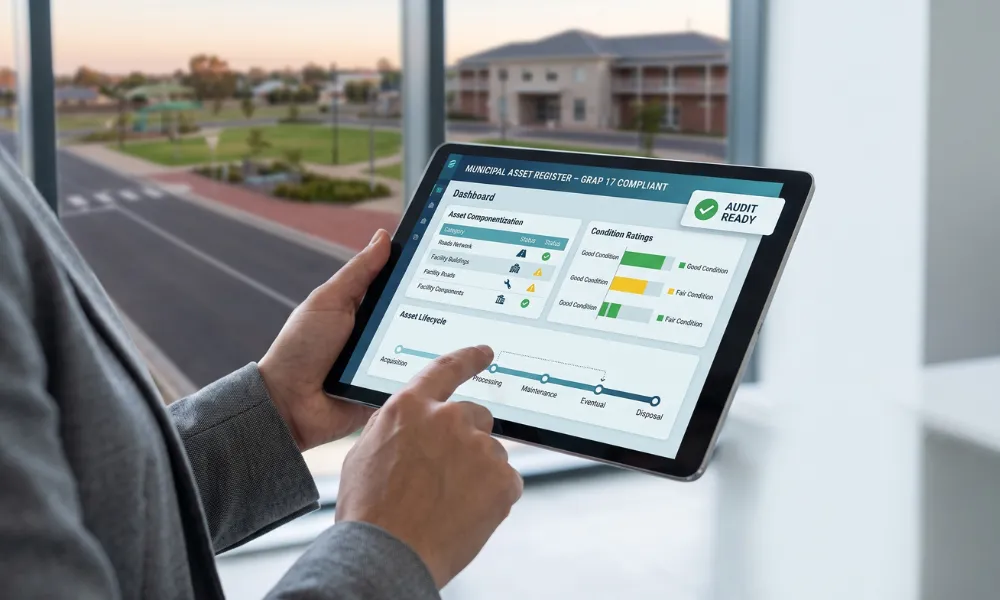




Introduction
If you run finance for an Indian company, your auditor will ask to see your register of fixed assets. Under CARO 2020, they now have to report on how well you keep it. This guide explains what the Companies Act 2013 expects: the records you must keep, how Schedule II drives depreciation, why you often need two parallel views (book and tax), and the format that keeps you audit-ready.
Note: This is general guidance for finance and audit teams, not legal or tax advice. Always apply your company’s accounting policy and your auditor’s view.
In this guide, you will learn:
- Whether a fixed asset register is effectively mandatory under the Companies Act 2013, and how Section 128, Schedule II, Schedule III, and CARO 2020 shape asset recordkeeping requirements.
- The essential fields and statutory information a Companies Act-compliant fixed asset register should contain, including Schedule II useful lives, componentisation, and audit-ready documentation.
- How to maintain separate book and tax depreciation views, comply with the audit trail requirements under Rule 3 of the Companies (Accounts) Rules, 2014, and support CARO 2020 reporting.
- The practical steps, common audit findings, and recordkeeping practices that help maintain an accurate, compliant, and audit-ready fixed asset register.
Is a fixed asset register mandatory under the Companies Act 2013?
In practice, yes. The Companies Act 2013 does not use the words “fixed asset register” as a single line item, but it makes one effectively unavoidable. Section 128 requires every company to keep proper books of account that give a true and fair view and explain its transactions, and that includes its assets.
Schedule III sets how Property, Plant, and Equipment (PP&E) is presented in the financial statements. And Schedule II requires you to depreciate each asset over a useful life, which you cannot do without asset-level records.
On top of this, CARO 2020 requires your statutory auditor to report on whether you keep proper PP&E records and verify them. So even though the register is not named as a standalone rule, the Act and the audit framework assume you keep one. Most companies treat it as mandatory.

What the register must contain
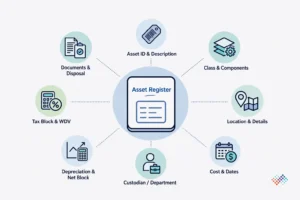
To support the Act and satisfy your auditor, each asset record should hold both statutory and practical details:
- A unique asset ID or code, and a clear description (make, model, specification).
- Asset class and any significant components are tracked separately.
- Quantitative details and the situation (location) of the asset CARO 2020 asks for both.
- Cost, date of acquisition, and the placed-in-service date.
- Custodian or department, so the responsibility is clear.
- Useful life, depreciation method, accumulated depreciation, and net block (book value).
- Income Tax block, rate, and written-down value (tax view).
- Source documents (PO, GRN, invoice) and disposal details.
Schedule II: useful lives and the component approach
Schedule II changed how Indian companies depreciate. The old Schedule XIV gave fixed depreciation rates. Schedule II instead prescribes a useful life for each class of asset, and companies typically maintain these useful lives, depreciation methods, and calculations in a depreciation register. You may use the straight-line method (SLM) or the written-down value method (WDV), but you must disclose which you use.
These are the useful lives for some common asset classes (single-shift basis):
Asset class |
Useful life (years) |
|---|---|
| Buildings (RCC frame structure) | 60 |
| Buildings (other than RCC) | 30 |
| Plant & machinery (general) | 15 |
| Furniture & fittings | 10 |
| Electrical installations & equipment | 10 |
| Laboratory equipment (general) | 10 |
| Motor vehicles (motor cars) | 8 |
| Servers & networks | 6 |
| Office equipment | 5 |
| Computers & laptops (end-user devices) | 3 |
Residual value is capped at 5% of original cost. You may adopt a different useful life or residual value, but only if you disclose it and support it with a technical justification.
Where the cost of a part of an asset is significant to the whole, and that part has a different useful life, you depreciate the part separately. For example, a furnace lining inside a larger plant may wear out far sooner than the plant itself. This has been mandatory for financial years from 1 April 2015 and aligns with Ind AS 16. Your register, therefore, needs to record significant components, not just the parent asset.
Companies Act book view vs Income Tax block of assets
Here is a point that trips up many teams: the depreciation in your financial statements is not the same as the depreciation in your tax return. They follow different rules, so companies keep two views of the same assets.
Aspect |
Companies Act 2013 (book) |
Income Tax Act, 1961 (tax) |
|---|---|---|
| Basis | Each asset, over its Schedule II useful life | Grouped into a “block of assets” by class and rate |
| Method | SLM or WDV (your choice, disclosed) | Mainly WDV |
| What drives it | Useful life | A prescribed depreciation rate |
| Purpose | A true and fair view in the accounts | Computing taxable income |
| In the register | Track per asset | Track per block |
A good register of fixed assets holds both views side by side. That way, one source of truth feeds your financial statements and your tax computation, and the two reconcile. (Income Tax rates and blocks are set by the Income Tax Rules and can change; confirm the current rates with your tax team.)
The audit trail rule: why a plain Excel register may not be enough
This is the change many finance teams have missed. Since 1 April 2023, Rule 3 of the Companies (Accounts) Rules, 2014 requires companies to keep their books of account in accounting software that has a built-in audit trail. The audit trail must record every change to a transaction, with the date and the user who made it, and it must not be possible to switch off.
A standard spreadsheet does not do this. You can edit any cell, with no record of who changed what or when. So a register of fixed assets kept only in Excel does not, on its own, meet the audit-trail expectation that now applies. This is one reason companies move their register into a fixed asset register system that logs every change.
A dedicated platform such as AssetCues keeps an attributable audit trail of additions, transfers, disposals and edits, which supports this requirement while your ERP stays the accounting system of record. Many organisations begin with an asset register template before moving to more controlled asset management processes
CARO 2020 and your register
CARO 2020 is the order that tells your statutory auditor what to report on. For fixed assets, Clause 3(i) asks the auditor to report whether you keep proper records with full particulars, including quantitative details and the situation (location) of each asset; whether assets are physically verified at reasonable intervals and material differences are dealt with in the books; whether title deeds of immovable property are in the company’s name; and on any revaluation or benami matters.
In short, the fixed asset register provides much of the evidence that supports CARO reporting requirements. Its accuracy, completeness, and supporting documentation play a key role in demonstrating asset existence, ownership, valuation, and compliance during audit and financial reporting processes.
Register of fixed assets format (Excel)
A Companies Act-ready register builds on the standard format and adds the statutory columns. Here is a practical layout:
Column group |
Columns to include |
|---|---|
| Identity | Asset ID, description, class, significant components, serial number |
| Acquisition | Purchase date, cost, placed-in-service date, PO/GRN/invoice reference |
| Location & control | Location/site, custodian/department, status, title-deed reference (immovable) |
| Book view (Companies Act) | Useful life, method (SLM/WDV), depreciation for the year, accumulated depreciation, net block |
| Tax view (Income Tax) | Block of assets, rate, WDV opening/closing |
| Disposal | Date, mode, sale value, profit/loss, approval reference |
You can build this in a spreadsheet to start. Just remember the audit-trail point above as you scale. For a ready structure with SLM and WDV columns.
How to prepare and maintain it (step by step)
- List assets and assign unique IDs: Capture every asset on its own row, with a unique ID. Avoid grouped “many units” lines.
- Map each asset to a Schedule II class and useful life: Use the prescribed useful life, or your justified estimate, and record the method (SLM or WDV).
- Identify significant components: Where a part has a different useful life and a high cost, record and depreciate it separately.
- Record cost, dates and location: Enter cost, acquisition date, placed-in-service date, location and custodian. Attach source documents.
- Maintain the book and tax views in parallel: Keep the Companies Act view and the Income Tax block view side by side, so both reconcile.
- Verify and keep evidence for CARO: Physically verify assets at reasonable intervals, record findings, and deal with material differences in the books.
A register is only as strong as the evidence behind it. Retain purchase documents, disposal approvals, and physical verification records alongside the asset register to support CARO and statutory audit requirements.
Common mistakes and audit findings
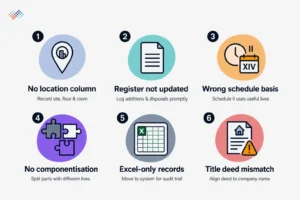
- No location column: CARO asks for the “situation” of each asset. A register without a location is a common finding. Record the site, floor and room.
- Register not updated for additions and disposals: Assets bought or sold during the year are missed. Update the register as events happen.
- Treating Schedule II like Schedule XIV: Schedule II uses useful lives, not the old fixed rates. Re-check your basis.
- No componentisation: Significant parts with different lives are lumped into the parent. Split them out.
- Excel-only records: A plain spreadsheet has no audit trail and fails the Rule 3 expectation. Move to a system as you scale.
- Title deeds not in the company’s name: Often a hangover from mergers. Track and explain any mismatch.
Key takeaways
- Effectively required: The Act (Section 128) requires proper books of account, and CARO 2020 requires your auditor to report on PP&E records and verification.
- Schedule II drives depreciation: It sets useful lives (not the old fixed rates of Schedule XIV); you choose SLM or WDV and disclose it.
- Two views: Companies keep a Companies Act (book) view and an Income Tax (block-of-assets) view of the same assets.
- Components matter: A significant part with a different useful life is depreciated separately.
- Audit trail rule: From 1 April 2023, accounting software must keep a non-disableable audit trail; a plain Excel register does not meet this.
Conclusion
A fixed asset register as per Companies Act 2013 helps companies maintain accurate asset records, support Schedule II depreciation, and meet statutory reporting requirements. It also strengthens audit readiness by capturing asset-level details, locations, and ownership information.
For IT-heavy organisations, a computer asset register extends this further, tracking hardware, software licences, and cloud services with each asset’s ID, owner, location, and lifecycle details. Moreover, proper recordkeeping simplifies physical verification and financial reporting. As a result, companies can maintain compliance while improving control over their assets.
AssetCues Fixed Asset Register Software provides a centralized, audit-ready register that keeps asset records accurate, current, and easy to manage. It helps organizations maintain complete asset visibility across the asset lifecycle while supporting compliance and physical verification activities.
Frequently asked questions
Q1. What is the difference between the Companies Act and Income Tax depreciation?
Ans. The Companies Act view depreciates each asset over its Schedule II useful life (SLM or WDV) for the financial statements. The Income Tax views groups of assets into blocks and applies prescribed WDV rates to compute taxable income. Most companies keep both views in the register.
Q2. Does the register need componentisation?
Ans. Yes. Where a significant part of an asset has a different useful life, you depreciate that part separately. This has been mandatory for financial years from 1 April 2015 and aligns with Ind AS 16.
Q3. How often must fixed assets be physically verified?
Ans. CARO 2020 requires verification at “reasonable intervals” rather than a fixed period; in practice, this is often interpreted as at least once every three years, with material discrepancies dealt with in the books. Higher-value or mobile assets are usually checked more often.