




Introduction
For South African municipalities and public entities, weaknesses in the fixed asset register are a common cause of audit qualifications. Common issues include lumped (“globular”) asset records, assets that cannot be physically verified, and registers that do not reconcile to the financial statements. A GRAP 17-compliant asset register supports accurate asset accounting, reconciliation, and audit readiness, with the records and controls needed to meet AGSA audit requirements.
Teams that want a broader understanding of what a reliable register of fixed assets should contain, from unique IDs and ownership to depreciation details and reconciliation, will find that a useful starting point before applying GRAP-specific requirements.
Note: This is general guidance for public-sector finance and asset teams, not a substitute for your accounting policy, a registered valuer, or your auditor’s view.
In this guide, you will learn:
- What makes a GRAP 17-compliant fixed asset register, the common causes of AGSA audit findings, and how it differs from a standard asset register.
- The essential GRAP 17 requirements include componentisation, deemed cost, useful-life reviews, condition assessments, and impairment indicators.
- How to reconstruct a non-compliant register, capture the required asset information, and reconcile it with the trial balance, Annual Financial Statements (AFS), and mSCOA.
- The most common AGSA audit findings and the practical controls that help improve compliance, strengthen asset accountability, and support audit readiness.
What makes a fixed asset register GRAP-compliant?
A fixed asset register is GRAP-compliant when it records Property, Plant and Equipment the way GRAP 17 requires. In practice, that means each asset is split into its main parts, valued at cost or a deemed cost, and given a useful life and residual value that you can support.
Each asset is also checked for condition and impairment, and the register is reconciled to the general ledger. Get this right, and every asset can be recognised, depreciated, verified and disclosed correctly in the Annual Financial Statements (AFS).
It also means covering the right assets. Public entities hold movable assets, such as vehicles, equipment and furniture. They also hold immovable assets, such as land, buildings and infrastructure (roads, water and sewer networks). For movable assets like computers and IT equipment, a hardware asset register covers each device with its ID, owner, location, status, and lifecycle details in one maintained record.
Investment property and heritage assets follow their own standards, GRAP 16 and GRAP 103. So the register should sort each asset into the right standard, not lump everything together.
What a GRAP asset register must contain
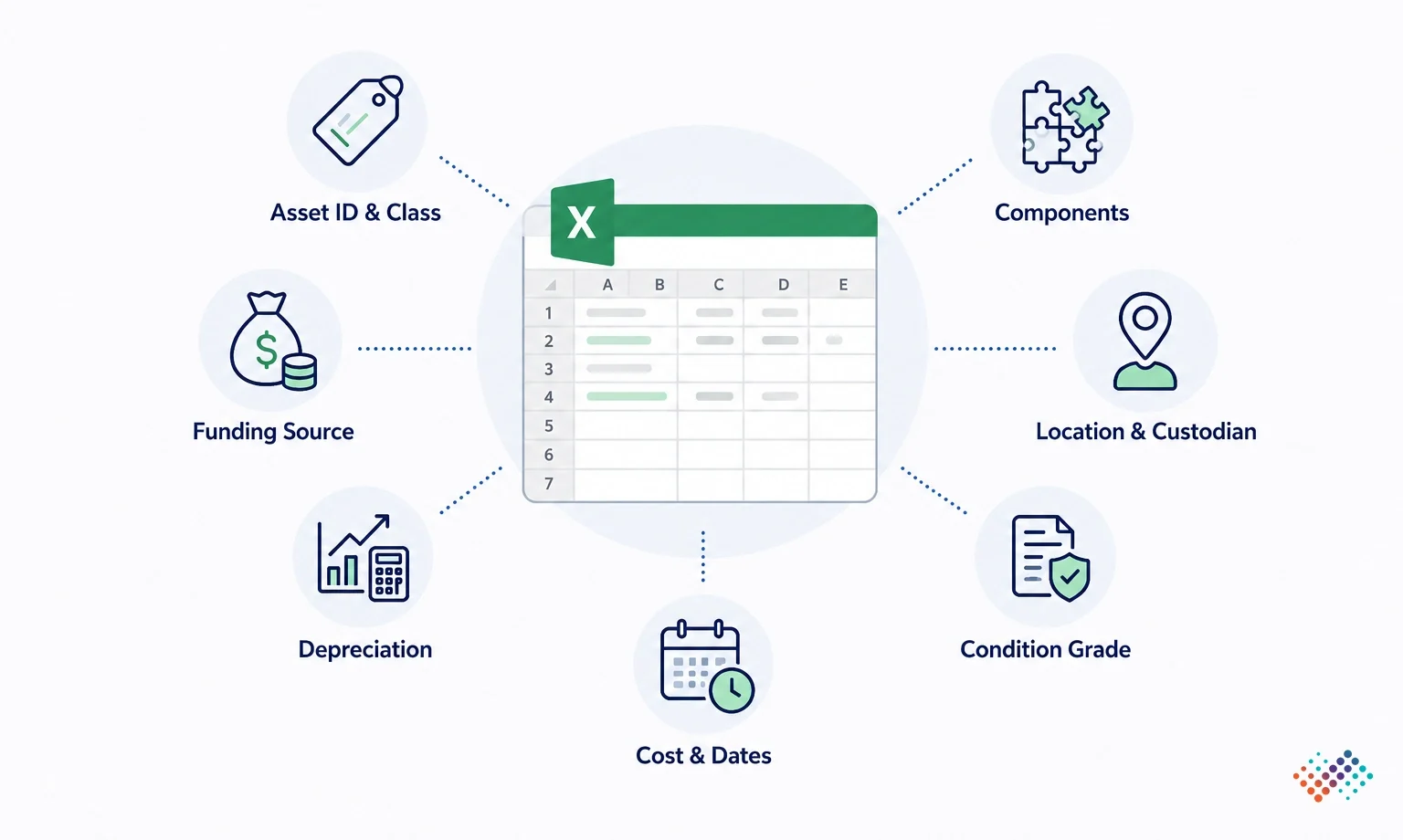
To support GRAP 17 and an AGSA audit, each asset record should hold:
- A unique asset number, a clear description and asset class (movable, immovable, infrastructure).
- Significant components, each recorded and depreciated separately.
- Cost or deemed cost, acquisition or valuation date, and the measurement basis used.
- Useful life, residual value, depreciation method, accumulated depreciation and carrying amount.
- Location (including GPS coordinates for infrastructure), department and the responsible official (custodian).
- Condition grade, last assessment date and any impairment recognised.
- Funding source (own revenue, grant, external loan) and any disposal or transfer details.
Componentisation: Unbundling globular amounts
Componentisation is the heart of GRAP compliance for infrastructure. It simply means splitting an asset into its main parts. Under GRAP 17, when a part of an asset costs a lot relative to the whole and wears out at a different rate, you account for that part on its own. The opposite is recording a whole network or building as one lumped, or “globular”, amount. That is one of the most common audit findings.
Take a road. As a single amount, it cannot be depreciated properly because its parts wear out at very different rates. Split into components, it becomes a register you can depreciate, maintain and renew with confidence:
Road component |
Why is it separate |
Illustrative useful life |
|---|---|---|
| Earthworks/formation | Very long life; sometimes not depreciated | Indefinite / very long |
| Pavement layers (base, sub-base) | Structural, long life | 20–30 years |
| Surfacing (asphalt/seal) | Wears fastest; renewed often | 8–15 years |
| Kerbs and channels | Separate replacement cycle | 20 years |
| Stormwater drainage | Long-life civil works | 30–50 years |
| Signage and road markings | Short life | 5–10 years |
These lives are illustrative only; your municipality sets them from condition and engineering input, and reviews them each year. The point is that each component carries its own life, so depreciation and renewal planning reflect reality.
Deemed cost under Directive 7
Older assets often have no reliable purchase records. GRAP allows for this. Under Directive 7, when you adopt the standards and an asset’s cost is not available, you may use a “deemed cost” instead of a stand-in value. The decision path is simple:
- Use the actual cost where you have source documents, such as invoices or contracts.
- Where cost is not available, use fair value as the deemed cost.
- Where there is no market price and no history, use depreciated replacement cost. This is what it would cost to replace the asset today, less an allowance for its age and condition.
A registered valuer or engineer usually does these valuations. The register’s job is to record the basis used, the value, the date and the evidence, so the figure can be defended later.
Useful life, residual value, condition and impairment
GRAP 17 asks you to review useful lives, residual values and depreciation methods at each reporting date. You then change them when your expectations change. This is where condition assessment helps.
A condition grade, say, 1 (very good) to 5 (very poor), links the state of an asset to how much life it has left and what it needs spending on. A water pipe graded “poor” has less life left than the same pipe graded “good”, and the register should show that.
Condition data also flags impairment. Impairment is a drop in an asset’s value when its ability to deliver a service falls sharply and unexpectedly. Recording condition and impairment signs in the register keeps these calls evidenced, not guessed.
How to reconstruct a non-compliant register (step by step)
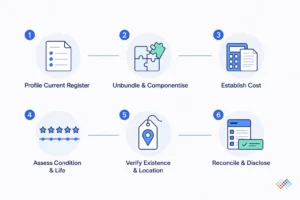
Many municipalities are not building from scratch; they are fixing a register that has drifted. Here is a practical sequence.
- Profile the current register: List globular amounts, missing fields, untraceable assets and classification errors. This baseline tells you the size of the job.
- Unbundle and componentise: Break globular and grouped assets into significant components, each with its own useful life.
- Establish cost or deemed cost: Use source documents where they exist. Otherwise, apply Directive 7 fair value, or depreciated replacement cost with a valuer where needed.
- Assess condition and remaining useful life: Apply a condition grading scale, then review useful life, residual value and method for each asset and component.
- Verify existence and location: Tag assets, capture location and GPS coordinates, and confirm each one exists. Resolve found and not-found items.
- Reconcile and disclose: Reconcile the register to the trial balance and AFS by category and total, prepare the GRAP 17 disclosure note, and engage your auditor early.
Reconciling the register to the trial balance and AFS
A GRAP-compliant register has to agree with the books. And it must agree for each asset category, not just the grand total. A register that nets to the right total while categories are wrong will still draw a finding. Before doing that, a depreciation register starts with getting the right inputs correct, because even a perfect formula gives a wrong answer if the underlying data is wrong. Then tie the closing carrying amounts (the values in the books) to the AFS note.
Physical verification of the register
Compiling the register is only part of the control process. Organisations must also verify asset existence and, where relevant, record condition, location, and supporting evidence. Activities such as tagging, scanning, photographing, and condition assessment should follow a defined verification process. The focus here is on how the results of those activities are recorded and maintained within the register.
Common AGSA audit findings
Most asset findings repeat across municipalities. Watch for these:
- Globular amounts: Networks or buildings recorded as one lump sum, not componentised.
- Unsupported useful lives: Lives applied without condition or engineering support.
- Untraceable assets: Records that cannot be traced to a physical asset, and assets on the ground with no record.
- Work-in-progress not controlled: WIP is not transferred to PP&E when the asset becomes available for use.
- The register does not reconcile to the AFS: Totals agree, but categories do not, or movements are unsupported.
- Classification errors: PP&E, investment property and heritage assets are mixed instead of being classified to the right standard.
Key takeaways
- GRAP 17 is the standard: Public-sector PP&E is recognised, measured and disclosed under GRAP 17, and the register is the evidence behind the AFS.
- Componentise: Split globular and grouped assets into significant components, each with its own useful life.
- Deemed cost: Where cost is not available, Directive 7 allows fair value, or depreciated replacement cost, where no history exists.
- Reconcile by category: The register must agree with the trial balance and AFS by asset category, not only on the total.
- It is ongoing: Review useful lives, residual values and condition each reporting date, and verify assets regularly.
Conclusion
A GRAP-compliant fixed asset register strengthens asset accountability by recording accurate values, useful lives, and asset components. Moreover, a GRAP 17-compliant asset register supports reliable financial reporting by linking physical assets with supporting records and disclosures.
By maintaining current asset information and regular reconciliations, organisations can reduce audit findings and improve transparency. Ultimately, a GRAP 17-compliant fixed asset register provides a solid foundation for effective asset management and audit readiness.
Frequently asked questions
Q1. How do you reconstruct a non-compliant asset register?
Ans. Profile the existing register, unbundle globular amounts into components, establish cost or deemed cost, assess condition and remaining useful life, verify existence and location, and reconcile the register to the trial balance and AFS, engaging your auditor throughout.
Q2. Why do municipalities get audit findings on fixed assets?
Ans. The usual causes are globular amounts that were never componentised, useful lives without support, assets that cannot be traced between the register and the ground, work-in-progress that was not controlled, and a register that does not reconcile to the AFS by category.
Q3. How does the register relate to mSCOA?
Ans. The register must align with the municipal Standard Chart of Accounts (mSCOA) so that asset transactions are classified and roll up consistently for reporting. If the register and the mSCOA asset segment do not agree, reporting and reconciliation break down.