



Introduction
Search for a “fixed asset register with depreciation” or a “fixed asset register and depreciation schedule”, and you will find plenty of spreadsheets that try to do the maths for you. If you are new to the concept, the register of fixed assets covers what it is, what fields it needs, and how to build and maintain one correctly.
The register’s real job is not to calculate depreciation; it is to hold the right inputs so the calculation is correct. Get those inputs right, and your depreciation is right. Get them wrong, and even a perfect formula gives a wrong answer.
In this guide, you will learn:
- The difference between a fixed asset register and a depreciation schedule, and why the register’s primary role is to capture the inputs that drive accurate depreciation.
- The key depreciation inputs a fixed asset register must contain, including cost, placed-in-service date, useful life, depreciation method, residual value, and significant components.
- How asset register data feeds the depreciation schedule, accumulated depreciation, and net book value calculations across different depreciation methods.
Does a fixed asset register calculate depreciation?
No. The register holds the inputs that depreciation depends on. The calculation itself is done by your accounting system or ERP, and the posted figures live in the general ledger. This is the single most useful thing to understand about depreciation and the register.
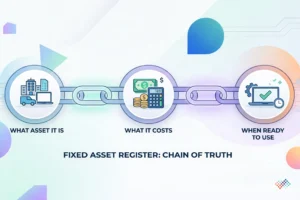
Think of it as a chain. The register is the source of truth for what each asset is, what it costs, and when it is ready to use. The depreciation schedule applies a method to those inputs and works out the charge for each period. The ledger records the posted amounts. Feed the chain good inputs, and every link is right. Feed it a wrong date or a missing disposal, and the system will calculate the wrong number with full confidence.
The depreciation inputs your register must capture
Six pieces of data drive almost every depreciation calculation. Make sure your register holds each one, per asset:
Input |
Why does depreciation need it |
|---|---|
| Cost (incl. directly attributable costs) | This is the amount to be depreciated. Include freight, installation, and other costs of getting the asset ready. |
| Placed-in-service date | Depreciation usually starts when the asset is available for use, not the invoice date. |
| Useful life | The period over which the cost is spread. |
| Depreciation method | How the cost is spread is straight-line, reducing balance, or another basis. |
| Residual value | The amount you expect to recover at the end; it is not depreciated. |
| Significant components | Parts with a different useful life are depreciated separately over their own lives. |
A seventh input matters at the end of life: the disposal date and proceeds, which tell the system when to stop depreciating and derecognise the asset. These inputs follow the principles in IAS 16. If you report in India, the useful lives come from Schedule II.
For South African public entities, a GRAP-compliant asset register takes the same approach under GRAP 17, splitting assets into components, valuing at cost, and assigning supportable useful lives and residual values.
How the register feeds the depreciation schedule
The flow is simple, and worth picturing:
- Register inputs: Cost, placed-in-service date, useful life, method, residual value and components captured per asset.
- Depreciation schedule: Your accounting system applies the method to those inputs and works out the charge for each period.
- General ledger: The system posts the periodic charge and the accumulated depreciation to the books.
The register sits at the start of this flow. That is why its accuracy matters so much: every figure downstream inherits whatever the register got right or wrong.
Straight-line vs reducing balance: What changes in the register
The two most common methods spread the cost in different shapes. The register records which method applies and the inputs that drive it.
Criteria |
Straight-line (SLM) |
Reducing balance (WDV) |
|---|---|---|
| How is the cost spread | An equal amount each period | A fixed percentage of the remaining value |
| Key register input | Useful life (and residual value) | The rate (or the life used to set it) |
| Charge pattern | Even across the life | Higher early, lower later |
| Often used for | Buildings, furniture, and fittings | Plant, vehicles, IT, and most tax books |
Many companies run two views of the same assets: a book view (per asset, over its useful life) and a tax view (often a grouped, reducing-balance basis). A good register holds the inputs for both, so they reconcile. The fixed asset register as per companies act explains the Indian book-versus-tax split in detail.
Accumulated depreciation and net book value: reference, not the source
Most registers also show accumulated depreciation (the total charged so far) and net book value (cost minus accumulated depreciation). These are useful to see at a glance, and they help you reconcile the register to the books.
But treat them as a reference copy. The authoritative figures are the ones your accounting system calculates and posts to the general ledger. If the register and the ledger disagree, the ledger wins, and you investigate why the register drifted. The register’s value is the quality of its inputs, not a second set of numbers.
What goes wrong when the inputs are wrong
Because the system trusts the register’s inputs, a small data error becomes a real accounting problem. The most common ones:
Wrong or missing input |
What it causes |
|---|---|
| Late or wrong placed-in-service date | Depreciation starts in the wrong period: prior-period adjustments. |
| Cost missing attributable costs | The depreciable amount is too low; depreciation is understated. |
| No componentisation | A short-life part rides on the parent’s long life; value is overstated. |
| Disposal not recorded | Ghost depreciation keeps running on an asset that is gone. |
| Wrong useful life or method | The charge pattern is wrong; possible restatement. |
| Duplicate asset record | The same asset is depreciated twice. |
A machine is delivered in March but is only commissioned and ready to use in May. If the register records the March invoice date as the start, depreciation begins two months early, and someone has to unwind it. The fix is upstream: capture the right placed-in-service date in the register.
Maintaining accuracy at period close
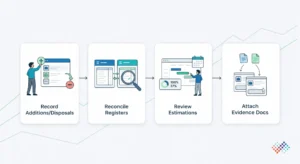
Depreciation is only as current as the register behind it. A few habits keep it clean:
- Record additions and disposals before you close the period, so the charge is complete.
- Reconcile the register to the general ledger each period, and investigate differences while they are small.
- Review useful lives, residual values, and methods at each reporting date, and update them when expectations change.
- Keep the evidence cost documents, commissioning records, and disposal approvals attached to each asset.
Key takeaways
- Inputs, not engine: The register holds the data depreciation needs; the accounting system or ERP does the calculation.
- Six inputs matter most: Cost, placed-in-service date, useful life, method, residual value and components.
- Start date is critical: Depreciation begins when the asset is ready for use, not when it was invoiced.
- Components depreciate separately: A short-life part should not ride on the parent’s long life.
- Bad inputs cost you: Late disposals cause ghost depreciation; wrong dates cause period errors and adjustments.
Conclusion
A fixed asset register with depreciation helps organisations maintain accurate asset records and support consistent financial reporting. By linking asset details to a fixed asset register and depreciation schedule, teams can track asset value changes throughout the lifecycle.
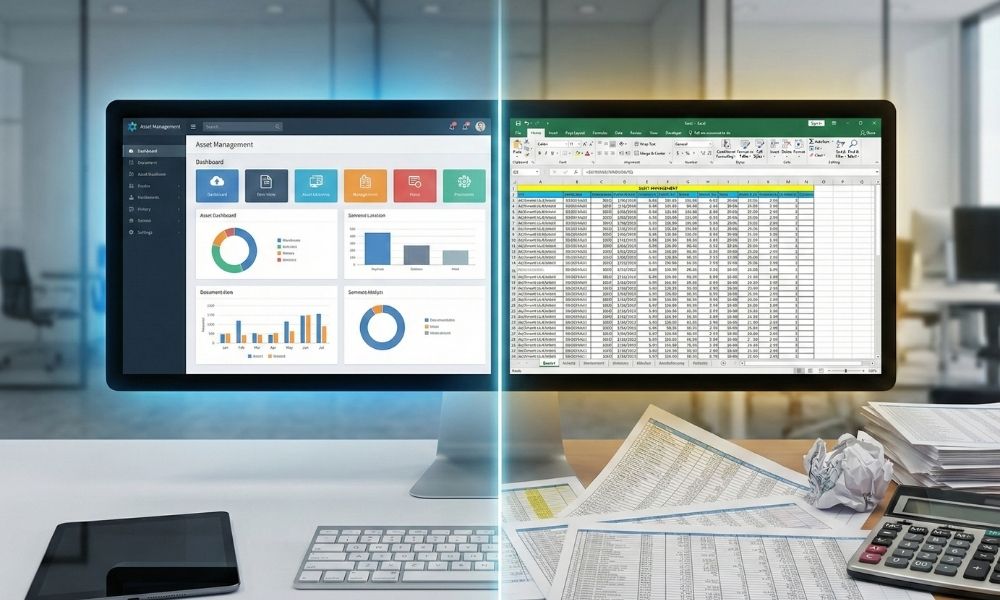
In addition, a well-maintained depreciation register improves reconciliation, reduces reporting errors, and supports informed decision-making. A fixed asset register with depreciation Excel format further simplifies record-keeping while keeping depreciation data organised and accessible.
If your team is still managing this in a spreadsheet, understanding when an asset register system becomes necessary covers exactly where spreadsheets start to drift, lose controls, and create reporting risks as asset volume grows. AssetCues helps organisations maintain accurate, evidence-backed depreciation inputs by preserving cost lineage, placed-in-service evidence, component records, and disposal history, while the ERP remains the depreciation engine and system of record.
Frequently asked questions
Q1. Why does the placed-in-service date matter?
Ans. Depreciation generally begins when the asset is available for use, not when it was invoiced. A wrong or late date shifts the charge into the wrong period and forces adjustments, so capture the date the asset was ready to operate.
Q2. Can I track component depreciation in the register?
Ans. Yes. Record significant components separately, each with its own useful life, so a short-life part (say, a furnace lining) depreciates over its own period rather than the parent asset’s longer life.
Q3. How does depreciation relate to disposals?
Ans. When an asset or component is disposed of, the register must capture the disposal date and proceeds so that depreciation stops and the asset is derecognised. A disposal that never reaches the register becomes a ghost asset that keeps depreciating.