


Introduction
The textbook asset capitalization process has four steps: identify the asset, determine its cost, record the entry, and start depreciation. If that matched your reality, your CWIP wouldn’t age, your auditors wouldn’t sample receiving, and month-end wouldn’t include an email hunt for commissioning certificates.
The real fixed asset capitalization process starts on a purchase order and ends in a reconciliation, nine steps across five teams and three systems. This guide follows the complete capitalization workflow, showing each step, the ten places the chain breaks in practice, and what a controlled version looks like.
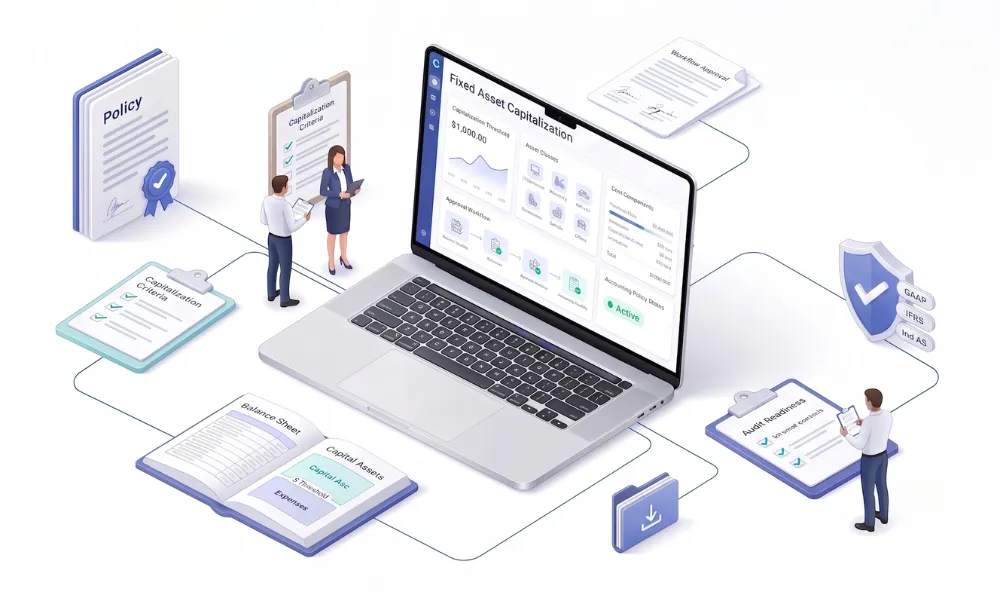
The asset capitalization meaning extends beyond the accounting entry. The asset capitalization process is the end-to-end workflow that turns capital expenditure into a recorded, depreciating fixed asset: from CapEx purchase order through dispatch, receipt and tagging, GRN and invoice matching, readiness confirmation, asset formation, evidence and approvals, posting, and final reconciliation. The accounting entry is its last step, not its substance.
In this guide
- What the asset capitalization process includes, how it extends beyond accounting entries, and why cross-functional workflows determine successful fixed asset capitalization.
- How to implement a structured capitalization workflow, from CapEx purchase orders and physical receipt to readiness, asset formation, posting, and reconciliation.
- Why asset capitalization processes fail in practice, which operational control gaps cause recurring issues, and how standardized workflows reduce audit and reporting risks.
- How to evaluate, improve, and govern your fixed asset capitalization process by assigning ownership, strengthening controls, managing exceptions, and monitoring the end-to-end workflow.
The textbook process (and why it isn’t yours)
Every accounting resource describes the same four-step loop: test the criteria, build the cost, post the entry, depreciate. The description is correct, and it covers perhaps the final fifth of what actually happens.
What it omits is everything operational: the asset exists physically for weeks or months before it exists financially, in the custody of teams who don’t report to finance, described in documents that don’t match each other. The textbook process assumes the inputs arrive clean. The real process is the fight to make that true.
The real process: 9 steps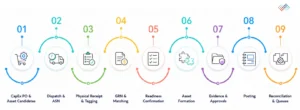
- CapEx PO and asset candidates: The PO’s lines are translated into classified, quantity-split asset candidates before anything ships, so receipt and tagging happen against a defined asset.
- Dispatch and ASN: The supplier’s shipment details, expected dates and serial files arrive before the goods do, so receiving plans instead of improvises.
- Physical receipt and tagging: A controlled pre-asset record at the dock: unique ID, scanned serials, photos, custody and location.
- GRN and matching: The GRN posts against the physical receipt, and PO, GRN, and invoice reconcile on quantity, price and serial identity.
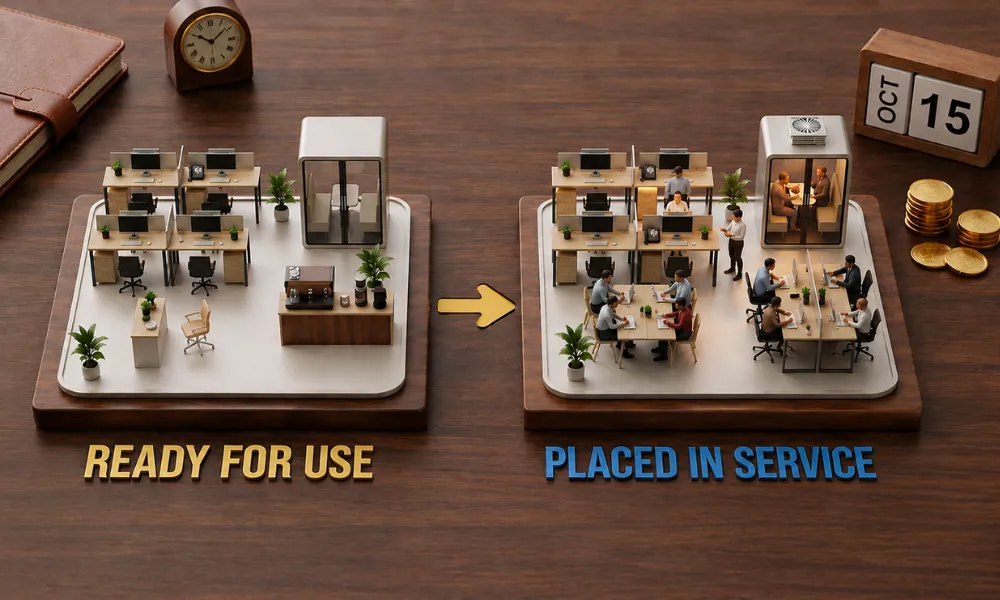
- Readiness confirmation: The ready-for-use event is captured at the site with evidence, because this date starts depreciation, not the posting date.
- Asset formation: The one-or-many, componentization, class, and asset capitalization threshold decisions are applied consistently, per policy, from receipt onward.
- Evidence and approvals: The capitalization pack assembles against the case as it moves: invoices, readiness certificates, formation reasoning, maker-checker sign-offs.
- Posting: The capitalization entry, on the right, is improvised from the readiness date, with the ERP as the book of record.
- Reconciliation and queues: Clearing accounts relieved, the physical record tied to the financial one, and every unresolved item in an owned exception queue rather than a spreadsheet.
Nine steps, five teams: procurement, receiving, projects, finance, audit, and three systems on a good day. Now the honest part: where it breaks.
Where it breaks: the ten failure patterns
Twenty years of walkthroughs produce the same ten findings, in different proportions, everywhere. Two deserve their full depth here: the first break and the last, because this page is their home; the middle eight are summarized with links to theirs.
Break 1: The PO never becomes an asset record (the process starts broken)
The deepest break happens before anything ships. CapEx PO lines are generic, bundled, or under-specified: one line covering five distinct assets plus installation, descriptions too thin to classify, categories missing from the master, quantity purchases lumped into single lines.
So nobody attempts to define what the asset actually is category, make and model, quantity split, tax treatment, until after receipt, when the pressure to capitalize is already on. The record gets reconstructed backwards from an invoice.
The impact compounds through every later step: Classification errors and wrong counts baked in early; finance blind to the CapEx pipeline; receipt and tagging performed against an undefined asset, so the physical object and its eventual record diverge before the asset exists.
Ideal outcome: PO data syncs as it changes, structured candidates are proposed and classified against the catalogue before receipt, thin lines wait in an enrichment queue rather than flowing through on bad data, and every edit is versioned and bounded by the approved PO value.
Breaks 2 to 9: The middle of the chain
Break 2: Dispatch blindness. No ASN, no packing list, no serial file; shipments discovered at the gate, receipt and tagging improvised.
Break 3: The uncontrolled interim. Assets received but not tagged, serialized or custody-tracked before capitalization the journey’s most vulnerable window for loss, theft and serial mismatch.
Break 4: Chain fragmentation. Receipt, GRN, invoice and asset creation split across teams and systems, with quantity and serial mismatches surfacing at close instead of at the handoff.
Break 5: The late date. Assets running while capitalization waits for paperwork; depreciation starting in the wrong period. The doctrine and the fix.
Break 6: Project lineage lost. No line-item path from WBS and AuC to the final asset; readiness certified late, by email, without a trail.
Break 7: Inconsistent formation. Without a consistent asset capitalization policy, identical purchases are formed differently across sites: one asset here, ten there, components split one way in one plant and not at all in another..
Break 8: Scattered evidence. Commissioning records, approvals and serials living in inboxes and shared drives; audit packs rebuilt manually every year auditors receiving explanations instead of evidence.
Break 9: Orphaned exceptions. Received-not-GRN, invoice-not-linked, ready-not-capitalized, and aged CWIP with no owner, no SLA, no escalation invisible until close makes them visible.
Break 10: The pipeline nobody can see (the quiet one)
The last break costs the most and gets found the least, because it produces no audit findings, only bad decisions. Incoming, received, tagged and ready-but-not-capitalized assets are invisible to anyone planning: installed equipment absent from availability discussions, purchases duplicated because nobody could see what was already in transit, leading to poor CapEx vs OpEx decisions.
The organization plans against the register that describes the past, while the pipeline of assets in motion appears nowhere. Utilization drops, capital is redeployed late, and the waste never appears on any exception report because no report covers it.
Ideal outcome: Every asset visible from dispatch onward with a status milestone in transit, received, tagged, ready, capitalized, dashboarded by site and class, linked to the register, at serial level for high-control assets. Not a planning engine; a reliable signal of what is actually available and what is nearly so.
Score your own process
Ten breaks, ten questions. The gap assessment below asks one honest question per pattern scored as no, partial, or yes, and turns your answers into a 20-point score with a reading. The low scores, taken in process order, are your roadmap: an early break poisons every later step, so fix upstream first.
The map: Problem to control
Every break above is a missing control, and each control is buildable. This mapping is the honest summary of what a pre-capitalization layer, ours or one you build, has to contain:
Break |
The failure |
The control that closes it |
| 1. PO-to-record | Assets reconstructed after receipt | PO sync + classified, quantity-split asset candidates with enrichment queues |
| 2. Dispatch blindness | No pre-arrival signal | ASN intake, packing lists, serial files, expected-date tracking |
| 3. Uncontrolled interim | Untracked assets before capitalization | Pre-asset register: mobile receipt, serial scan, pre-tags, custody |
| 4. Chain fragmentation | Receipt / GRN / invoice / asset disconnected | Single case linking all four, with mismatch rules and queues |
| 5. Late readiness | In-service dates guessed at close | Ready-for-use workflow with checklists, evidence and escalation |
| 6. Lost lineage | No project-to-asset path | WBS/order/AuC-linked cases, sub-asset readiness, partial capitalization |
| 7. Inconsistent formation | Same purchase, different registers | Policy engine: thresholds, class logic, one-to-many formation rules |
| 8. Scattered evidence | Audit packs rebuilt manually | Centralized evidence, maker-checker approvals, generated capitalization pack |
| 9. Orphaned exceptions | Queues without owners | Exception workbench: named queues, SLAs, reason codes, escalation |
| 10. Invisible pipeline | Planning blind to assets in motion | Milestone visibility from dispatch to capitalization, by site and class |
Who owns what: the process by role
Role |
Their slice of the process |
| Fixed asset accounting | Formation, posting, reconciliation, and the timing of it all the owners of steps 6 through 9 and the consumers of everything upstream |
| Project / CapEx teams | Readiness certification by sub-asset, cost lineage, and the documented trail that replaces email chasing |
| Receiving, stores & IT asset teams | The pre-asset record: receipts, serials, tags, custody and photo evidence before the ERP asset exists |
| AP & procurement operations | Clean PO lines up front; the GRN-invoice match and its exceptions in the middle |
| Internal audit | The beneficiaries of a process that produces evidence as it runs, reviewing trials instead of reconstructing them |
The table explains why the process breaks so reliably: no single role owns the chain, so every handoff is a place where the asset can fall between teams. Whatever controls you build, the first one is deciding who owns the whole.
How to fix a broken capitalization process: 6 steps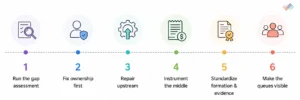
- Run the gap assessment honestly: Score what happens, not what the procedure document says.
- Fix ownership first: Name an owner for the end-to-end chain and for each exception queue before changing any tooling.
- Repair upstream: Get PO lines translating into classified candidates and dispatch visibility flowing early breaks poison everything downstream.
- Instrument the middle: Pre-asset records at receipt, four-way matching, readiness captured at source with evidence.
- Standardize formation and evidence: The policy applied at the point of decision, the assembled assembling as the case moves.
- Make the queues visible: Assign ownership, define SLAs, and provide a dispatch-to-capitalization view that planning can use.
Key takeaways
- Capitalization is an operational chain, not an accounting event, nine steps across procurement, receiving, projects, finance, and audit, of which the journal entry is the eighth.
- The chain breaks in ten recurring patterns, and they compound: a PO that never became a classified record poisons receipt, matching, formation, and reconciliation downstream.
- The two ends matter most and get managed least: what happens before receipt, and whether the pipeline of not-yet-capitalized assets stays visible.
- Every break has the same anatomy: a handoff between teams with no owner, which is why the fix is workflow and queues, not more accounting knowledge.
- Your ERP posts the ending perfectly; it controls almost nothing before it. That gap is where the process is won or lost.
Conclusion
An effective capitalization workflow depends on consistent controls from procurement through final reconciliation, not just the accounting entry. A well-designed fixed asset capitalization process improves data accuracy, reduces delays, strengthens audit readiness, and ensures assets move into the register at the right time with complete supporting evidence.
FAQs on the asset capitalization process
Q1. What are the steps in the fixed asset capitalization process?
Ans: Nine steps in practice: translate CapEx PO lines into classified asset candidates, capture supplier dispatch details, create a controlled pre-asset record at receipt, post and match the GRN and invoice, confirm readiness with evidence, form the asset per policy, assemble approvals and the capitalization pack, post the entry from the readiness date, and reconcile the physical and financial records.
Q2. Why do assets stay in CWIP after they are ready?
Ans: When organizations fail to capture and act on the readiness event in time, they often miss the in-service date or enter it retrospectively. In addition, teams wait for full project closure even when individual sections are already operating, and finance discovers ready assets only during the financial close. The solution is to capture readiness at the site with supporting evidence and hold assets in a visible ready-not-capitalized queue until the capitalization process is complete.
Q3. Who is responsible for asset capitalization?
Ans: Fixed asset accounting owns the formation, posting and reconciliation, but the process crosses five functions: procurement writes the PO lines, receiving creates the physical record, projects certify readiness, AP matches the invoice, and audit consumes the evidence. Processes fail when no one owns the chain between those handoffs, which is why naming an end-to-end owner is the first control.
Q4. How long should capitalization take after an asset is ready?
Ans: Posting should follow readiness within the same accounting period days, not months, because depreciation runs from the ready-for-use date regardless of when the entry is made, and every period of lag is a misstatement carried in the books. Aged ready-not-capitalized queues and CWIP older than the project timeline are the standard symptoms of a slower process.
Q5. What is the capitalization process in SAP or Oracle?
Ans: SAP capitalizes through FI-AA with AuC settlement, and Oracle through Mass Additions and CIP both execute the posting well and control little of the operational chain before it.