


Introduction
Asset capitalization is where two worlds meet: an accounting decision that shapes your balance sheet for a decade, and a physical workflow that starts on a loading dock.
Most guides cover only the first world. This one covers both the meaning, criteria, and rules under GAAP, IFRS, and Ind AS, and how asset capitalization software connects operational workflows with accounting controls so capitalization decisions are applied consistently and on time.
Asset capitalization means recording a cost as a long-term asset on the balance sheet rather than an immediate expense because it will deliver economic benefits beyond the current period. The capitalized cost then reaches the income statement gradually, through depreciation or amortization over the asset’s useful life.
In this guide
- What asset capitalization means, which expenditures qualify for capitalization, and how recognition criteria differ across US GAAP, IFRS, and Ind AS.
- How to determine capitalized cost, identify qualifying transactions, establish capitalization dates, and distinguish capitalization from depreciation and expensing.
- Why capitalization policies, thresholds, readiness evidence, and consistent asset formation are essential for compliance, financial accuracy, and audit readiness.
- How to implement a structured asset capitalization process, from evaluating expenditures and building asset costs to posting entries and maintaining supporting documentation.
What is asset capitalization?
When your company spends money, accounting asks one question first: Did this spending buy the future, or just the present? Rent, salaries, and repairs are expenses in the present, hitting profit now.
A machine, a building, or a server buys years of future output. Capitalizing it records that reality: The cost becomes an asset, and each year of use bears its share through depreciation. That matching cost recognized as the benefit arrives is the entire logic of capitalization.
The same word carries a second meaning worth disambiguating: Market capitalization (a company’s share value) has nothing to do with asset capitalization.
The capitalization criteria by standard
The test is remarkably convergent across frameworks. An item is capitalized when future economic benefits are probable, the cost can be measured reliably, the benefit extends beyond one year, and the amount clears your asset capitalization threshold.
| Criteria | US GAAP (ASC 360) | IFRS (IAS 16) | Ind AS 16 (India) |
|---|---|---|---|
| Recognition | Future economic benefit; measurable cost; policy threshold | Probable future benefits AND reliable measurement (IAS 16.7) | Converged with IAS 16.7 |
| Initial measurement | Cost | Cost | Cost |
| Threshold source | Entity policy (plus the IRS de minimis election, for tax) | Materiality-based policy | Materiality policy; Schedule II lives interact |
| Useful-life floor | More than one year / one operating cycle | More than one period | More than one period |
| Held for | Use in operations; resale items are inventory | Use in production, supply, rental or administration | Same as IFRS |
Capitalization Standards by Country
UK: Listed groups apply IAS 16, while UK GAAP entities apply FRS 102 Section 17 with the same core criteria.
Australia: AASB 116 is effectively identical to IAS 16
Canada: IFRS for public companies, ASPE 3061 for private.
South Africa: IFRS, with GRAP in the public sector.
Philippines: PFRS is fully converged with IFRS, so the IFRS criteria above apply with different standard names.
What goes into capitalized cost (and what stays out)
Capitalized cost is the purchase price plus every cost directly attributable to bringing the asset to its location and condition for intended use. That second half is where errors live:
| CAPITALIZE directly attributable | EXPENSE never part of cost |
|---|---|
| Purchase price, net of trade discounts and rebates | Training staff to operate the asset |
| Import duties and non-refundable purchase taxes | General and administrative overheads not directly attributable to the asset |
| Freight, delivery and handling | Initial operating losses while output ramps up to capacity |
| Site preparation and installation | Relocating or reorganizing operations |
| Assembly, testing and commissioning | Abnormal wastage of material or labour |
| Professional fees and directly attributable labour or supervision costs during construction | Advertising and promotion |
| Borrowing costs during construction, for qualifying assets | Routine repairs and maintenance that don’t extend life, capacity or performance |
GST paid on capital goods enters the asset’s cost only when input credit is not claimed claiming the credit and capitalizing the tax would double-count it. Every jurisdiction has an equivalent recoverable-tax rule.
A worked example: From invoice to capitalized cost
A manufacturer buys a CNC machine. The invoice says $100,000 but the capitalized cost doesn’t:
| Cost element | Amount ($) | Treatment |
|---|---|---|
| Machine, list price | 100,000 | Capitalize |
| Trade discount negotiated | (4,000) | Reduces cost |
| Freight and insurance to site | 3,200 | Capitalize |
| Foundation and installation | 5,600 | Capitalize |
| Test runs and calibration | 2,400 | Capitalize |
| Operator training programme | 3,000 | EXPENSE |
| First-year maintenance contract | 1,800 | EXPENSE |
| Capitalized cost | 107,200 | The asset’s value on day one |
The machine enters the register at $107,200, not the $100,000 on the invoice, and not the $112,000 the project actually spent. Depreciation, gains on eventual disposal, and every ratio built on the asset base all flow from getting this number right.
Capitalization vs depreciation vs expensing
Three terms, one timeline. Expensing recognizes a cost in profit immediately; capitalization defers it onto the balance sheet. Depreciation then releases the capitalized amount into profit, period by period, over the asset’s useful life.
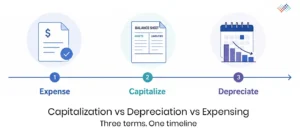
So capitalization and depreciation are not alternatives; they are sequential. The real decision is capitalize versus expense, and it moves profit between periods without changing total cash: capitalize, and this year’s profit rises; expense, and it falls, with the reversal spread over later years.
Where the judgement gets genuinely hard, improvements versus repairs, overhauls, spare parts, our capitalize vs expense decision framework works through ten real classification examples.
Which transactions trigger capitalization?
Capitalization is not one event but five distinct transaction families, each with its own moment:
| Trigger | The capitalization moment |
|---|---|
| Direct purchase, ready to use | Receipt plus readiness cost built up per the components table |
| Construction or project completion | When the asset, or a usable part of it, is ready for intended use costs transfer out of CWIP/CIP/AuC |
| Subsequent cost/improvement | When spending extends life, capacity or performance repairs stay expensed |
| Exchange or trade-in | At fair value per the standard’s measurement hierarchy |
Partial capitalization deserves emphasis: a plant that becomes operational line by line should be capitalized line by line. Waiting for the entire project to close while completed sections are already in use is one of the most common construction accounting errors.
The capitalization date: When it all starts
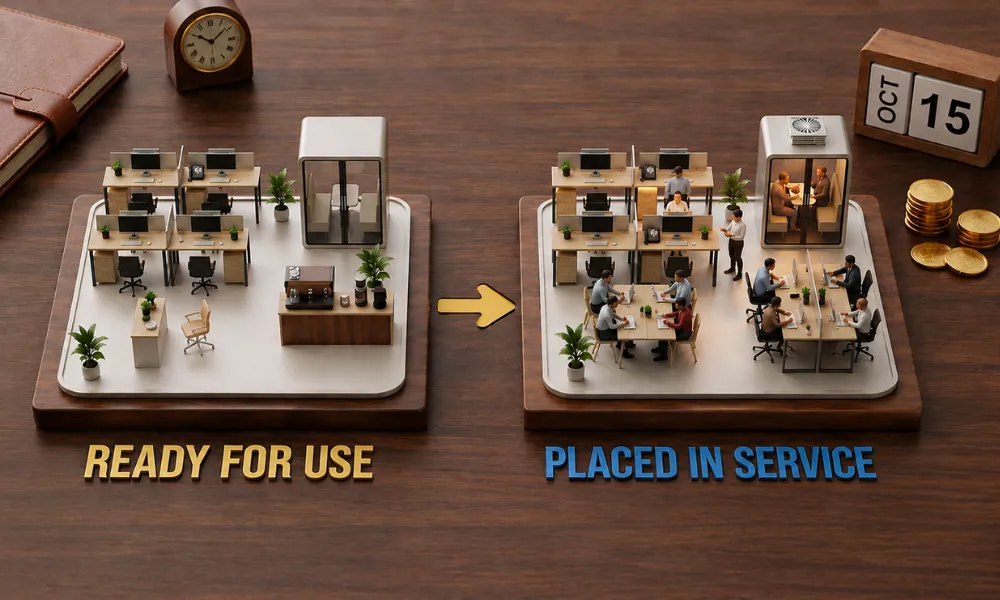
Every trigger above resolves to one question: when was the asset ready for its intended use? That date starts capitalization and depreciation, and it is a fact about the asset, not about when paperwork is completed.
US tax law sharpens it into the placed-in-service doctrine, while IAS 16 and Ind AS 16 refer to assets being available for use. Understanding placed in service vs ready for use helps clarify the different date requirements and why organizations often record this milestone later than they should.
Thresholds and policy: Where you draw the line
The standards deliberately leave two things to you: how small is too small to capitalize, and how your rules get written down.
The threshold is a materiality call, commonly $2,500 to $5,000 in the US, where the IRS de minimis safe harbor election anchors practice, and materiality-based elsewhere. Setting and defending yours is the capitalization thresholds guide’s subject.
The rules themselves thresholds, classes, useful lives, cost components, componentization belong in a written asset capitalization policy, applied at invoice coding rather than remembered at close. A policy nobody codes against is a document, not a control.
The capitalization process at a glance
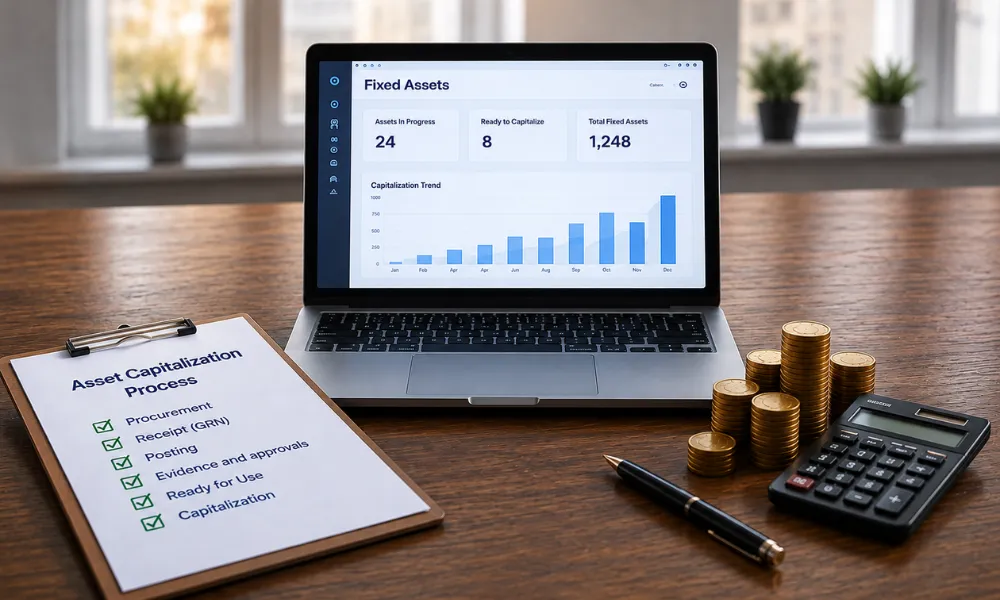
Between the purchase decision and the asset record runs an operational chain: CapEx PO → dispatch → receipt and tagging → GRN and invoice match → readiness confirmation → asset formation → posting with evidence → reconciliation.
Each arrow is a handoff, and each handoff can break in ten distinct ways in practice. Understanding the capitalization workflow makes it easier to identify each step in the chain and the ten most common failure points.
Special cases: Construction and ERP
- Assets being built: Costs accumulate in capital work in progress (CWIP) before capitalization. Under US GAAP, this is commonly referred to as Construction in Progress (CIP), while many IFRS organizations use the term Assets Under Construction (AuC).
- ERP execution: SAP capitalizes through FI-AA and AuC settlement, while Oracle uses Mass Additions and CIP. Both modules execute capitalization well but rely on upstream processes for operational control.
Why capitalization goes wrong at scale
Here is the honest close. In twenty years of enterprise fixed asset work, the recurring capitalization findings are almost never misread standards. They are operational.
Assets run for months while capitalization waits for paperwork the ready-for-use event captured late, depreciation starts in the wrong period, and CWIP ageing. And identical purchases get formed differently across sites: one asset here, ten there, components split one way in one plant and not at all in another.
Both failures share a root: the rules live in documents while the decisions happen in the capitalization workflow. The documents never reach receipt docks, project sites, or invoice coding screens.
That workflow layer is what AssetCues adds around your ERP: readiness captured at source with evidence, formation and threshold rules applied by a policy engine at the point of decision, and exceptions in owned queues while SAP or Oracle remains the book of record.
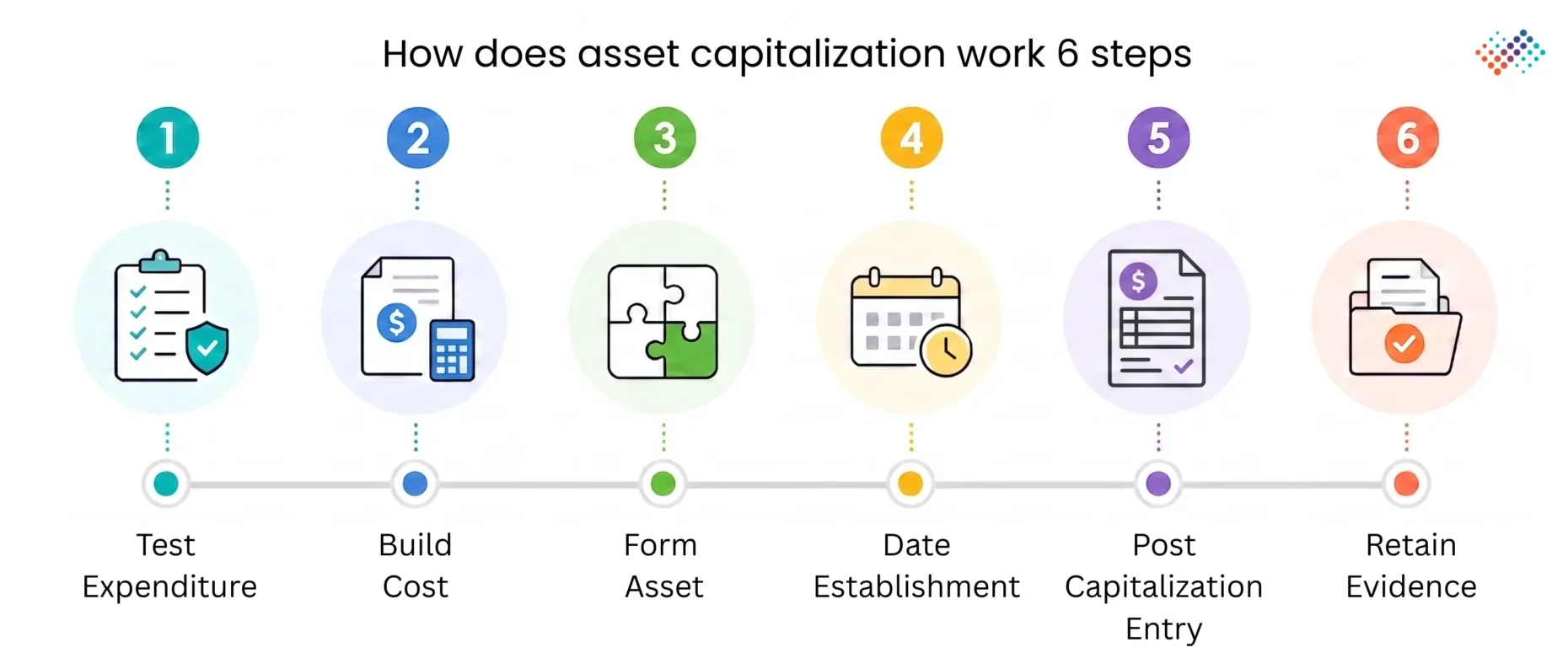
How does asset capitalization work? 6 steps
- Test the expenditure: Future benefit beyond a year, probable, measurable, above threshold, held for use.
- Build the cost: Purchase price net of discounts, plus every directly attributable cost and nothing else.
- Form the asset: One record or many, components identified, class assigned per policy.
- Establish the ready-for-use date from evidence: Commissioning, handover, first productive use.
- Posting: Post the capitalization entry and start depreciation from that date, in the right class and life.
- Retain the evidence against the asset record: Invoices, readiness certificates, approvals; the audit pack builds itself, or it gets rebuilt every year.
Key takeaways
- Capitalize when a cost creates future economic benefit beyond one year, is reliably measurable, and clears your threshold; otherwise, expense it.
- The criteria converge across US GAAP, IFRS, and Ind AS; the differences that matter are revaluation, componentization, and where thresholds come from.
- Capitalized cost is more than the invoice: duties, freight, installation, testing, and qualifying borrowing costs all enter; training and overheads never do.
- Five transaction types trigger capitalization, each with its own moment, and the moment is always readiness, not paperwork.
- At enterprise scale, capitalization fails operationally before it fails technically: late readiness capture and inconsistent asset formation, not misread standards.
Conclusion: Capitalize the future, control the process
Asset capitalization is a decision with two halves. The accounting half is settled and convergent: capitalize what buys the future, build the cost from everything directly attributable, and start the clock at readiness.
The operational half is where enterprises actually win or lose because the rules only work when they reach the loading dock, the project site, and the coding screen on time.
Not every organization needs a control layer. At low asset volumes, a few hundred assets, one site, one system, a written policy, disciplined invoice coding, and a monthly roll forward are genuinely sufficient. The economics change with scale, sites and systems; run your current process honestly against last year’s findings before buying anything.
FAQs on asset capitalization
Q1. What is fixed asset capitalization?
Ans: Fixed asset capitalization applies the same principle specifically to tangible long-term assets machinery, buildings, vehicles, IT equipment recording their cost, plus all directly attributable costs of bringing them into use, as property, plant and equipment. It is governed by ASC 360 under US GAAP, IAS 16 under IFRS, and Ind AS 16 in India.
Q2. What are the criteria for capitalizing an asset?
Ans: An asset is capitalized when four tests pass: future economic benefits are probable, the cost can be measured reliably, the benefit period exceeds one year, and the amount meets the entity’s capitalization threshold. US GAAP, IFRS, and Ind AS state these criteria in converged terms; thresholds are the entity’s own policy decision.
Q3. What is the difference between capitalization and depreciation?
Ans: Capitalization and depreciation are sequential, not alternatives: capitalization records the cost as an asset on day one, and depreciation then allocates that capitalized cost to expense over the asset’s useful life. The genuine either/or decision is capitalize versus expense, which determines whether the cost hits profit now or over many years.
Q4. What are asset capitalization categories?
Ans: Capitalization categories group assets for consistent treatment: typically land, buildings, plant and machinery, vehicles, IT equipment, furniture and fixtures. The class assigned at capitalization drives the useful life, depreciation method, and GL accounts, which is why a written policy defines the categories and their rules.