


Introduction
A contractor replaces half your roof. Is that a repair you expense today, or an improvement you depreciate over thirty-nine years? The capitalize vs expense decision is rarely straightforward because asset capitalization rules and fixed asset capitalization rules can produce different answers for the same invoice.
Many of those decisions begin with the same question: is the spending CapEx vs OpEx? The answer depends on whether the cost creates a new asset, improves an existing one, restores it, or simply keeps it operating, and the applicable framework may reach different conclusions.
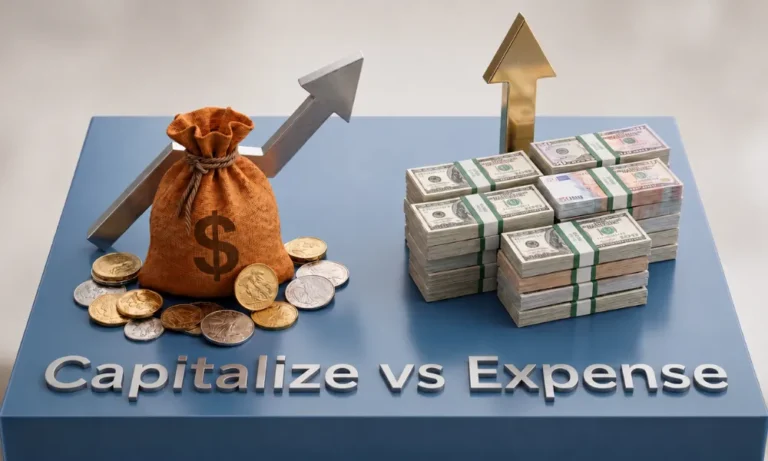
The asset capitalization meaning starts with a simple distinction: capitalizing a cost records it as an asset and spreads it over future periods through depreciation, while expensing recognizes it in profit immediately. The asset capitalization rules determine which treatment applies: new items of lasting value are capitalized, spending that keeps existing assets running is expensed, and spending that makes them better, adapted, or restored is capitalized.
In this guide
- What determines whether a cost should be capitalized or expensed, and how GAAP, IFRS, and tax rules apply to new assets, repairs, and improvements?
- How to distinguish capital improvements from routine maintenance by applying practical decision tests, worked examples, and framework-specific accounting requirements.
- Why consistent capitalization decisions improve financial reporting, audit outcomes, and CapEx versus OpEx classification across multiple sites and business units.
- How to apply a structured capitalize-versus-expense decision process using thresholds, improvement criteria, documentation, and supporting evidence.
The two halves of the decision
Every capitalize-or-expense question is one of two questions in disguise. If the spending buys a new, standalone item, the analysis follows the capitalization criteria: whether it provides a lasting benefit, has a measurable cost, and exceeds the applicable capitalization threshold.
If the spending goes into an asset you already own, the analysis changes entirely: is this keeping the asset running, or making it more than it was? That second question, repairs versus improvements, is where the hard calls live, and where this page spends its depth.
What capitalize vs expense does to your numbers
| Dimension | Capitalize | Expense |
|---|---|---|
| Balance sheet | Asset base rises; equity higher through retained profit | No asset; nothing to depreciate or track |
| P&L | Cost arrives gradually as depreciation; current profit and EBITDA higher | Full cost hits now; current profit lower, later periods cleaner |
| Tax | Deductions spread over the recovery period unless bonus depreciation or Section 179 accelerates them | Deduction now (subject to the improvement rules actually permitting it) |
| Audit | Judgement scrutinized: was capitalization justified, is the life right | Scrutinized in reverse: should this have been capitalized |
Cash. The direction moves profit between periods, which is precisely why the choice attracts both management bias and auditor attention. Capitalizing aggressively is the classic earnings-inflation pattern, and expensing aggressively understates the asset base.
CapEx vs OpEx: the budget language
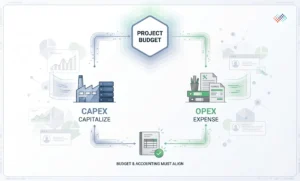
The same accounting boundary appears under different names in budgeting. CapEx (capital expenditure) includes spending that a company capitalizes, while OpEx (operating expenditure) includes spending that it expenses. Therefore, the accounting treatment and the budget classification should align. If a company approves a project as CapEx but later finds that half of its costs fail the capitalization criteria, the resulting variance flows to someone’s P&L in the middle of the financial year.
That is the practical reason to run the tests at approval time, not at invoice time: the budget holder should know before committing which parts of the project will hit profit immediately.
The US tax tests: betterment, adaptation, restoration
The US tangible property regulations turned decades of repair-versus-improvement case law into three named tests, applied to the unit of property. Capitalize the spending if it does any one of the following:
- Betterment: Fixes a pre-existing defect, or measurably increases the property’s capacity, productivity, efficiency, strength, or quality.
- Adaptation: Converts the property to a new or different use from the one intended when placed in service.
- Restoration: Replaces a major component or substantial structural part, rebuilds the property after its class life, or returns a deteriorated, non-functional asset to working order.
These three tests are federal tax rules; book GAAP has no equivalent named test. Under GAAP, the question is whether the spending extends useful life, increases capacity, or improves efficiency, judged against the entity’s own capitalization policy and materiality threshold. In practice, book and tax usually land on the same answer, since GAAP’s standard covers similar ground to the tax betterment and restoration tests — but the two aren’t the same test, and nothing requires them to agree.
Everything else is a deductible repair, and the routine maintenance safe harbor gives that a working definition: activities you reasonably expect to perform more than once during the unit of property’s class life (the IRS-assigned depreciation life for that asset type, not its book useful life) for non-building property, or more than once in any ten-year period for a building structure or building system, are maintenance by rule, not by argument.
The unit-of-property concept does real work here. A building is analysed as the building structure — walls, floors, windows, doors and the roof — plus eight defined building systems: HVAC, plumbing, electrical, elevators, escalators, fire protection and alarm, security, and gas distribution. Replacing an entire system, or a major part of the structure such as the roof, is a restoration of that unit even though it is a fraction of the building. Choosing the unit is half the answer.
IFRS and Ind AS: subsequent costs under IAS 16
IAS 16 and Ind AS 16 reach similar conclusions with a simpler approach. They require companies to capitalize subsequent expenditure only when it meets the same recognition criteria as the original asset: the expenditure must generate probable future economic benefits, the company must measure the cost reliably, and it must expense day-to-day servicing costs as incurred.
However, two key mechanics differ from US practice and are worth understanding. First, when a company replaces a part, it capitalizes the new part and derecognizes the carrying amount of the old one. In other words, the roof that the company removes leaves the books as the new roof enters them.
Second, companies treat major inspections or overhauls as separate components. They capitalize these costs and depreciate them until the next scheduled inspection or overhaul.
Ten worked examples, two verdicts for each
These ten worked examples reflect real-world situations, with the outcome under US book accounting, US federal tax, and IFRS/Ind AS, and an explanation of why each conclusion applies.
| Scenario | US GAAP (book) | US federal tax | IFRS / Ind AS | The deciding fact |
|---|---|---|---|---|
| 1. Full roof replacement | Capitalize | Capitalize | Capitalize | A major component replaced — restoration; IFRS also derecognizes the old roof’s carrying amount |
| 2. Roof leak patched | Expense | Expense | Expense | Keeps the asset in ordinary operating condition; nothing is better than before |
| 3. Engine overhaul extending life | Capitalize | Capitalize | Capitalize | Restores the unit beyond routine upkeep; IFRS books it as an overhaul component depreciated to the next one |
| 4. Annual servicing contract | Expense | Expense | Expense | Expected more than once over the life — the routine maintenance safe harbor’s exact case |
| 5. Critical standby spares | Policy choice, often capitalizes major rotables | Materials-and-supplies rules apply, or a rotable-parts capitalization election | Capitalize | IAS 16 and Ind AS 16 classify spares expected to serve more than one period as PP&E; US book and tax treatments follow separate elections |
| 6. Relocating a machine | Expense | Expense | Expense | Relocation creates no new benefit — excluded from cost in every framework |
| 7. SaaS subscription fees | Expense | Expense | Expense | A service contract, not an asset — implementation costs follow separate cloud-computing rules |
| 8. Capacity upgrade, +30% output | Capitalize | Capitalize | Capitalize | Textbook betterment — measurably more capacity than the original condition |
| 9. Repainting the offices | Expense | Expense | Expense | Maintenance unless absorbed into a larger capital renovation, where project framing governs |
| 10. Operator training | Expense | Expense | Expense | Explicitly excluded from asset cost everywhere — capability lives in people, not the machine |
Read the pattern, not just the verdicts
The frameworks agree in nine out of ten. The judgement that varies in practice is rarely the rule it is whether the facts were gathered (what was replaced, what improved, what was expected) before the invoice was coded.
Where the judgement breaks at scale
One plant capitalizes the overhaul; the sister plant expenses the identical one. Without a consistent asset capitalization policy, neither decision is indefensible on its own, but together they become an inconsistency finding and the pattern compounds across every site, making these calls from memory.
The rules in this guide are exactly what a policy engine applies throughout the capitalization workflow. AssetCues applies configurable classification rules, capitalization thresholds, asset formation rules, and approval workflows when teams submit costs for capitalization. It captures the supporting evidence, approvals, and audit trail for each decision before approved capitalization instructions are synchronized with the ERP.
The genuinely hard decisions, such as partial roofs, mixed invoices, and storm restorations, deserve a human with the facts and, on the tax side, a specialist. The tangible property regulations reward professional judgement, and no software replaces it. Automation standardizes the ninety percent of decisions that have clear answers, so judgement is spent where it earns something.
How to make the decision: 5 steps
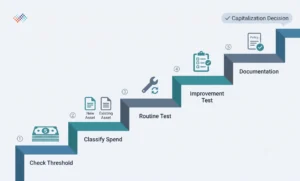
- Using the threshold: Check the threshold for asset capitalization first. Below it, expense and stop; no analysis is owed to trivial amounts.
- Using spend classification: Classify the spend as a new standalone asset (run the capitalization criteria) or spending on an existing asset (continue).
- Routine maintenance test: Test routine first. If the work was expected more than once over the asset’s life, expense it as maintenance and stop.
- Improvement tests: Run the improvement tests—better, adapted, or restored (US), or the recognition criterion with derecognition of replaced parts (IFRS/Ind AS) and capitalize on any yes.
- Supporting documentation: Document the facts behind the call: what was replaced, what improved, and what was expected, because the file, not the decision, is what survives audit.
Key takeaways
- The decision has two halves: new items pass through the capitalization criteria and threshold, while spending on existing assets passes through the improvement-versus-repair tests.
- The US tangible property regulations formalize three capitalization triggers: betterment, adaptation, and restoration applied to the unit of property; GAAP and IFRS ask the same questions as life, capacity, and performance.
- Routine and recurring maintenance is expensed everywhere, and the US routine maintenance safe harbor makes ‘expected more than once over the life’ the working test.
- The direction moves profit between periods, not cash capital, and profit rises now; expense and it falls now, reversing later.
- Consistency beats direction: the same spend classified differently across sites is the finding auditors actually write, whichever way each site went.
Conclusion
The decision between capitalizing vs. expensing affects the timing of financial reporting, but it starts with applying consistent judgment rather than individual preference. Following clear fixed asset capitalization rules helps organizations classify costs accurately, align CapEx vs OpEx decisions with accounting requirements, and maintain reliable, audit-ready financial records.
FAQs on capitalize vs expense
Q1. What are the asset capitalization rules under GAAP?
Ans: US GAAP capitalizes costs that create future economic benefit beyond the current period: new assets meeting the recognition criteria, and spending on existing assets that extends useful life, increases capacity, or improves efficiency. Repairs and maintenance that keep an asset in normal operating condition are expensed as incurred, and no specific dollar threshold is prescribed; that is, the entity’s materiality policy.
Q2. When should a cost be capitalized instead of expensed?
Ans: Capitalize a cost when it buys a lasting benefit: a new asset with a useful life beyond one year and a cost above your threshold, or spending that makes an existing asset better, adapts it to a new use, or restores a major component. Expense costs that keep assets in ordinary working condition, however large the invoice.
Q3. Are repairs and maintenance capitalized or expensed?
Ans: Organizations expense repairs and maintenance under every major accounting framework because these activities only keep an asset in its normal operating condition without improving it. In addition, US tax rules treat routine maintenance expected to occur more than once during an asset’s life as deductible under the routine maintenance safe harbor. However, organizations must capitalize spending that improves, adapts, or restores the asset instead.
Q4. Is a roof replacement capitalized or expensed?
Ans: A full roof replacement is capitalized under both US GAAP and IFRS because it restores a major structural component of the building. In contrast, organizations expense repairs that only patch part of the roof. Under IFRS, organizations also derecognize the carrying amount of the old roof when they capitalize the new one. Ultimately, the extent of the replacement a complete component or merely a patch determines the accounting treatment.
Q5. Are spare parts fixed assets?
Ans: Under IAS 16 and Ind AS 16, organizations recognize spare parts, standby equipment, and servicing equipment as property, plant, and equipment (PP&E) when they expect to use them for more than one accounting period. However, organizations classify minor spare parts as inventory and expense them when they are consumed. US GAAP practice treats major rotatable spares as a policy choice, commonly capitalized for critical equipment.