




Introduction
Ask an auditor what separates clean fixed asset files from messy ones, and the answer is rarely the standard; it’s whether a written fixed asset capitalization policy existed and whether anyone actually applied it. A well-defined policy, built on clear asset capitalization principles, provides consistent rules for capitalization decisions regardless of the accounting framework.
This guide covers both halves: what a capitalization policy must contain, clause by clause, and how it becomes a control rather than a document. A sample fixed asset capitalization policy for US GAAP, IFRS, and Ind AS is available for download below.
A fixed asset capitalization policy is the written rulebook governing when expenditure becomes an asset: the capitalization threshold, qualifying cost components, asset classes and useful lives, componentization rules, and the approvals and evidence each capitalization requires. It is the document auditors request first and test against your actual codings.
In this guide
- What a fixed asset capitalization policy should include, how it supports consistent accounting decisions, and why auditors rely on it during compliance reviews.
- How to define capitalization thresholds, cost components, asset classes, componentization rules, approvals, and documentation requirements for different accounting frameworks.
- Why policies fail in practice when they are not consistently applied, and how standardized workflows improve compliance, financial accuracy, and audit readiness.
- How to create, implement, and maintain a fixed asset capitalization policy that aligns with US GAAP, IFRS, or Ind AS while supporting consistent enterprise-wide capitalization decisions.
What is a fixed asset capitalization policy?
The accounting standards deliberately stop short of your operational questions. IAS 16 and ASC 360 say to capitalize what brings future benefit; they do not say whether a $1,800 printer qualifies, whether 500 chairs are one asset or 500, or who signs off.
The policy is where your organization answers those questions once, in writing, so every plant accountant follows the same guidance instead of making different decisions under pressure. That consistency is the entire purpose of the policy, and without it, auditors continue to find the P7 pattern.
One policy, two names
Users search for both “fixed asset capitalization policy” and “fixed asset accounting policy.” However, in practice, organizations usually combine these into a single document, and they should. The capitalization rules form the core of every fixed asset accounting policy, while sections covering depreciation, disposals, and verification schedules support and extend those rules.
By contrast, organizations that maintain two separate documents often create conflicting capitalization thresholds or useful lives. Instead, develop a single policy, give it a broad title, and use it to govern both areas. Accordingly, the template below follows that structure.
The 9 required elements and the audit question each answers
A useful test for policy completeness: every element should answer a question your auditor will otherwise ask you in person.
Policy element |
The audit question it answers |
| 1. Capitalization criteria & threshold | Why is this $3,000 item an asset and that $2,000 item an expense, and is it consistent? |
| 2. Cost components (in and out) | Why is freight in this asset’s cost, and why isn’t the training? |
| 3. Asset classes & useful lives | Why is this machine depreciating over 15 years and the identical one at your other plant over 10? |
| 4. Formation & componentization rules | Why are these 500 laptops one record, and are significant components separated? |
| 5. Subsequent expenditure rules | Why was this overhaul capitalized and that repair expensed? |
| 6. CWIP & readiness rules | Why did depreciation start in March when the line ran from January? |
| 7. Evidence & documentation requirements | Show me the support for this capitalization now. |
| 8. Roles & approval matrix | Who approved this, and were they authorized to? |
| 9. Governance, exceptions & review | When was this policy last reviewed, and who approved the exception? |
Elements 4 and 6 are the two most commonly missing, and they map exactly to the two failure patterns that dominate real findings: inconsistent asset formation and late capitalization.
The threshold clause
The threshold decides more day-to-day treatment than any other line in the policy. Common practice runs $2,500–$5,000 in the US, anchored by the IRS de minimis safe harbor and materiality-based elsewhere, with the number reviewed annually.
Follow two rules when drafting the clause: state the asset capitalization threshold clearly, and specify that the company expenses items below it even if they last for years. The threshold serves as a materiality simplification, not a failure of judgment. The accompanying guidance explains how to choose and justify the threshold, including the conditions for applying the de minimis election.
Classes and useful lives
The class table is the policy’s engine room: the class assigned at capitalization drives the useful life, method, and GL accounts for the asset’s entire existence. Typical structures run land, buildings, plant and machinery, vehicles, IT equipment, furniture, and office equipment.
India adds a statutory layer: Schedule II of the Companies Act prescribes indicative lives for factory buildings 30 years, general plant and machinery (15 years), and computers (3 years), with departures permitted but disclosed and justified.
Cost components and subsequent expenditure
The policy restates, in your own words, the asset capitalization rules covering what enters capitalized cost, the directly attributable list, and what never does. Subsequent expenditure also needs its own clause: capitalize costs that extend an asset’s useful life, increase its capacity, or improve its performance, and expense all other costs.
Furthermore, when parts of an asset have materially different useful lives, IFRS and Ind AS require componentization, while US GAAP benefits from adopting it as a policy.
Fixed asset capitalization policy examples: three jurisdiction variants
The same threshold-and-criteria clause reads differently under each framework; here is the flavour of each, with full versions in the template:
Framework |
Sample policy clauses |
| US GAAP | “Assets with a unit cost of $5,000 or more are capitalized; amounts below are expensed. For tax purposes, the Company makes the de minimis safe harbor election under Reg. 1.263(a)-1(f), applied consistently from the start of each tax year.” |
| IFRS | “Assets with a unit cost of [amount] or more are capitalized; the threshold is set on materiality grounds consistent with IAS 16 and reviewed annually. Individually insignificant items material in aggregate are capitalized as a group.” |
| Ind AS | “Assets with a unit cost of ₹[amount] or more are capitalized. GST is included in the cost only where input credit is not availed. Useful lives follow Schedule II except where a different life is technically justified and disclosed.” |
The US clause coordinates book policy with a tax election, the IFRS clause leans on materiality and aggregation, and the Ind AS clause must handle GST and Schedule II. A template that ignores these differences produces a policy that fails its first local audit question.
From document to control: making the policy enforce itself
Now the uncomfortable part. Most organizations that suffer capitalization findings have a policy, often a good one. The findings happen because the policy lives in a PDF while the decisions happen elsewhere: at invoice coding, at the receiving dock, at project settlement, where the correct asset capitalization date is often determined.
The symptoms are always the same. Teams capitalize multi-quantity invoices as one asset at one plant and as individual units at another; they group components here and split them there. Teams capture freight and installation on some assets but miss them on others, creating different registers for identical purchases.
The impact compounds quietly: wrong counts, classes, and useful lives affect every downstream process; depreciation, verification, transfers, disposals, and physical-financial reconciliation gradually degrade until an audit or verification exercise surfaces every issue at once.
How to write a fixed asset capitalization policy: 7 steps
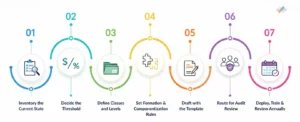
- Inventory the current state: pull last year’s findings, the thresholds actually in use per site, and every existing policy fragment.
- Decide the threshold with finance and tax together in the US, coordinated with the de minimis election.
- Define classes and levels against your actual asset base, aligning with Schedule II where Ind AS applies.
- Write the formation and componentization rules the section most templates skip, and most findings trace to.
- Draft with the template, keeping your framework’s variant clauses and deleting the rest.
- Route through Internal Audit and the external auditor before the board; their objections are cheaper now than at year-end.
- Deploy to the point of decision: train invoice coders, embed rules in the workflow, and calendar the annual review.
Key takeaways
- One policy should govern both names, ‘capitalization policy’ and ‘fixed asset accounting policy’, as they describe the same document in practice, and splitting them invites contradiction.
- Nine elements make a policy complete; each one exists to answer a specific audit question.
- The threshold is a materiality decision you must be able to defend and, in the US, coordinate with the de minimis safe harbor election.
- Sample wording differs by framework: the same threshold clause is written three different ways under US GAAP, IFRS, and Ind AS.
- A policy nobody codes against is a document; not a control enforcement at the point of decision is what makes it real.
Conclusion
A well-defined fixed asset capitalization policy creates consistent capitalization decisions and strengthens financial reporting across the organization. Whether you use a standard policy or adapt a fixed asset capitalization policy example to your reporting framework, consistent application improves compliance, supports audit readiness, and maintains accurate fixed asset records.
AssetCues serves as a pre-capitalization control layer by applying capitalization thresholds and asset formation rules—including one-to-one, one-to-many, many-to-one, and componentization decisions—as teams create asset candidates, capture approvals and supporting evidence, and define the final asset structure. Once approved, AssetCues synchronizes the capitalization instructions with your ERP, which remains the system of record.
FAQs on capitalization policy
Q1. What should a capitalization policy include?
Ans: Nine elements make a policy complete: capitalization criteria and threshold, cost components, asset classes and useful lives, formation and componentization rules, subsequent expenditure rules, CWIP and readiness rules, evidence requirements, an approval matrix, and governance with a review cadence. Each element answers a specific question that auditors otherwise ask in person.
Q2. What does a sample fixed asset capitalization policy look like?
Ans: A complete sample runs ten to twelve sections, opening with purpose and definitions, then the threshold clause, cost components, a class-and-lives table, componentization and subsequent-expenditure rules, CWIP treatment, evidence and approval requirements, and a version register.
Q3. Is a capitalization policy different from a fixed asset accounting policy?
Ans: In practice, they are the same document: the capitalization rules form the core of any fixed asset accounting policy, with depreciation references, disposal rules, and verification cadence wrapped around them. Maintaining them as two separate documents commonly produces contradicting thresholds or lives, so a broadly named policy is the safer design.
Q4. What capitalization threshold should we set?
Ans: The threshold is a materiality judgement: US practice commonly runs $2,500 to $5,000, anchored by the IRS de minimis safe harbor, while IFRS and Ind AS entities set materiality-based amounts reviewed annually. The right number depends on your asset volumes and audit posture.
Q5. How often should the policy be reviewed?
Ans: Annually at minimum, plus immediately upon any change in accounting framework, threshold, or organizational structure. The review compares the policy with actual practice. Teams check sampled codings, asset formation decisions, and capitalization dates. This helps identify gaps between policy and execution. Even a well-written policy fails its audit purpose if practice has drifted from it.