


Introduction
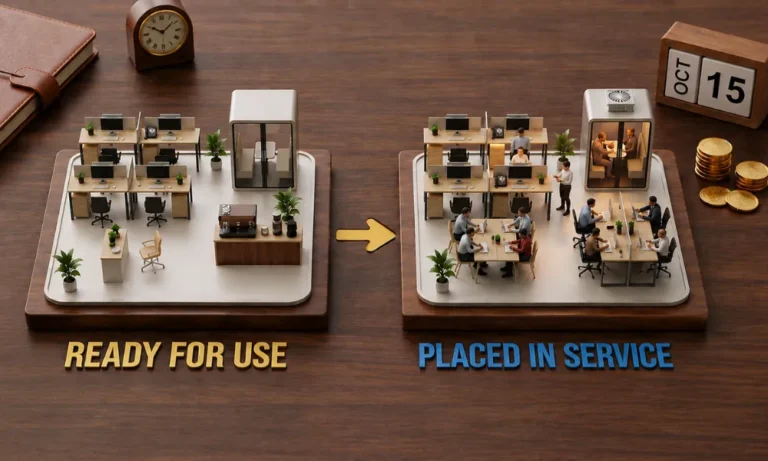
In early 2025, two identical machines earned very different tax treatment: one, acquired and placed in service on January 25, qualified for 100% bonus depreciation; the other, acquired and placed in service on January 15, qualified for only 40%. The One Big Beautiful Bill Act sets the 100% rate for qualifying property acquired after January 19, 2025; the acquisition date decides it, not the placed-in-service date alone. Ten days apart, on the wrong side of that line, cost most of the asset’s cost in deductions.
Understanding the date placed in service is essential because it determines when depreciation begins and how it differs from the asset capitalization date used in financial reporting. This discussion explains what the date legally means, how it differs from the dates around it, and why organizations that understand the doctrine still capture it incorrectly.
The placed-in-service date is the date an asset is in a condition or state of readiness and availability for its specifically assigned function, not the purchase date, and not necessarily the first day of actual use. Understanding asset capitalization helps explain why this operational milestone determines when capitalization ends, and depreciation begins. Under US tax law, the placed-in-service date starts depreciation, while under IAS 16 and Ind AS 16, depreciation begins when the asset is available for use.
In this guide
- What the placed-in-service date means, how it differs from acquisition and capitalization dates, and why it determines depreciation under US tax, IFRS, and Ind AS.
- How to identify the correct placed-in-service date using readiness criteria, supporting evidence, and practical tests across different asset types.
- Why delayed or incorrect readiness dates lead to misstated depreciation, missed tax benefits, aged CWIP balances, and audit risks.
- How to establish a consistent readiness capture process by validating evidence, applying standardized controls, and documenting placed-in-service dates accurately.
What does placed in service mean?
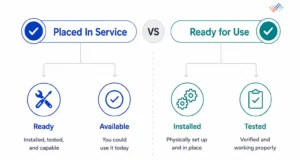
An asset is placed in service when it is ready and available for its specifically assigned function. Ready means installed, tested, and capable; available means you could use it today; whether you actually do is irrelevant.
That last clause surprises people. A generator held in standby is in service from the day it stands ready, not the day the power fails. The doctrine tests capability, not activity, which makes the date a fact about the asset, provable by evidence, rather than an event in the ledger.
The IRS readiness doctrine
The US regulations set the standard: property is placed in service when in a condition or state of readiness and availability for a specifically assigned function (Reg. 1.167(a)-11; Reg. 1.46-3(d)). Rulings apply it by asset type: a facility is in service when operational, not when formally accepted from the contractor (Rev. Rul. 79-98).
Buildings turn on legal readiness, with the certificate of occupancy as anchor evidence. Equipment turns on operational readiness: installation complete, testing passed, capable of its function.
A notable U.S. tax court decision held that retail buildings were placed in service once they were substantially complete and ready to house racks and merchandise, even before opening for business.
The IRS formally disagreed (AOD 2017-02) and maintains that a retail store must be open to the public. Conservative practice documents both readiness and the opening date.
Three dates, one asset
| Aspect | Acquisition date | Placed-in-service / ready-for-use date | Capitalization transfer/posting date |
|---|---|---|---|
| What it marks | Ownership and risk transfer to you | Readiness and availability for the assigned function | When the asset record and entry are created |
| What it drives | Contractual and insurance matters | Depreciation start, bonus depreciation, Section 179, MACRS convention | Nothing; it is administrative |
| Typical failure | Confused with in-service for year-end planning | Captured late, defaulted, or reconstructed | Treated as depreciation starts when it lags readiness |
For a self-constructed asset, this table starts after the fact that matters most for capitalization timing: costs were already capitalized into CWIP as they were incurred, well before any of these three dates. This posting date is when the completed asset transfers out of CWIP into the fixed asset register — not when the cost was first recognized.
The same trigger under IFRS and Ind AS
Outside the US, the identical concept wears different words. IAS 16.55 starts depreciation when the asset is available for use in the location and condition necessary to operate in the manner management intends. Ind AS 16 carries the same wording for India.
The convergence matters for multinationals: one readiness event, evidenced once, should drive the date in every book. The frameworks diverge only at exotic edges; the operational discipline they demand is identical.
Why was the date captured late?
In many organizations, teams leave assets that are ready or already operating in CWIP or outside the asset register because they fail to capture, validate, and act on the readiness event in time.
The symptoms remain consistent across organizations: teams omit the in-service date, enter it late, or update it retrospectively. They also wait for full project closure even though specific units, production lines, or locations are already ready. As a result, assets enter productive use while depreciation starts late or even in the wrong accounting period.
The root cause is structural. Engineers witness readiness on site, but finance teams often enter the date weeks later from an invoice, a settlement run, or memory because the asset capitalization policy is not consistently enforced. In other words, the accounting standards require a factual event, while the process often relies on a guess.
What a wrong date costs
| Consequence | How it bites |
|---|---|
| Depreciation misstated | A late start understates expense in the readiness period and overstates it later a period misstatement, not a rounding error |
| Tax elections missed or misdated | Bonus depreciation and Section 179 anchor to the in-service year, and the 100% bonus rate also requires the asset to be acquired after January 19, 2025 — the scale is shown in the introduction’s example |
| Aged CWIP | Ready assets parked in CWIP inflate the ageing schedule auditors, and analysts read |
| Audit exposure | The date must be evidenced, and for buildings, the documentation must survive until limitations expire after disposal: decades |
Capturing readiness operationally
The fix is to capture the event where it happens: A readiness capitalization workflow puts the declaration in the hands of the site: an asset-class checklist, evidence attached to the declaration, commissioning report, certificate, deployment record, and the date locked from that evidence.
This is exactly what AssetCues do: Readiness captured at source with evidence, routed for review, escalated when unresolved, and the asset held visible in a ready-not-capitalized queue until the final entry posts and reconciles in the ERP.
A workflow tool is the fix for volume and dispersion, not for every organization. A company commissioning a handful of assets a year needs a readiness certificate template and one accountable engineer, not software. The queue earns its keep when projects, sites, and asset counts make memory and email unreliable carriers of data.
How to determine the placed-in-service date: 5 tests
Work the tests in order; all five must be yes, and the first no names the missing evidence:
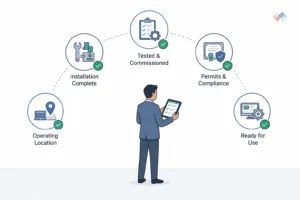
- Is the asset at its operating location, under your control? No → it is not yet yours to place in service.
- Is installation or assembly complete? No → the completion record is the evidence you are waiting for.
- Has it been tested or commissioned as capable of its assigned function? No → the test run or commissioning report decides the date.
- Are the required permits and certificates in place for occupancy, safety, and regulatory compliance? No → legal readiness gates the date for buildings and regulated assets.
- Is it available for its specifically assigned function, even if not yet used? Yes to all five → the asset was placed in service on the date it first met every test, not the date you happen to be running this checklist. Where several pieces of evidence exist, use whichever one actually documents that earliest true date, even if it was issued or filed later; don’t default to whichever document happens to be dated last.
Key takeaways
- An asset is placed in service when it is ready and available for use; under asset capitalization rules, actual use is not required, so an idle but ready asset already qualifies as placed in service.
- However, teams often confuse three different dates: the acquisition date, the placed-in-service date, and the capitalization posting date. Of these, only the placed-in-service date determines depreciation and tax elections.
- Similarly, IFRS and Ind AS use the same trigger under a different term: available for use, as defined in IAS 16.55.
- The financial impact is significant. Once an item exceeds the asset capitalization threshold, bonus depreciation, Section 179, and MACRS conventions all depend on this date, and even a few days can shift an entire year’s tax deduction.
- However, most organizations fail to manage this data operationally rather than doctrinally. Readiness occurs on site, but teams often enter the date later from memory during the financial close.
Conclusion
Understanding the meaning of ” placed in service” is essential because the readiness date, not the purchase or posting date, determines when depreciation begins. Aligning the placed-in-service date with the correct asset capitalization date ensures accurate financial reporting, timely depreciation, and stronger audit support through consistent, evidence-based capitalization practices.
FAQs on the placed-in-service date
Q1. Is the placed-in-service date the same as the purchase date?
Ans: No. The purchase or acquisition date marks when ownership transferred, while the placed-in-service date marks when the asset became ready and available for use, and only the placed-in-service date starts depreciation. An asset bought in December but installed in January is placed in service in January, so its depreciation and tax elections belong to the later year.
Q2. When does depreciation start on a fixed asset?
Ans: Depreciation starts on the placed-in-service date under US rules, applied through the MACRS convention for the asset’s class, and on the available-for-use date under IAS 16 and Ind AS 16. In every framework, the trigger is readiness, not the invoice date, payment date, or the date the accounting entry happens to be posted.
Q3. What is the capitalization date of an asset?
Ans: For a directly purchased asset, capitalization lands close to the placed-in-service date. For a self-constructed asset, capitalization starts earlier, in CWIP, as costs are incurred; readiness triggers the transfer into the operating asset class and the start of depreciation. Either way, a late posting catches depreciation back to the readiness date. The posting date itself carries no accounting significance.
Q4. Can an asset be placed in service if it is not being used?
Ans: Yes. The test is readiness and availability, not activity. Standby equipment, backup generators, and seasonal machinery are placed in service from the date they stand ready for their assigned function. Courts have even held buildings in service before opening for business, though the IRS formally disputes that position for retail, so both dates are worth documenting.
Q5. What evidence proves the placed-in-service date?
Ans: The evidence matches the asset class: a certificate of occupancy for buildings, a commissioning or test-run report for machinery, a deployment record for IT equipment, and registration for vehicles. The depreciation start date is the date the evidence establishes the asset actually became ready, which can predate the document itself. Where documents disagree, resolve which one evidences the true readiness date rather than defaulting to the latest one. Retain the supporting evidence for depreciable property until the limitations period expires after disposal.