


Introduction
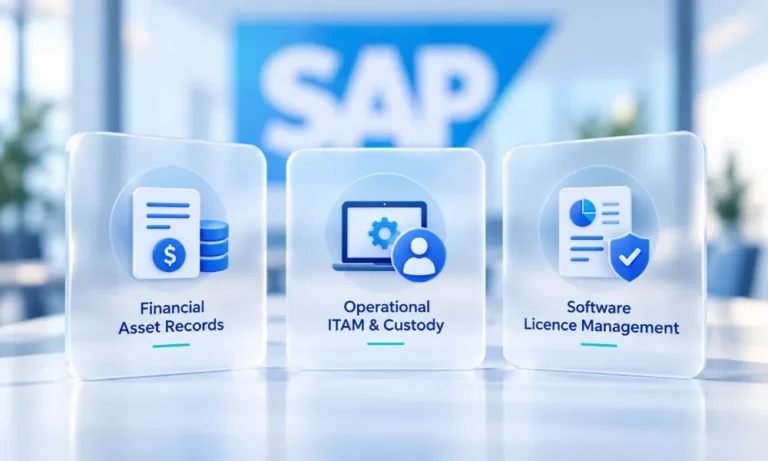
Search for SAP IT asset management and three different industries answer: ITAM vendors pitching a replacement, licensing suites talking entitlements, and integrators selling connectors. The phrase genuinely means three different jobs: hardware recorded in SAP, operational ITAM connected to SAP through SAP asset tracking software that matches each device to its SAP record, and management of SAP software entitlements; buying the wrong one is expensive.
This decision guide separates the three, maps the systems that serve each, follows one laptop across every record that describes it, and ends with the selection checklist downloadable below that tells you which capability you actually need.
In this guide, you will learn:
- What SAP IT asset management covers across financial asset accounting, operational ITAM and custody, and software licence entitlement management.
- How SAP FI-AA, ITAM tools, CMDB systems, and software asset management tools serve different purposes and where their responsibilities overlap.
- Why network discovery cannot replace physical verification, and how to link financial, IT, and custody records using consistent serial numbers, tags, and identifiers.
- How to select the right capability by use case, define system-of-record ownership, govern integrations, and reconcile hardware records without confusing physical asset control with licence management.
What do you need to manage: hardware, CIs, or software entitlements?
Finance needs the asset’s value defended, IT needs its configuration and custody managed, and licensing needs its entitlements reconciled: three questions, three record types.
Job | The question it answers | Record type | Typical owner |
|---|---|---|---|
| Hardware financial management | What is this device worth, where is it, does it exist? | SAP FI-AA asset record | Finance/controller |
| Operational ITAM & custody | Who has it, what state is it in, is it secure and returnable? | ITAM asset record and/or CMDB CI | IT / ITAM team |
| Software entitlement management | What are we licensed for, and what are we using? | Licence/entitlement records | SAM/procurement / SAP CoE |
Most “SAP ITAM” frustration is a category error: evaluating a tool from one row against the problems of another. The rest of this guide equips each row properly and keeps the third visibly separate, because it is the one most often conflated.
SAP FI-AA, ITAM/CMDB and SAP licensing tools
SAP asset accounting provides the hardware’s financial identity, including asset values, depreciation, and fixed asset register records. ITAM tools and the CMDB carry the operational identity; and for mobile asset workflows, SAP has native products of its own.
On licensing, credit where due: SAP provides SAP Software Asset Manager for measuring and managing SAP software entitlements. Claims that SAP ‘has no software asset management’ circulate in vendor comparisons; they do not survive contact with SAP’s own documentation, and licence questions belong with those tools and your SAM team.
Compare required controls by use case
1. Receipt, identity, allocation, return and physical verification
Hardware control is won or lost at five operational moments: receipt (serial and identity captured before the device disperses), identity (tag linked to the financial record), allocation (custodian named and acknowledged), return (HR-exit and role-change recovery), and periodic physical verification with evidence. None of these is a licensing capability, and none is proven by a network scan.
 Employee-held devices add the custody cycle: Periodic self-certification the custodian confirms possession with proof with exceptions routed for remediation, so IT and Finance records stop drifting between refreshes.
2. Discovery and technical status versus physical presence
Discovery and agent tools answer “what is on the network,” invaluable for configuration and security, and structurally blind to everything powered off: storeroom spares, devices in transit, retired-but-undisposed stock. A device absent from discovery is not physically missing, and a device present in discovery is not physically verified.
The two asset lists reconcile; they never substitute. Matching mechanics include field priority, confidence levels, and exception queues.
One laptop across finance, IT, and custody records
Record | System | What it holds (illustrative) | Linked by |
|---|---|---|---|
| Financial asset | SAP FI-AA | Asset 600412, laptop batch line, value & depreciation terms, cost centre | Serial + tag ↔ asset number |
| ITAM / CI record | ITAM tool / CMDB | Device model, OS, configuration, lifecycle state, assigned user | Serial + hostname ↔ ITAM ID |
| Custody evidence | Operational layer | Tag scan, custodian acknowledgement, location, self-certification history, verification evidence | Tag ↔ serial ↔ both records above |
| (Separate branch) Entitlements | SAM tooling (e.g., SAP Software Asset Manager for SAP software) | Licences and usage for the software on the device, | User/installation NOT the hardware chain |
The fourth row highlights an important distinction: software entitlements are linked to users and installations, not just hardware identities. Hardware controls alone cannot resolve licence issues, just as licence management cannot verify physical assets. The first three rows connect to the same asset through consistent identifier governance, with serial numbers, asset tags, and clearly defined rules for which system owns each data field.
Evaluate integration and source ownership
Whatever you select, the integration questions are constant: which system is authoritative for each field (serial, user, location, status, value); which direction updates flow and on what trigger; how discovery, ITAM, HR and SAP asset lists reconcile and who owns the exceptions; and what evidence standard field changes must carry before any record updates.
Source-authority rules matter more than connector counts a two-way sync with no field authority just moves errors faster. For how an operational layer’s approved updates reach SAP in practice, see SAP-connected physical asset tracking.
Where AssetCues fits and its confirmed scope limits

AssetCues serves the first two jobs’ physical layer: hardware identity (tagging, serials, cataloguing), custody and return workflows with self-certification, physical verification with evidence, and FAR-to-IT reconciliation linking financial, IT/CMDB and physical records by governed identifiers, with integrations across ERP, ITSM/CMDB, IT discovery and HRMS systems. SAP remains the system of record for the financial side throughout.
AssetCues does not manage software licences, perform patching, or map CMDB relationships. Use software asset management (SAM) tools for licence compliance. AssetCues focuses on hardware IT asset management, connecting physical asset records with finance data. See how it works in a demo with a finance and IT reconciliation walkthrough through our IT asset management solution.
Conclusion
SAP IT asset management involves more than maintaining hardware records; it connects financial asset data with IT inventory, device custody, and physical verification. Effective SAP ITAM links these records through consistent identifiers, helping Finance and IT reconcile asset information and resolve discrepancies. For organisations using IT asset management with SAP, choosing the right capabilities depends on whether the priority is hardware control, financial reconciliation, or software licence management.

SAP IT Asset Management FAQs
Q1. Is SAP software licence management the same as hardware ITAM?
Ans: No. Licence management reconciles entitlements against usage SAP provides SAP Software Asset Manager for SAP software. Hardware ITAM manages physical devices: identity, custody, condition and existence. They share the phrase ‘asset management’ and almost nothing else.
Q2. Does SAP have IT asset management?
Ans: SAP covers parts of all three jobs: FI-AA records hardware as financial assets, SAP’s own products provide mobile asset workflows, and SAP Software Asset Manager handles SAP licences. What enterprises typically add is the operational hardware layer custody, tagging, verification connected to those records.
Q3. Is a device found by discovery physically verified?
Ans: No. Discovery proves the device was on the network at scan time. Physical verification proves a person confirmed the physical device, with evidence. Spares, in-transit and retired-but-undisposed hardware are invisible to discovery and fully visible to a physical count.
Q4. Why does one laptop need three records?
Ans: Because three teams ask three different questions: Finance defends its value, IT manages its configuration and user, and operations proves its custody and existence. Control comes from linking the records by serial and tag not from forcing one system to do all three jobs.
Q5. Who should own the IT-to-finance asset reconciliation?
Ans: Jointly, with named field authority: Finance owns value and register fields, IT owns configuration and user fields, and an agreed owner adjudicates identity mismatches. The reconciliation workflow itself needs an owner per exception, or differences age until audit.
Q6. Can hardware ITAM tools manage SAP licences?
Ans: Generally no, and AssetCues explicitly does not licence measurement and entitlement reconciliation are SAM capabilities. Route licence questions to SAM tooling and the SAP CoE; route hardware custody and existence questions to the operational layer.


